Thomas Hobbes, writing in Leviathan in 1651, described the natural condition of mankind — absent the ordering force of law and legitimate authority — as a war of all against all: bellum omnium contra omnes. Life in that state, he famously wrote, was solitary, poor, nasty, brutish, and short.
On Wednesday, April 8, 2026, the requiem mass of the late Ol Kalou MP David Kiaraho, held in Nyandarua County, offered a vivid illustration of what that Hobbesian condition looks like when it erupts within the supposedly ordered confines of a democratic republic — and at a funeral service, no less.
For more than a year, the battle between President Ruto and his former deputy was waged at a distance. But the send-off service of Hon Kiaraho upended this equilibrium. It provided the perfect Hobbesian moment: a space in which neither side recognised the full legitimacy of the other and where every action was interpreted as either a sign of strength or an invitation to challenge.
Former Deputy President Rigathi Gachagua and President William Ruto were going to fight it face-to-face, sitting a few metres from each other. The momentum was gathering towards a crisis point. This, in narrative theory, is called foreshadowing combined with rising action: two powerful and opposing figures were in the same space, and confrontation was inevitable.
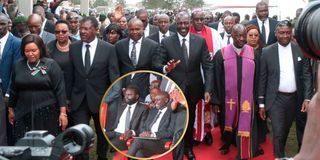
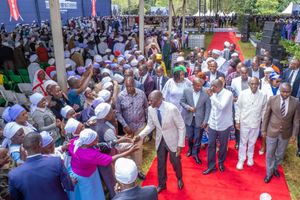
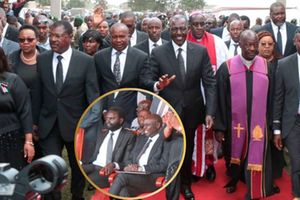
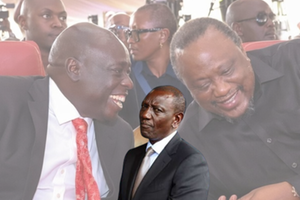
DCP Party Leader Rigathi Gachagua and Nyandarua Senator John Methu seated as others stand in honour as President William Ruto arrives at the requiem mass for the late Ol Kalau MP David Kiaraho in Nyandarau County on April 8, 2026.
Photo credit: Boniface Mwangi | Nation Media Group
Tension was high because of the anticipation of the conflict long before the conflict came. It was the classic dramatic tension, created by Gachagua and Ruto’s proximity to each other; their unresolved and accumulating grievances; a charged audience at the service and Kenyans watching online; and the sense that one wrong move or one wrong word could trigger escalation that could take a terrifying turn. Kenyans followed the proceedings with a discernment born of years of watching politicians destroy one another for much less.
Hobbes would have understood it perfectly that on those Ol Kalou grounds, the façade of order remained: the tents were still standing, the choirs sang, and the family wept. But beneath it, “the war of all against all" seethed, awaiting to erupt. It was just a matter of time. This was suspense, and Kenyans felt something was about to happen. And it did.
It fell to the bearded Nyandarua Senator, John Methu, with the sloped shoulders and boxer’s grin of someone who knew both the rules of protocol and the pleasure of breaking them, to officially open the season of open confrontation between President Ruto and Gachagua, whom the Senator acknowledged as his party leader.
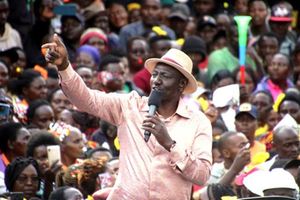
"I respect you, but I don’t fear you,” Methu told the president, his voice rising with a metallic ring to it.
"Our work is not to come clap for you but remind you of the pending projects," he continued. It was in the defiant language of a challenge for a street fight —challenging the most powerful man in the land and letting the chips fall where they may — consequences be damned.
Surprisingly, when Rigathi Gachagua took the microphone, he was more measured than Methu. Gachagua’s performance was that of a smooth political operator and not the usual brash and swaggering gladiator. Instead of channelling Hobbes, Gachagua channelled John Locke, who believed that humans are naturally reasonable, capable of cooperation, and guided by natural rights. Gachagua performed magnanimity — while making it unmistakably clear who controlled the crowd.
"There will be no confrontation here," he said, the words simple but unmistakable. "This is a solemn occasion, and we come in peace." That is how he portrayed Locke — the philosopher of consent, of government by popular agreement, of limits on power. He was saying, "We are civilized people, we respect institutions." But in the same breath, he was demonstrating that he, not the president, was the one with the authority to tell that crowd what to do.
Of course, though measured, Gachagua flung a hard punch at the president: "You got me out of office, but removing me from the hearts of the people of the mountain is going to be a difficult task.”
He warned the president that those surrounding him could mislead him and damage his relationship with Mt. Kenya voters, specifically singling out Kimani Ichung'wa.
The name landed like a gauntlet thrown, though the former deputy's face showed nothing but the concern (whether true or false) of a leader watching a friend make poor choices.
In the end, the confrontation in Ol Kalou was about more than a falling-out between Ruto and Gachagua. It raised the question: Are Kenya’s political institutions strong enough to withstand personal rivalries at the highest levels? Will political disputes be resolved through institutions, dialogue, and constitutional mechanisms — or through public confrontation, humiliation, and factional warfare?
The events in Ol Kalou showed how easily political life can slip into a Hobbesian contest of wills. But they also remind us that Kenya has a constitutional framework — a Lockean foundation — capable of channelling conflict into constructive, democratic processes. The challenge ahead is whether leaders will choose that path.
Because in the end, the question is not whether conflict will arise. It always does. The real question is how a society chooses to resolve it — through force or through reason. And that choice will determine whether Kenya’s democracy deepens or whether it drifts toward the war of all against all.