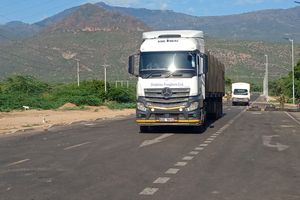
On Monday, April 27, a team of detectives from the Directorate of Criminal Investigations (DCI) headquarters tracked down and arrested three suspects believed to be masterminds of a string of highway robberies on the Mombasa–Nairobi highway, in Nairobi and its surrounding areas.
The three were arrested during a midnight sting operation that involved a chase that ended near the Mlolongo toll station.
Upon arrest, detectives recovered a Mazda vehicle believed to have been used in the robberies, a military jungle hat and three reflector jackets.
Investigators have linked the three suspects to a string of robberies, including a recent one in which a Chinese national lost Sh2.4 million.
Preliminary investigations revealed that the suspects flagged down the foreigner on the Nairobi–Mombasa highway, pretending to be traffic police officers, before robbing her.
She had withdrawn the money from the Diamond Trust Bank Mombasa Road branch and the Standard Chartered Bank Sameer branch. The three are still in police custody.
A few months ago, on January 18, 2026, DCI detectives also arrested three suspects connected to the same notorious criminal network.
Investigations indicated that the suspects had been terrorising truck drivers and other motorists at various spots along the Mombasa–Nairobi highway, including the Bonje area of Mazeras Township.
Upon arrest, detectives recovered two pairs of military boots, currency from different countries, among other items linked to their criminal activities.
In yet another incident months ago, an Isuzu lorry driver transporting gypsum worth millions of shillings from Nairobi to Mombasa was similarly attacked in the Ikanga area and robbed.
A thief breaking into a car.
Photo credit: Shutterstock
Police reports indicate that one of the suspects dashed out from a nearby thicket, attempting to cross the road. In a split-second decision to avoid a head-on collision, the driver swerved, causing the truck to veer off the road and stall.
"Seizing the opportunity, a group of five other suspects emerged from the bushes, forcefully entering the vehicle, with one brandishing a pistol. The driver and his co-driver were handcuffed and bundled behind the seats. One of the robbers took the wheel, steering the lorry towards Mombasa. The two victims were later dropped off along the way as the criminals vanished with the lorry and the gypsum," stated a police report.
DCI detectives later arrested two suspects who were trailed to their hideout in the Bahati area of Taita Taveta.
A third suspect was also arrested, and a number plate belonging to the stolen lorry was recovered.
The DCI says detectives have been employing a combination of advanced forensic technology and intelligence to track down suspects and flush them out of their hideouts.
"In the January 18 incident, for instance, we launched investigations and, through meticulous forensic analysis, two of the suspects were arrested. We trailed and arrested them at a hideout in Taita Taveta. We then tracked down a third suspect using mobile phone triangulation and arrested him in Makindu," revealed a detective involved in the crackdown.
"We used call data records and mobile phone triangulation to trace the movement of the suspect's mobile phone. We also relied on intelligence," the DCI officer explained.
He said most of the arrests have been successful, mainly due to intelligence-led operations.
The surge in highway robberies prompted the Directorate of Criminal Investigations (DCI) to dispatch a special unit to deal with the ruthless criminal syndicate.
"A team made up of officers from the Crime Research and Intelligence Bureau (CRIB) and the Operation Action Team (OAT) has been tracking down and arresting members of the criminal network. Detectives have been conducting intelligence-led operations to arrest the criminals," revealed DCI Director Mohamed Amin.
"We have made numerous arrests and recovered stolen goods. The successful operations are a clear warning to criminals who prey on innocent motorists that the law will catch up with them. We are committed to combating highway crime and ensuring the safety of travellers and motorists," he added.
The DCI boss said the crackdown will continue until all remnants of the criminal syndicate are completely eliminated.
For several months, motorists, especially long-distance truck drivers, have borne the brunt of the notorious highway robbery network, which has been staging attacks at various points along the busy Mombasa–Nairobi–Nakuru–Eldoret highway.
Motorists, especially long-distance truck drivers, have lost cargo worth millions in brazen robberies along the corridor that connects Mombasa to Western Kenya.
For instance, on January 29, 2026, a truck driver was attacked and killed by highway robbers at Burnt Forest on the Nakuru–Eldoret highway.
During the night attack, the robbers stole cargo of coffee worth Sh8 million.
Most victims have described a consistent pattern: they are flagged down by individuals posing as police officers before being robbed.
"Once a motorist stops, they are bundled into the suspects' vehicle, driven to a remote location and forced to transfer money via mobile platforms before being abandoned," revealed Joseph Maina, who narrowly escaped but lost his mobile phone, valuables and cargo worth millions.
Another victim, a 42-year-old logistics manager, Patrick Muthomi, who was robbed on January 5, 2026, also described his ordeal.
"I thought they were genuine police officers because of the uniforms they were wearing and the way they talked. I stopped my car near Sachangwan, and they robbed me. They took everything, including my mobile phones. I was lucky to escape without being hurt."
DCI detectives say they have arrested several suspects, some of whom they believe are ringleaders of the highway robbery syndicate.
Records show more than 10 incidents of highway robberies have been reported along the corridor in the last six months.
However, police say that while most victims report incidents, others choose to remain silent.
The mode of operation, the DCI said, confirms the syndicate’s wider network, pointing to a well-organised criminal enterprise.
Detectives revealed that the criminals have evolved their tactics of intercepting vehicles, including posing as police officers by wearing reflector jackets, flagging down vehicles before robbing occupants or making away with cargo.
Other tactics used by the criminals, according to police, include using objects such as stones to block roads before staging ambushes when motorists slow down.
"Mostly, the criminals, wearing fake police uniforms and using private vehicles, stage roadblocks to stop, rob and sometimes kidnap drivers. They carry out robberies at gunpoint, especially during late-night hours when police patrols are lighter. They also sometimes throw spikes on the road to force vehicles, especially long-distance trucks and lorries, to stop, then take the opportunity to rob their victims," revealed a senior DCI officer involved in the crackdown.
"Apart from staging ambushes, they sometimes use accomplices posing as stranded passengers before staging robberies at gunpoint. They also stage minor collisions to get drivers to stop," added the officer.
According to police records, highway robbery hotspots where previous incidents have been reported include the Timboroa–Makutano–Burnt Forest and the Salgaa–Sachangwan–Kibunja stretches on the Nakuru–Eldoret highway.
Others include the Kamandura area along the Nakuru–Nairobi highway and several spots on the Nairobi–Mombasa highway, such as Voi, Mlolongo, Makindu and Mazeras.
Highway robberies targeting public service vehicles, long-distance trucks and private vehicles have been on the rise in recent months, prompting the DCI to intensify its crackdown.
The DCI has urged motorists to remain vigilant, especially when travelling through isolated or poorly lit sections of the highway, and to report any suspicious activity immediately.
The busy Mombasa–Nairobi–Nakuru–Eldoret highway is a key transport corridor to Western Kenya and a critical artery linking Kenya to the landlocked countries of Uganda, South Sudan, Rwanda and Burundi.
The road is used to transport most westbound cargo from the Port of Mombasa and Nairobi and connects the capital to Western Kenya.