The Supreme Court judges, including Chief Justice Martha Koome, have told the Court of Appeal that they are immune to civil judicial proceedings and are protected from lawsuits for actions taken within their judicial capacity.
The seven judges, together with the Supreme Court Registrar, have made the argument in a case filed by the Law Society of Kenya (LSK) challenging the ban imposed by the apex court last year on lawyer Ahmednasir Abdullahi, senior counsel, and the advocates working at his law firm.
At the same time, Nation has established that the negotiations between the lawyers handling the case were not fruitful and were abandoned.
Chief Justice Martha Koome speaks during the swearing-in ceremony of the new IEBC Commissioners at the Supreme Court in Nairobi on July 11, 2025.
Photo credit: Bonface Bogita | Nation Media Group
"There were talks, but they were abandoned. It was a one-off talk done on a without prejudice basis. No current talks ongoing. The talks that we had involved representatives of the parties. Judges of the Court of Appeal had asked us to discuss amongst ourselves," said LSK's lawyer Wilfred Nderitu, a senior counsel.
The parties include the Supreme Court of Kenya, Registrar of the Supreme Court and the Supreme Court judges on one side against the LSK, Ahmednasir Abdullahi Advocates LLP and ten lawyers working at the law firm. Mr Abdullahi is listed as an interested party in the suit but he is yet to enter an appearance and hence has not participated in the court proceedings.
In their filings at the Court of Appeal, where they are challenging the High Court’s decision to assume jurisdiction on the dispute, the apex court judges have argued that they were wrongly sued.
"The appellants fault the learned High Court judge for failing to find that the third to tenth appellants (the judges) enjoyed judicial immunity from civil proceedings and that they were thus improperly named in the petition," reads the written submissions.
This argument is pegged on provisions of Article 160(5) of the Constitution and Section 6 of the Judicature Act and Section 45(1) of the Judicial Service Act, which state that judicial officers are immune from suits in respect of anything done or omitted to be done in good faith in the lawful performance of a judicial function.
It is argued that their decision to ban Mr Abdullahi and his associates was made by the judges in their official capacities, and hence they cannot be sued for the same.
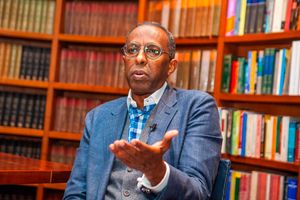
Senior Counsel Ahmednasir Abdullahi at his office on January 4, 2024.
Photo credit: Francis Nderitu | Nation Media Group
Reason: "judicial officers in Kenya enjoy unquestionable and absolute immunity from civil or criminal liability for actions taken in the course of their duties".
The contested ban was communicated to Mr Abdullahi by the Supreme Court Registrar through a letter dated January 18, 2024
It is their case that the banned advocates had not exhausted the remedies available to them in law, including petitioning the Supreme Court to review the decision.
"It is undisputed that the Respondents did not pursue the remedies available to them, including the right to seek a review of the decision of the Supreme Court pursuant to Section 21A of the Supreme Court Act. It is the policy of the courts that parties must first exhaust the statutory or procedural options available to them before filing suit," says the apex court judges in their submissions.
Mr Nderitu says the Supreme Court judges do not enjoy absolute immunity and that they were not improperly sued, since their decision to ban Mr Abdullahi also affected the rights of litigants.
"Judicial immunity is not absolute. It does not per se excuse judges and judicial officers from the legal process. The Supreme Court judges have declared as much, in a multiplicity of decisions," says Mr Nderitu.
He cites one case where the Supreme Court held that “a Judge remains unquestionably immune for only as long as he does not take actions that intentionally and plainly prevent litigants from enjoying Constitutional and statutory rights.”
"However, in the present case, the actions of the Supreme Court Judges “intentionally and plainly prevented litigants [and their Counsel] from enjoying Constitutional and statutory rights”. The Supreme Court Judges and Registrar cannot plead immunity in respect of the impugned order and the impugned letter," says Mr Nderitu.
He stated that the contested decision of the judges was made without the taking of any court proceedings.
Therefore, he argues that the same cannot be said to have been an act “done or omitted to be done in good faith”, and to have amounted to “the lawful performance of a judicial function”.
According to Mr Nderitu, the ban of Mr Abdullahi and his associates was patently erroneous and undoubtedly violates the fundamental right to be heard".
"The impugned order violates the right to be heard (Article 50 of the Constitution). This right is stated to be a non-derogable right in the Bill of Rights (in Article 25) of the Constitution. This perse makes the impugned order amenable to the High Court’s constitutional jurisdiction. Any person, in this case the Law Society, has the free and unlimited right to institute court proceedings before the High Court claiming the violation of such a fundamental right," says Mr Nderitu.
On whether the affected advocates could be expected to seek a review from the Supreme Court, Mr Nderitu says there was no right of review reasonably available from the Supreme Court based on the circumstances of the case.
"Further, a review under Section 21A presupposes the review of judicial decisions (i.e.Judgments, Rulings or Orders), which have been made in the course of proceedings directly between the parties before the Court. Going by this definition, the impugned order did not amount to a judicial decision. The directly affected Respondents had already been condemned unheard and could not reasonably be expected to successfully convince the same Supreme Court Judges to review their own decision," he says.
According to Mr Nderitu, the letter of the Supreme Court Registrar to Abdullahi was also neither a judgment, nor a ruling or an order of the Supreme Court, but a “communication” of "an extra-juridical decision that was therefore not reviewable by the Supreme Court under the Supreme Court Act.
"The proper and only available avenue for confronting the letter was through the High Court’s jurisdiction," he says.
Lawyer Issa Mansur.
Photo credit: File | Nation Media Group
The affected advocates also want the appeal dismissed, on the grounds that the contested decision was not a judicial decision and that the High Court has the jurisdiction to hear and determine the dispute.
Through lawyer Issa Mansur they argued that the decision was administrative in nature, which was reached "ultravires" and without according them due process. Hence, they say the same could not be termed to have been on good faith or in lawful performance of a judicial duty.