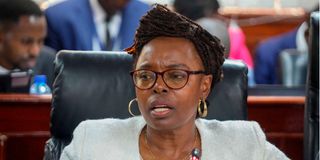
The Controller of Budget, Margaret Nyakang’o, is set to receive Sh14.63 million in a golden parachute when her eight-year nonrenewable term comes to an end in January 2027, Parliamentary documents show.
The Report on Expenditures of the Consolidated Fund Services for the financial year 20236/27 budget estimates also shows that the Teachers Service Commission (TSC) will incur Sh44.4 million on commissioners' exit.
Dr Nyakang’o replaced Agnes Odhiambo, the first Controller of Budget, whose term came to an end in August 2019.
The Constitution requires that the Controller of Budget serve a single term of eight years. She is expected to retire in early 2027.
Controller of Budget Margaret Nyakang’o.
Photo credit: File | Nation Media Group
“The increase is mainly driven by Sh139.54 million for the Judicial Department, gratuity payment of Sh14.63 million to the Controller of Budget, and Sh44.4 million to the Teachers Service Commission, partly offset by reductions across the other Commissions and Offices,” Balambala MP Abdi Shurie, who chairs the committee, said in the report currently before the House for consideration.
A holder of a doctorate degree in Business Administration from the University of Liverpool, UK, Dr Nyakang’o is leaving the office of the Controller of Budget (OCoB), an independent office established under Article 228 of the Constitution, with the core mandate being to oversee implementation of the budgets of the National and county governments by authorising the withdrawal from public funds.
The Office is also expected to prepare, publish and publicise statutory reports, conduct investigations based on its own initiative or on a complaint made by a member of the public, and conduct alternative dispute resolution mechanisms to resolve disputes.
The OCoB also has a mandate to advise Parliament on issues related to transfer of funds to State organs or any other public entities.
Article 228 stipulates that there shall be a Controller of Budget who shall be nominated by the President and, with the approval of the National Assembly, appointed by the President.
To be qualified to be the Controller, a person shall have extensive knowledge of public finance or at least ten years’ experience in auditing public finance management.
The Controller shall, subject to Article 251 of the Constitution, hold office for a term of eight years and shall not be eligible for re-appointment.
The Controller of Budget shall oversee the implementation of the budgets of the national and county governments by authorising withdrawals from public funds under Articles 204, 206 and 207.
Under the Supreme law, Dr Nyakang’o is required every four months to submit to each House of Parliament a report on the implementation of the budgets of the national and county governments.
During her tenure, Dr Nyakang’o brushed the government on the wrong side, warning that it faces the threat of defaulting on its Sh3.32 trillion external debt repayment obligation, unless sound fiscal consolidation proposals, which she regretted have been ignored by mandarins at the National Treasury, are implemented.
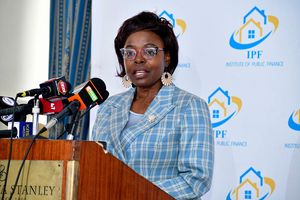
The Controller of Budget Margaret Nyakang'o.
Photo credit: Dennis Onsongo | Nation Media Group
Dr Nyakang’o, at an earlier meeting with the National Assembly Public Debt and Privatisation Committee, disclosed that high debt servicing obligations will “significantly” constrain fiscal space, limiting the government’s ability to finance development and social programmes- health, education, social protection, and other critical investments.
The CoB revealed that the possibility of the government defaulting on its debt obligations has been exacerbated by fiscal deficits, which she says have elevated the country’s public debt to a staggering Sh12.3 trillion as of December 31, 2025.
She noted that fiscal deficits have become a moving target due to over-projected revenue collection that has not been met, forcing the government to increase expensive borrowing, largely from the local market, to support budgetary operations.
“The high debt servicing heightens fiscal vulnerability, indicating substantial near-term repayment pressure,” Dr Nyakang’o told the committee, adding, “the skew towards short-term maturities exposes the government to refinancing and rollover risks.”
The CoB noted that the government has previously defaulted on the repayment of Sh53.6 billion Treasury Bonds by one to two months, raising concerns about its ability to honour debt obligations.
“Bonds with due dates are paid much later,” said the CoB, adding, “Continued reliance on borrowing to meet both recurrent and debt obligations put the country in a debt trap as it raises the risk of a debt spiral, in which new borrowing is required to service existing debt.”
She also revealed that the concentration of domestic debt in short-term instruments “creates liquidity and refinancing risks, while reliance on market-based borrowing exposes the government interest rate risk, particularly in a high-interest environment.”
The short-to medium-term maturity profile of domestic debt and sovereign bonds has also necessitated frequent refinancing, exposing the government to rollover pressures.”
The Sh3.32 trillion debt repayment is part of the Sh5.5 trillion external debt stock, due in at least 10 years.