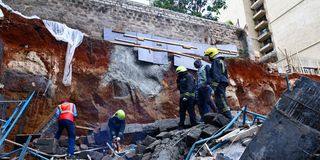
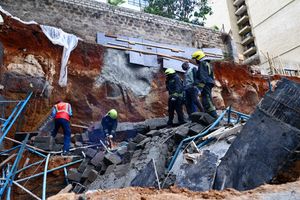
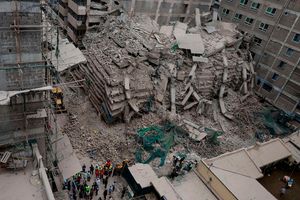
Neglect, possible engineering failures and disregard for workers’ safety are under scrutiny after a retaining wall under construction collapsed along Riverside Drive in Nairobi, killing four people and injuring 11 others in the latest construction disaster to hit the capital.
The Saturday morning tragedy, which occurred near Grand Residence as workers reported for their daily shifts, is the third major construction-related collapse in Nairobi in just over three weeks, raising fresh questions about the enforcement of building regulations, supervision of construction projects and the accountability of developers and contractors.
Riverside wall collapse: Death toll rises to 4
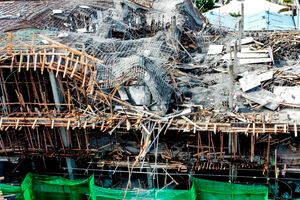
On October 23, an 18-storey building under construction collapsed in Eastleigh, killing eight people, with three others still reported missing at the last major update on the rescue operation.
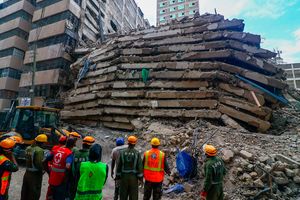
Barely three weeks later, on November 13, an eight-storey building under construction collapsed along Mombasa Road near the Standard Gauge Railway (SGR) terminus, killing six people and leaving five others injured.
The latest incident along Riverside Drive brings the reported death toll from the three disasters to at least 18, with dozens more people injured or rescued.
The back-to-back tragedies have exposed the human cost of what critics describe as persistent failures in construction oversight, despite repeated government assurances that safety standards would be enforced and rogue developers brought to account.
At Riverside, the wall gave way suddenly, burying workers beneath tonnes of debris and triggering an emergency rescue operation.
What makes the incident particularly disturbing is that the main building was still at the excavation and foundation stage, with no upper floors erected, according to Nairobi City County Chief Officer for Disaster Management and Coordination Bramwell Simiyu.
Who is responsible for Nairobi's deadly buildings?
The collapse therefore involved a retaining wall at a site where the main structure had yet to rise above its foundation, raising questions about the engineering standards and precautions used to support the excavation and prevent the surrounding soil from giving way.
Kilimani Sub County Police Commander Patricia Yegon confirmed that four people had died, while 11 others sustained injuries and were taken to various hospitals in Nairobi.
“The search and rescue operation has been called off, with the site declared a crime scene as police began investigations into the circumstances surrounding the collapse,” she said.
The incident also triggered a political backlash, with leaders accusing Nairobi City Hall of failing to enforce construction regulations and protect residents and workers.
Kasarani MP Ronald Karauri said the disaster was the direct result of county leadership that had failed to enforce building standards, supervise construction and hold developers accountable.
“The same City Hall that should protect lives has turned a blind eye, again and again...The writing is on the wall. The failure is at City Hall,” he said.
Kileleshwa MCA Robert Alai also blamed the county administration, saying those responsible for enforcing construction standards should face criminal consequences.
“The current leadership of the county from the governor to the junior staff responsible should be in jail,” he said.
Rescuers at site of a collapsed building in Eastleigh, Nairobi, on October 23, 2026.
Photo credit: Wilfred Nyangaresi | Nation Media Group
But some of the most damning accounts came from workers at the site, who accused the contractor of ignoring safety concerns and exposing them to dangerous working conditions.
Kevin Amadi, who had only recently started working at the site and lost a cousin in the collapse, said he had warned the contractor that the wall was unstable.
“I lost my cousin today, I warned the contractor that he should wait for it to dry so that we can continue working, and within minutes as I was walking away, I heard screams, the wall had collapsed and trapped people,” he said.
Another worker, Samuel Paul, who was carrying a pair of shoes and a mobile phone belonging to an injured colleague, described what he termed exploitative working conditions at the site.
He said he was recruited after an earlier group of workers refused to continue working over a pay dispute.
“I was employed after the first batch of workers refused to work after they demanded more pay. When we came we were added Sh100 from Sh500. The sad part is we worked for 12 hours without even a lunch break. If you said that you were going out for lunch, they told you that you should not bother to return. I injured an arm last week but I was told I was a strong man and I should continue working,” he said.
The main contractor has been identified as Nishchay Builders Limited, while Custom Homes Limited is listed as the developer in the legally required notice at the site.
In an initial update, Mr Simiyu said three people had died and 22 workers had been accounted for, including 11 who had been rescued alive from the rubble and taken to nearby hospitals with serious injuries, while another 11 had been confirmed safe at the scene. The death toll subsequently rose to four, according to Ms Yegon.
The county government said a comprehensive structural and regulatory compliance audit would be undertaken jointly by its Department of Built Environment and Urban Planning and the National Construction Authority.
The investigations are expected to establish whether the retaining wall was properly designed and constructed, whether excavation works complied with approved plans and whether adequate safety precautions were taken before workers were allowed into the area.