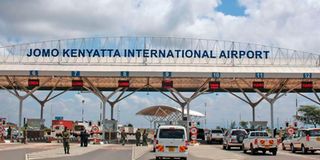
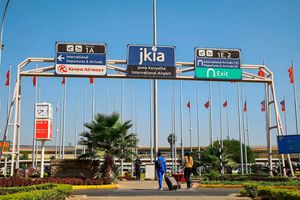
Tax agents at the Jomo Kenyatta International Airport (JKIA) were going about their usual checks sometime in mid-June, trying to stop cheats using courier services to avoid paying Caesar’s dues, when a slightly damaged package landed on their desk.
Owing to the damage, one could partially see what was inside. And the contents were suspicious, at least to the Kenya Revenue Authority (KRA) officers.
The label indicated that someone from Germany had sent clothes to a Kenyan in Nairobi through KeBay Shipping Ltd, a courier firm owned by British national Louis Kabbani.
The KRA agents contacted the package recipient, sending a WhatsApp photo which inadvertently showed the damage, through which one could see the marijuana that was being smuggled into Kenya.
They also asked the police to be on standby. The recipient, shortly after seeing the photo of the package, switched off his phone.
Using the little declared information, officers from the anti-narcotics unit of the Directorate of Criminal Investigations (DCI) raided an apartment in Kahawa West.
The officers hoped to arrest a Nigerian national believed to be the recipient of multiple drug consignments disguised as ordinary items and sent through KeBay. But the house was empty and nobody had enough information that could help trace the mystery man.
Three months later, a package from New York sent through the same courier service managed to slip through the cracks. As KeBay staff were going about their usual routine, one of the packages drew Mr Kabbani’s attention.
The name and address of a man, who was to receive this parcel in Nairobi, looked familiar. They were the same details on numerous other parcels that had in the past been sent from different parts of the US and Europe to the same individual in Kenya.
Mr Kabbani decided to run the name and address through KeBay client database. After seeing the results, Mr Kabbani knew it was time to contact the police.
The latest parcel did contain assorted items, just not food.
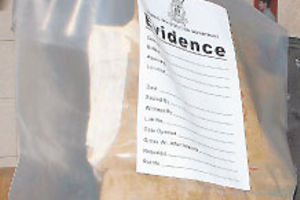
In the presence of officers from Spring Valley Police Station, Mr Kabbani unpacked the consignment and discovered sachets of what is believed to cocaine, marijuana and lysergic acid diethylamide (LSD).
Police records show at least 13 reported incidents since 2016 in which traffickers attempted to conceal narcotics as legitimate goods before declaring them as parcels.
Photo credit: Photo | Pool
Also, found inside were chewing gums believed to be laced with drugs and bottles of juice, which the anti-narcotic investigators believe were laced with marijuana.
The Nigerian man, who has been on the run since June, is suspected to be at the centre of a syndicate that has been using KeBay to smuggle drugs into Kenya.
Mr Kabbani declined to a request for an interview, but insisted that he is the “good guy here”, having tipped off the police and helped in the confiscation of the narcotics. At the DCI ant-narcotics unit headquarters, this incident has put the spotlight on the new routes and methods that drug traffickers are using to beat scrutiny the security agents.
Criminal networks are increasingly using courier firms as unwitting drug mules, as anti-narcotics officers tighten surveillance along traditional trafficking routes such as the Namanga road. Over the years, local authorities have intercepted drug-laden parcels sent through multinational courier DHL and bus companies such as Buscar. National Council for Law Reporting records show that at least five people have been imprisoned for disguising drugs as legal items and attempting to traffic them as regular parcels.
Three Kenyans — Geoffrey Onchangu Ondieki, Scola Imbiti Namunyu, Omar Said Bwana (Kenyan) — and Nigerians Samuel Uche and Austine Obinwanne Igwilo, are serving prison terms.
Igwilo, Ondieki and Uche were convicted for trafficking heroin. Namunyu was convicted for trafficking cocaine, while Bwana’s sin involved marijuana.
Police records show at least 13 reported incidents since 2016 in which traffickers attempted to conceal narcotics as legitimate goods before declaring them as parcels. In some cases, Kenya served as a transit point, while in others it was the origin or destination. The records indicate that heroin is the drug most frequently intercepted by authorities.
In the 13 incidents tracked by Nation , six involved attempts to traffic heroin, four involved marijuana disguised as parcels, and three involved methamphetamine. However, the records accessed by Nation do not represent the total number of reported cases during that period.
Police spokesperson Muchiri Nyaga said drug traffickers and peddlers are becoming increasingly innovative, but security agencies are continuously training officers to keep pace. He added that in some low-income estates, dealers have resorted to using schoolchildren to sell drugs.
The innocence of children often shields them from suspicion, making them ideal drug couriers who can easily slip past even the most vigilant anti-narcotics officers. Mr Nyaga added that traffickers are also using fuel tankers and long-distance passenger buses to ferry narcotics to neighbouring countries, a scheme that involves bribing drivers to load the tankers with drugs after completing petroleum deliveries.
National Police Service Spokesperson Michael Nyaga Muchiri during an interview at his office at Jogoo House in Nairobi on July 2, 2025.
Photo credit: Wilfred Nyangaresi | Nation Media Group
“In some informal settlements, schoolchildren are used to ferry bhang from suppliers to buyers. The traffickers know that no police officer would go as far as sniffing around a fuel tanker,” Mr Nyaga said.
He added that fuel tankers were intercepted at border points such as Malaba and Busia, where searches revealed drugs concealed inside the trucks.
To curb the entry of narcotics, the Interior ministry established a multi-agency team drawn from all security agencies and the Kenya Revenue Authority to man all points of entry. A report by the Global Initiative against Transnational Organised Crime (GITOC) noted that many Eastern and Southern African countries have become key transit routes for global drug cartels.
The report, which draws on studies from several countries including Kenya, notes that marijuana remains the most widely used illegal drug in Africa. Cocaine and heroin are also prevalent. It adds that synthetic drugs — such as methamphetamine, LSD and methaqualone — are increasingly penetrating the black market. The report blames weak governance and lax security enforcement, which the GITOC says have allowed the drug trade to flourish.
“The corruption of domestic enforcement institutions may be the single greatest structural enabler across the ESA (Eastern and Southern Africa) region. Incompetence among some officials in the execution of their duties and responsibilities is also a fundamental concern of every enforcement body in the region,” the report reads in part. Police spokesperson Mr Nyaga said anti-narcotics officers undergo continuous training to keep pace with the evolving nature of the drug trade.
He added that the training has enhanced the ability of Kenya’s security officers to screen and detect drug-laden cargo concealed among ordinary goods.
He warned that any officer found colluding with traffickers or peddlers would face prosecution in accordance with the law. The GITOC report noted that heroin, cocaine, and methamphetamine are shipped through countries such as Kenya by air and sea.
It said heroin enters the region mainly through coastal points in Tanzania and central Mozambique, while South Africa and Kenya serve as key entry points for cocaine.
According to the State of the Judiciary and the Administration of Justice Report for the 2024/25 financial year, civil litigation in Kenya expanded sharply.
Photo credit: Photo | Pool
The report also identified Kenya, Eswatini, Malawi, Tanzania, and Uganda as some of the countries where the drugs originate.
The National Authority for the Campaign Against Alcohol and Drug Abuse (Nacada) has raised concern over rising drug abuse, particularly among university students. In a report released in April, the agency said a survey showed that 45.6 per cent of university students had used drugs at least once in their lifetime.
Nacada noted that emerging trends, such as the use of digital platforms to market drugs, pose a major challenge to the fight against substance abuse.
“The combination of drug trafficking and digital communication poses a serious challenge. Emojis such as the maple leaf for marijuana, snowflake for cocaine, and pill for prescription drugs are used to subtly indicate availability. This coded language complicates efforts to monitor and curb the spread of narcotics among young people,” the report said.
The agency recommended the formation of a regional body to track drug movement and facilitate intelligence sharing among member states to curb the black market trade.