The argument arose as Deputy President Prof Kithure Kindiki urged the court to uphold the impeachment and dismiss petitions challenging Mr Gachagua’s removal from office.
The submissions introduced a fresh constitutional dilemma into the politically charged case, with advocates pointing to a potential constitutional power crisis over who lawfully occupies the office of Deputy President.
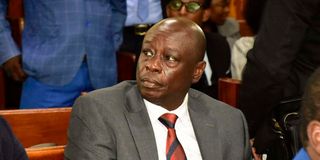
Former Deputy President Rigathi Gachagua (left) and his wife Dorcus Rigathi leave the Milimani Law Courts in Nairobi on May 13, 2026, after the hearing of his legal challenge against his 2024 impeachment.
Photo credit: Billy Ogada| Nation Media Group
Prof Kindiki’s lawyer, Muthomi Thiankolu, told the three-judge bench that Mr Gachagua’s amended petition contained contradictory prayers that could destabilise constitutional order if granted.
“He says he does not want reinstatement, but he wants you to quash and declare the impeachment process unconstitutional, null and void,” Mr Thiankolu submitted during day four of the hearing.
“The legal effect of quashing that process would be that there was no impeachment at all and the petitioner remains in office. He never left office,” he added, insisting that his client was properly nominated and appointed following approval by the National Assembly.
The lawyer argued that under the Constitution, a Deputy President can only leave office through resignation, death or lawful removal.
“A Deputy President can only leave office by death, resignation, or removal. He (Gachagua) has not died. He has not resigned,” Mr Thionkolu told the bench comprising Justices Eric Ogolla, Anthony Mrima and Frida Mugambi.
Constitutional consequences
According to Prof Kindiki’s legal team, nullifying the Senate vote while Prof Kindiki remains in office would create irreconcilable constitutional consequences.
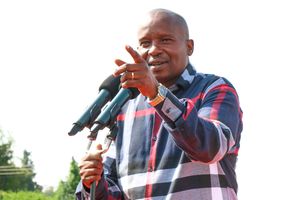
Deputy President Kithure Kindiki.
Photo credit: File | Nation
“He cannot have it both ways,” Mr Thiankolu argued, referring to Mr Gachagua’s request for non-reinstatement to the office and quashing of the impeachment.
The submissions came as respondents continued defending Parliament’s October 2024 decision to impeach Mr Gachagua after the Senate upheld five charges against him.
Mr Gachagua and 40 co-petitioners are seeking declarations that the impeachment breached constitutional requirements on fair hearing, public participation and due process.
They also want the court to invalidate Prof Kindiki’s nomination and approval as Deputy President following the Senate vote. Petitioners accused Parliament of acting under Executive influence and conducting what they described as a rushed and predetermined process.
Lawyers representing Mr Gachagua earlier told the court the impeachment was “a mockery of the Constitution” that violated rights to fair hearing and meaningful public participation.
However, Mr Gachagua recently amended his petitions and dropped his prayer seeking reinstatement to office.
Former Deputy President Rigathi Gachagua at Milimani Law Courts on May 13, 2026 for the hearing of his legal challenge against his 2024 impeachment.
Photo credit: Billy Ogada| Nation Media Group
Instead, his advocate Paul Muite said Mr Gachagua was seeking compensation covering salaries, allowances and retirement benefits he would have earned between 2022 and 2027 had he completed a full term as Deputy President.
But Prof Kindiki opposed the compensation claim, arguing that damages based on “lost future earnings” could not stand if the court simultaneously quashed the impeachment.
“If there was no impeachment, then by operation of law he returns to office,” Mr Thiankolu submitted.
“There can be no future earnings for a term he legally continues to hold,” he added.
“You cannot say there was no impeachment and then proceed to compensate someone for removal from office,” he argued.
The submissions added a new constitutional and political dimension to the case, which has largely focused on claims that Parliament rushed the impeachment process and denied Mr Gachagua a fair hearing.
The Senate later upheld five charges in a late-night vote on October 17, 2024. At the time the senators were voting, he was admitted to the hospital and he was not able to defend himself from the charges.
In addition, the Senate rejected his advocates’ request to adjourn the proceedings for two days to allow his health to recover. The petitioners argue that this breached Gachagua’s Constitutional right to a fair hearing.
“It is a misrepresentation to suggest that there was no evidence that this question of health did not arise at all. And so the decision to proceed without hearing the Deputy President was a deliberate violation of his Article 50 and Article 47 Constitutional rights,” lawyer Tom Macharia told the court during the hearing.
President Ruto subsequently nominated Prof Kindiki, who was then the Interior Cabinet Secretary, to replace him.
PHOTO 47
Photo credit: File | Nation Nation Media Group
In his submissions, Mr Thiankolu urged the judges not to lose sight of what he termed the “real issue” before the court.
“We know lawyers come in their grandeur and sophistication and say a million and one things. In that forest of allegations and counter-allegations, it is easy to lose sight of the real crux of the matter,” he submitted.
He framed the dispute as a broader constitutional question on whether courts should overturn Parliament’s decision to remove a Deputy President “accused of conduct threatening national unity.”
“Should courts quash the impeachment of a Deputy President found guilty by Parliament of inflammatory ethnic incitement in a polarised multi-ethnic country like Kenya?” he asked.
Mr Thiankolu told the court that judicial authority over impeachment proceedings was supervisory rather than appellate.
“The judiciary only has interpretive power. It cannot stretch or expand the Constitution,” he submitted.
The respondents, including the Senate and National Assembly, also dismissed claims that Mr Gachagua was denied a fair hearing during the Senate proceedings.
“What was denied to the first petitioner was not an opportunity to make his case, but an opportunity for him to be cross-examined,” they argued.
Lawyer Edwin Mukele, for Senate, said Mr Gachagua had fully participated in the Senate proceedings through his lawyers before leaving the chamber on the day of the vote.
According to the submissions, after presenting his evidence and cross-examining witnesses, Mr Gachagua had a constitutional duty to avail himself for cross-examination.
“He cannot convert his duty under the Constitution into a right inherent in him,” counsel submitted. He also defended the Senate’s decision to proceed without appointing a special committee to investigate the charges.
The respondents argued that Article 145 gives senators discretion to either establish a committee or hear the matter in plenary.
“The framers of the Constitution deliberately used the word ‘may’ and not ‘shall’,” he argued.
The lawyer told the judges that earlier constitutional drafts contained mandatory language requiring committee hearings before the final Constitution adopted discretionary wording.
The hearing of the consolidated petitions will proceed on May 22, 2026.