The Senate has launched a fresh challenge to medical evidence filed by former Deputy President Rigathi Gachagua in the ongoing court battle over his impeachment, questioning the authenticity, timing and credibility of hospital records produced by his cardiologist.
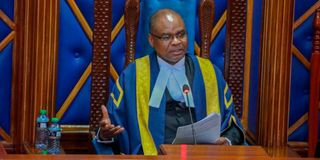
Senate Speaker Amason Kingi at the Senate.
Photo credit: File | Nation Media Group
Together with its Speaker, Amason Kingi, the Senate argues that documents introduced by Dr Daniel Gikonyo are inconsistent, defective and were never presented before senators during the impeachment trial.
In a replying affidavit filed through Senate Clerk Jeremiah Nyegenye, the Senate says the medical records were introduced long after proceedings had concluded, despite indications from Mr Gachagua’s lawyers that they would be tabled during the hearing.
The affidavit escalates an already politically charged constitutional dispute over whether Mr Gachagua was denied a fair hearing on the night senators voted to uphold five impeachment charges against him.
Mr Gachagua and 40 co-petitioners, including Gema Watho Association, argue that Parliament violated his right to a fair hearing by proceeding with impeachment while he was ill and hospitalised.
They say the Senate ignored medical information relayed by Senior Counsel Paul Muite and rushed through a politically motivated process aimed at removing him from office.
DP Gachagua is suffering intense chest pains - Muite
Their lawyers also accuse Parliament of acting under Executive influence and using impeachment to settle political disputes within the Kenya Kwanza administration.
Clerk of the Senate Mr Jeremiah Nyegenye at a past event.
Photo credit: File | Nation Media Group
But Mr Nyegenye argues it was incumbent upon Mr Gachagua to provide “cogent reasons” for the postponement of proceedings on October 17, 2024, when senators considered the impeachment charges.
“Given that the request for adjournment was premised on alleged illness, it was reasonably expected that counsel would provide material evidence demonstrating that the petitioner had been taken ill,” he states.
He adds that the medical report was only produced in court long after the conclusion of the impeachment process.
The Senate and its Speaker are listed as the third and fourth respondents in the petition seeking to overturn Mr Gachagua’s removal from office.
Dr Daniel Gikonyo, founder of Karen Hospital, told the court that Mr Gachagua was admitted on October 17, 2024, with severe chest pain consistent with a possible cardiac event and required urgent treatment and hospitalisation for 48 to 72 hours.
Karen Hospital Chief Cardiologist and Founder Dr Dan Gikonyo.
Photo credit: Jeff Angote | Nation Media Group
He also disclosed that President William Ruto called him during treatment to inquire about Mr Gachagua’s condition.
However, the Senate now argues that the medical evidence contains contradictions that undermine its reliability.
Mr Nyegenye says the Senate, sitting as an impeachment court under Article 145 of the Constitution, had discretion to decide whether to adjourn proceedings.
He further argues that because the adjournment request was based on alleged illness, proper medical proof should have been presented during the proceedings.
The Senate’s main challenge focuses on the discharge summary annexed to Dr Gikonyo’s affidavit, claiming it does not support the stated timeline.
“The annexed ‘system-generated’ medical report indicates that the petitioner was admitted on October 17, 2024 at 4:18pm and discharged on November 20, 2024 at 1:36pm,” the affidavit states.
Mr Nyegenye argues that, if accepted, the report would mean Mr Gachagua remained hospitalised for 31 days, which he says is inconsistent with impeachment timelines.
He adds that this contradicts Dr Gikonyo’s own account that admission was recommended for 48 to 72 hours.
The Senate also claims the documents were not presented during the impeachment hearing despite assurances from Mr Gachagua’s lawyers.
The affidavit further questions the evidentiary value of the discharge summary, arguing it was prepared by a different doctor and cannot be relied upon by the deponent.
The challenge follows a court decision declining to expunge Dr Gikonyo’s affidavit, allowing the medical evidence to remain part of the record.
The petitioners maintain that Parliament acted under Executive influence and unlawfully bypassed the requirement to form a special committee to investigate the charges.