From billboards in Nairobi promising $700 (Sh90,560) monthly salaries and free flights to Russia to hundreds of online platforms, recruiters have for years lured Kenyans to the frontlines of the Russia-Ukraine war.
A new investigation, published in the report Death Benefits: the industry selling Russia’s war as a job, identified 289 digital assets used to recruit foreign nationals systematically into military service for the Russian Federation.
The assets include 197 websites and web pages, 19 social media accounts and 73 messaging accounts or channels on platforms including WhatsApp, Telegram, VK and MAX.
Investigators said some of the sites are built as disposable “burn-and-replace” pages that can be taken down and replaced when exposed.
The report says the recruitment industry operates through several competing operations rather than a single organisation, with investigators identifying at least 14 and possibly as many as 33 separate recruitment operations.
“The recruitment funnel does not belong to one organisation,” the report says, adding that the core brands include Military Staff Agency (MSA), Work in Russia (WiR), IRC Russian Bear and Work Crew Agency (WCA).
The report was produced by researchers at Code for Africa's iLab, as part of the African Digital Democracy Observatory, a project that investigates how digital platforms and technologies are used to influence and shape public discourse.
This comes in as Billboards advertising the Russia-based Alabuga Start programme have been erected in Nairobi, offering young people a chance to relocate to Russia for employment under a programme that advertises free flights and monthly salaries.
The billboards, seen in Nairobi, carry the message “Start Your Career Journey” and promote the Alabuga Start Programme as an “international community” offering opportunities in six fields of work.
One of the billboards advertises a starting salary of US$700, alongside a promise of a free flight to Russia. It directs interested applicants to the email address [email protected] mailto:[email protected] > .
The investigation also documents an offline recruitment operation in Kenya involving Global Face Human Resources (GFHR).
On February 26, 2026 Kenyan prosecutors charged GFHR’s suspected head, Festus Arasa Omwamba, with trafficking 22 Kenyans “for the purpose of exploitation by means of deception”. The men had reportedly been found in a residential building in Athi River, outside Nairobi, waiting to travel to Russia.
Festus Arasa Omwamba, the 33-year-old man whom the National Intelligence Service has accused of recruiting 1,000 Kenyans to fight for Russia in its invasion of Ukraine.
Photo credit: Pool
The report says five months earlier prosecutors had also charged a GFHR employee, Edward Gituku, over allegations that he arranged the recruitment of former Kenyan soldiers into Russian military units.
Both men deny the charges, and the cases are before the courts. The report notes that prosecutors have not named a Russian company, military unit or ministry as a defendant in either case.
Russia’s embassy in Nairobi, according to the investigation, has denied involvement in illegal recruitment and maintained that foreign nationals may enlist voluntarily.
The investigators said the Kenyan cases demonstrate a part of the recruitment trade that cannot be captured through online monitoring involving a recruitment agency, rented premises and face-to-face recruiters.
The investigators said the Kenyan cases demonstrate a part of the recruitment trade that cannot be captured through online monitoring involving a recruitment agency, rented premises and face-to-face recruiters.
The investigation found that recruiters advertise military service using language and techniques associated with ordinary employment agencies.
Some websites reportedly offer construction work, film roles, visas and flights, while others target people with technical skills, including drone pilots, doctors and engineers.
Investigators said some recruiters advertise substantial financial rewards, with one operation cited in the report offering up to 4.5 million Russian roubles, about US$53,000, upon signing, as well as monthly payments and other benefits.
Another recruitment operation was found to offer commissions to individuals who bring in new candidates.
The report says a recruiter webpage invited people to work either offline, including at military recruitment offices and railway stations, or online through social networks and group chats.
Sub-recruiters could reportedly earn 100,000 to 200,000 roubles, roughly US$1,190 to US$2,380 for every candidate delivered, with higher rates available through other arrangements.
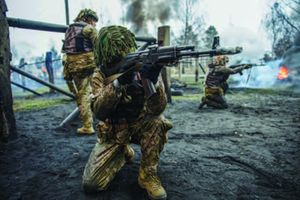
Ukrainian serviceman from mobile air defence unit fires a machine gun towards a Russian drone in Kharkiv region.
Photo credit: Sofiia Gatilova | Reuters
Investigators described this as a commission-paid, geographically dispersed sales force recruiting people through personal social media accounts.
The investigation says the recruitment network is expanding geographically as individual operations are exposed.
After Meta removed hundreds of Africa-focused campaigns in August, investigators said the network shifted towards Syrian recruits in early September, while another West African campaign began on September 20.
The report says investigators found evidence of campaigns targeting people in Africa, Asia, Belarus and Latin America, with recruitment messages translated into different languages.
One operation, Sadiq Rossia, was found to solicit recruits in Russian, English and Arabic and to have launched a campaign targeting Syrians.
At the top is a wholesale layer that sells recruitment as a business opportunity to other operators. A second, global retail layer uses websites, advertising and messaging platforms to connect recruits with human recruiters. The third consists of smaller startups, storefronts and individual recruiters.
The report says these operations can compete with one another for recruits, with the Russian state ultimately acting as the buyer of the manpower supplied through the system.
The investigators said the recruitment operations rely heavily on mainstream digital infrastructure, including websites built using Western software, Western hosting services and advertising on social media platforms.
They identified shared tracking codes, telephone numbers, email records and other technical links connecting some operations.
The report says Meta enforcement action has already removed an estimated 300 Facebook advertising campaigns, together with associated profiles and advertising accounts.
However, investigators said the removal of individual pages does not necessarily dismantle the recruitment machinery because recruiters can replace websites, accounts and advertising identities.
The investigation concluded that the recruitment industry has evolved into a sophisticated cross-border operation selling military service to vulnerable labour markets.
It said the network remained active and was expanding as of September 22, 2026, despite efforts by technology companies and authorities to disrupt individual recruitment operations.
In a new briefing, the human rights organisation said economically vulnerable people from countries in the Global South were being lured into the Russian Armed Forces through false promises of civilian employment, lucrative salaries and opportunities to obtain Russian citizenship.
The recruits were often promised jobs such as drivers, cooks, security guards, construction workers and IT professionals, only to discover after arriving in Russia that they had been enlisted into the military.
Amnesty said some recruits were targeted while already in Russia, particularly migrants and refugees in precarious legal situations.
“Recruiters have developed a system of coercion, fraud and deception, including false promises of civilian or non-combat employment, to enlist foreigners in the military,” Amnesty Secretary General Agnès Callamard said.
The rights organisation says economically vulnerable foreigners are being lured with promises of civilian jobs, high salaries and Russian citizenship before being turned into soldiers and deployed to the front line.
“Amnesty’s research demonstrates how Russia’s Armed Forces are bolstering their ranks with economically vulnerable foreign nationals and using them as cannon fodder in the war of aggression against Ukraine,” said Amnesty Secretary General Agnès Callamard.
“The level of exploitation and coercion involved led us to conclude that in many cases this amounts to human trafficking, as defined under the UN’s Palermo Protocol.”
The findings are contained in a new Amnesty briefing based on interviews with nationals from Brazil, Colombia, Cuba, Egypt, Sierra Leone, Sri Lanka, Somalia and South Africa held in two Ukrainian prisoner of war camps between 2024 and 2026.