A government exercise to establish why thousands of schools were missing from capitation records exposed weaknesses in the Ministry of Education’s data management systems, leaving some 800,000 learner enrolment records unverified, and some 200 schools that only exist on paper, raising questions about how public funds were allocated to schools.
The nationwide verification exercise found 800,000 excess learner records, according to President William Ruto.
The discrepancies exposed gaps in the systems used to capture, verify and update school enrolment data, which determines how much government capitation each institution receives.
The Ministry had developed three separate digital links to collect information from school heads, sub-county directors of education and officials at the headquarters.
School heads were required to submit institutional details, learner enrolment figures and GPS coordinates, while sub-county directors independently mapped schools within their jurisdictions and provided corresponding enrolment information.
The Ministry then compared the two sets of submissions to establish whether the figures matched. For instance, a school reporting 2,000 learners against 1,000 recorded by the sub-county office would be flagged for further investigation.
Similarly, institutions appearing in the schools’ database but missing from sub-county records were flagged for scrutiny.
However, the two field-level platforms were not synchronised, forcing officials to reconcile the submissions to identify inconsistencies.
The exercise also revealed that some schools had submitted information using incorrect identification codes or formats, making them appear as though they had not submitted data.
The verification team further examined whether institutions had previously received government funding and whether their names, bank account details and identification codes matched Ministry records.
Learner records were also cross-checked against other education databases, including those maintained by the Kenya National Examinations Council (KNEC). For learners from Grade Three upwards, assessment numbers were compared with records in the National Education Management Information System (NEMIS) and other Ministry databases.
The checks were intended to establish whether a school existed, whether its reported learners could be accounted for and whether its banking details matched official records before public funds were released.
By November 10, 2025, about 44,495 institutions had been cleared for capitation based on their verified enrolment.
Another 4,555 schools whose submissions were pending because of errors received 50 per cent of the amounts reflected in their previous capitation records, while 5,851 institutions that fell below the minimum enrolment threshold were paid according to the numbers established during verification.
These comprised 3,978 primary schools, 1,706 junior schools and 167 senior schools.
At the time, the Ministry had also identified 1,005 primary and junior schools that had either submitted incorrect information or had not submitted data. They included 244 primary schools and about 102 junior schools that had not submitted their records. All secondary schools had been cleared.
The verification findings were presented to the National Assembly Public Accounts Committee on February 24, 2026, when the then Basic Education Principal Secretary Julius Bitok appeared before the committee to explain the exercise and the action taken.
The Ministry reported that 20 school heads had been referred to the Teachers Service Commission (TSC) for disciplinary action, while 28 sub-county education officers had been issued with show-cause letters.
However, the Ministry has not publicly provided a comprehensive account of the outcome of the disciplinary process or established how much public money may have been paid against the unverified enrolments.
It also remains unclear how long the questionable records had existed in government databases and whether any capitation paid against them has been recovered.
The issue resurfaced during the Kenya Comprehensive Schools Heads Association (KECSHA) conference in Mombasa, where President Ruto announced that a government audit had identified about 800,000 non-existent pupils in primary school registers and nearly 200 schools that existed only on paper.
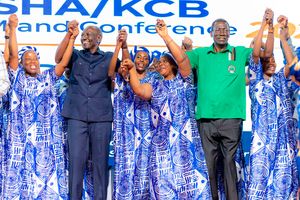
President William Ruto, Mombasa Abdulswamad Shariff Nassir (second left) and National Chairman, Kenya Comprehensive Schools Heads Association (KECSHA) Fuad Abdalla Ali (left) join Tarab dancers in a dance after the Head of State addressed the Kenya Comprehensive Schools Heads Association Annual General Meeting and Conference at Sheikh Zayed Children Welfare Centre in Nyali, Mombasa on Thursday, November 12, 2026.
Photo credit: PCS
“Every shilling must follow a real learner. Our recent audit found about 800,000 non-existent pupils in primary school registers and nearly 200 schools that existed only on paper. Money must reach classrooms with children, not registers with ghost learners,” Dr Ruto said.
However, the President said the government would digitise every learner’s record to ensure that capitation followed actual pupils rather than fictitious names in school registers.
The revelations have placed the integrity of the Ministry’s education databases under scrutiny, particularly the safeguards used to verify enrolment before capitation is released.
The President said the government would digitise every learner’s record to ensure that capitation followed actual pupils rather than fictitious names in school registers. He also called on school heads to account for public funds and ensure that every learner was captured in the national database.
The Ministry of Education has yet to respond to questions on why the school and sub-county platforms were not synchronised, who was responsible for reconciling the records before payments were made, how much money was allocated against the questionable enrolments and what action has been taken against officials implicated in the discrepancies.
The Ministry has also yet to disclose who registered and approved the non-existent institutions, whether their bank accounts were investigated and how much public money may have been paid against their records.
A Ministry of Education official said the State should strengthen school data verification by introducing ICT-led checks between the point of data capture and the national education databases, NEMIS and KEMIS, to identify inconsistencies before enrolment records are accepted.
“It should also conduct impromptu visits to schools to establish whether learners listed in official registers are physically present. School and learner records should be updated every term to ensure that the information held by the Ministry reflects current enrolment,” said the source, who requested anonymity.
The official also advised the employer to use artificial intelligence tools to cross-check learner records in NEMIS and KEMIS against databases held by KNEC and the TSC, helping to weed out inconsistencies and identify questionable entries.
“Teachers and other personnel responsible for capturing school data should receive regular training in digital skills to improve the accuracy of information submitted to the Ministry and strengthen their capacity to manage and analyse learner records,” said the source.
Each sub-county should also have a designated data officer to handle school data management issues, while individual schools should appoint such officers where possible. Headteachers should be required to authorise and supervise the capture and submission of records to strengthen accountability for the information submitted.
On February 24, 2026, the then Basic Education Principal Secretary Julius Bitok appeared before the National Assembly Public Accounts Committee to explain the verification findings and the action taken.
The PS told the committee that 20 school heads had been referred to the TSC for disciplinary action, while 28 sub-county education officers had received show-cause letters.
The exercise exposed discrepancies in learner enrolment figures, school identification codes, institutional records and submissions made by education officials at different administrative levels.