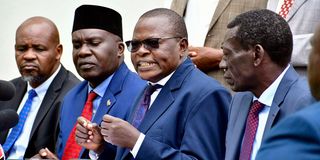
Kenya’s proposed overhaul of the education system has exposed a split among the country’s two main teachers’ unions, with one demanding a halt to public participation while the other wants the process to proceed.
The Kenya Union of Post-Primary Education Teachers (Kuppet) wants Parliament and the Ministry of Education to suspend public participation on the Basic Education Bill, 2026, and the Tertiary Education, Placement and Funding Bill, 2026.
The union says the process should resume only after comprehensive consultation and countrywide sensitisation, arguing that the proposed laws are being considered without a Sessional Paper setting out the Government’s policy direction, a clear costing framework and adequate stakeholder engagement.
“Every major education reform in Kenya has historically been preceded by a Sessional Paper on Education, setting out the policy direction before legislation follows,” Kuppet Secretary-General Akelo Misori said.
Kenya Union of Post-Primary Education Teachers (Kuppet) Secretary-General Akelo Misori.
Photo credit: File | Nation Media Group
He warned that legislating before the underlying policy is settled could lock the country into structures and funding models that may later require costly amendments.
Kuppet cited inadequate sensitisation, inaccessible public participation venues and the absence of a clear costing framework among its concerns.
The union wants participation venues decentralised to reach teachers, parents and learners in rural and hard-to-reach areas.
But the Kenya National Union of Teachers (Knut) has rejected calls to suspend the process, saying stakeholders should use the opportunity to make submissions before Parliament considers the Bills.
“We have had public participation because what has come from Parliament is a Bill, and it should undergo public participation,” Knut Secretary-General Collins Oyuu said.
Knut Secretary-General Collins Oyuu.
Photo credit: File | Nation Media Group
Mr Oyuu said he could not support suspension of the process, while backing the comprehensive school model proposed under the reforms.
However, Knut also wants changes to provisions affecting teachers’ representation in education governance structures.
“If you want to remove a particular structure or representative, what is it that they have done to warrant their removal?” Mr Oyuu said, arguing that governance arrangements should remain open to periodic review.
The Basic Education Bill proposes a new legal framework covering school governance, financing, learner welfare, teacher management, quality assurance and education data.
The Tertiary Education, Placement and Funding Bill proposes a new system for placing students in universities, TVET institutions and other tertiary institutions, alongside a proposed Tertiary Education Funding Authority. Four other Bills under consideration seek changes to national educational assessment, teacher training, the Kenya National Qualifications Framework and the Kenya Institute of Curriculum Development.
Kuppet has also raised concerns over learner placement, school governance, teacher management, basic education financing and the Kenya Education Management Information System (Kemis).
On tertiary education, it says the proposed financing framework does not clearly guarantee full funding, adequately define scholarships or loans, or explain how continuing students and learners whose applications for financial support are rejected will be funded.
Kiambu Senator Karungo Wa Thang’wa has separately questioned the proposed financing framework, particularly whether poor students could end up relying more heavily on loans than scholarships.
In a seven-page statement on the Bill, the senator questioned why the proposed law does not specify guaranteed scholarship categories for vulnerable and extremely needy students.
He cited the 2023 Presidential Working Party on Education Reform, which proposed combining scholarships and loans according to students’ needs. Under that model, vulnerable students would receive 82 per cent of their costs as scholarships and 18 per cent as loans, while extremely needy students would receive 70 per cent scholarships and 30 per cent loans.
University Academic Staff Union TUK Chapter Secretary-General Fred Savanje said repeated changes to university funding models risk leaving the sector’s underlying financial problems unresolved.
He said the former Differentiated Unit Cost model was intended to fund universities according to the actual cost of different programmes, but the Government funded only about 48 per cent of the required amount, contributing to accumulated university debts.
The subsequent Student-Centred Funding Model, he said, brought other challenges, including inaccurate classification of students, delays in loans and scholarships and difficulties for families unable to meet their required contributions.
The model also left universities with about Sh103 billion in unremitted funding, he said.
“The problem is that the proposed models are not addressing the problems in universities,” Mr Savanje said. He said universities continued to face delayed salaries, inadequate investment in laboratories, equipment, libraries and ICT, as well as insufficient funding for research and postgraduate training.
“Unless they come up with a model that addresses the entire ecosystem, universities will still feel the distress of insufficient funding,” he said.