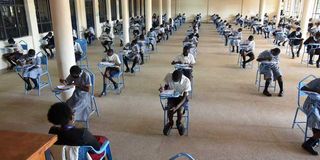
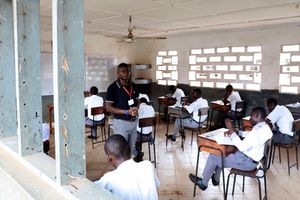
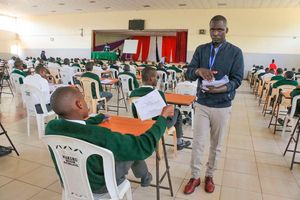
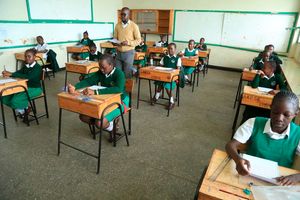
A record 3.4 million candidates will sit three sets of national examinations which start on October 17, an exercise that will test the limits of the basic education sub-sector as well as the security apparatus.
The tests will include the first ever Kenya Junior School Education Assessment (KJSEA) that will be administered to the pioneer class of the competency-based education (CBE) curriculum, for which 1,130,669 learners have been registered.
According to the CEO of the Kenya National Examinations Council (Knec), Dr David Njeng’ere, 996,078 candidates have been registered for the Kenya Certificate of Secondary Education (KCSE), while another 1,298,089 candidates will sit the Kenya Primary School Education Assessment (KPSEA). This makes 2025 the largest examination year in Kenya’s history, with a total of 3,424,836 candidates.
The huge number of candidates has also necessitated the mobilisation of a huge contingent of security officers who will be deployed to man the storage containers across the country, as well as escort centre managers to collect and return examination materials.
Speaking during the launch of the 2025 national examinations and assessments, Dr Njeng’ere said the council conducted a pilot study for KJSEA in 265 sampled schools in July 2024, and sample papers were shared with all junior schools through the CBA portal in January 2025.
The Knec boss also allayed fears of some rogue candidates gaining access to examination materials before the appointed time.
“In the last two years, we have managed to deal with the challenge of early exposure of the second session paper in KCSE through double collection of papers for the two sessions.
"This practice will continue this year. To further ease this process, Knec has installed an additional 25 containers in various sub-counties, bringing the total number of containers to 642, up from 617 last year,” said Dr Njeng’ere.
Dr David Njeng’ere, the CEO of the Kenya National Examinations Council, at a past event.
Photo credit: Evans Habil | Nation
The examination and assessment cycle, however, began with registration of candidates, which was undertaken between January 30 and March 30, 2025.
The KPSEA and KJSEA will provide the summative component of the assessments. The learners have been undergoing school-based assessments (SBAs), which will contribute to their final grade. Dr Njeng’ere revealed that the council will continue with personalisation of examination papers, a process that was first introduced in 2024 to curb malpractices.
Each question paper will bear the candidate’s name and index number, and learners will append their signature and date on both the script and its counterfoil, which will be detached and packed separately after each paper.
“To eliminate any bias during marking of candidates scripts, last year we introduced personalisation of the KCSE candidate question papers. This practice will also continue. The KJSEA question papers with structured questions will also be personalised and candidates will be expected to provide their responses within the question papers,” he said.
“These counterfoils will then be detached at the end of each paper and packed separately in envelopes that shall be provided. Supervisors, invigilators and centre managers will be adequately briefed on this beginning Monday next week,” he added.
Further, he said, 10,765 centre managers will be in charge of the KCSE examinations alongside 12,126 supervisors, 54,782 invigilators, 22,247 security officers and 2,692 drivers.
Centres that will host both KJSEA and KPSEA will require even larger numbers: 24,213 centre managers, 26,479 supervisors and 125,492 invigilators.
An invigilator distributes exam materials during the Kenya Primary School Education Assessment at Aga Khan School in Kisumu on November 1, 2023.
Photo credit: File | Nation Media Group
“During the administration of KJSEA and KPSEA, security officers will be engaged only where it is absolutely necessary in order to ensure that these assessments are administered in a normal and conducive environment for these candidates. In this regard, they will only be engaged in the distribution of examination materials to examination centres and return of candidates’ answer sheets and scripts to the container in few areas that have security challenges,” he said.
However, Dr Njengere said during the KCSE examination, there should be at least two security officers in every examination centre.
Kenya National Examinations Council David Njeng’ere.
Photo credit: Courtesy | KICD
A total of 2,568 security officers will be engaged to secure the containers.
During the conduct of the examination and assessments, supervisors and invigilators will be the only persons in direct contact with candidates and are, therefore, responsible for preventing irregularities.
“To further strengthen the security of examination materials, Knec will pilot the use of digital smart padlocks in 250 containers this year,” said Dr Njeng’ere.
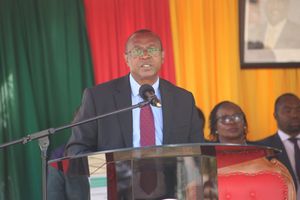
Education Cabinet Secretary Julius Ogamba said that this year, the KJSEA will be used to place learners in Senior School. He noted that the placement of learners will follow the three pathways of STEM, social sciences and arts and sports science.
“These pathways will largely define the learners’ career paths upon completion of senior school, and subsequently their roles in nation-building,” he said.
The CS emphasised the need for honesty in the examinations, warning that there will be no mercy for anyone found engaging in malpractice.
“We will have no mercy on anyone who will be found engaging in any form of malpractices. All candidates, centre managers, supervisors and invigilators must comply with examination regulations, failing which they will be subjected to the full force of the law,” he said.
Mr Ogamba said 37,128 schools across primary, junior and senior levels, with a total of 8,820,703 learners, have so far been verified. Funds for these institutions, he added, have already been disbursed.
Education Cabinet Secretary Julius Ogamba before the National Assembly Committee on Implementation at Bunge Tower, Nairobi, on August 19, 2025.
Photo credit: Dennis Onsongo | Nation Media Group
The Education CS revealed that in the current financial year, the education sector has a budget of Sh950 million to retool teachers for effective implementation of CBE and expressed confidence that the transition will proceed smoothly next year.
The acting CEO of the Teachers Service Commission, Ms Evaleen Mitei, urged parents to support their children during the examination period by creating a calm and encouraging environment.
She emphasised that while it is natural for parents to be concerned about performance, they should avoid transferring exam-related anxiety or pressure onto learners, as this could negatively impact their confidence and overall performance
“This is an assessment, not a competition. Learners should know: this is their chance to showcase not only what they know, but also how and who they are becoming. I wish to also inform you that we have recalled all our field officers who were on leave during this examination period to ensure effective examination management,” said Ms Mitei.