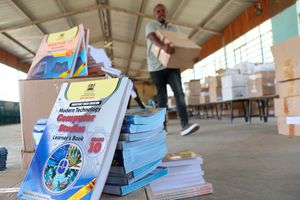
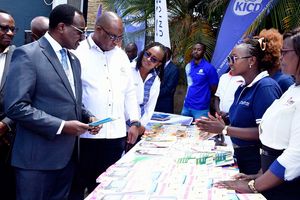
Some Grade 10 textbooks during the launch of the distribution of the textbooks at English Press Ltd offices on January 22, 2026.
It is nearly a month and a half since senior school was rolled out, and gaps have begun emerging in the distribution of textbooks to institutions.
The Kenya Institute of Curriculum Development (KICD) blames the hiccup on the data provided by the Ministry of Education.
In a letter dated March 2 to the Kenya Secondary School Heads Association chairman, KICD said the number of learners admitted to senior school had “changed considerably.” The number is not consistent with earlier distribution lists provided by the ministry, KICD said.
The institute said that the discrepancy had resulted in some schools receiving fewer textbooks and others getting more than they needed.
Education Cabinet Secretary Julius Ogamba before the flagging off the distribution of Grade 10 textbooks at English Press Ltd offices on January 22, 2026.
“We are aware that the numbers of learners admitted to senior school has changed considerably and is not consistent with the distribution list earlier provided by the Ministry of Education. This has caused gaps in the number of textbooks supplied,” KICD Chief Executive Officer Prof Charles Ongondo.
KICD said that it began distributing Grade 10 textbooks in January at a ratio of 60:40 as directed by the ministry. Under the model, if a school has 100 learners in Grade 10, 60 textbooks would be supplied by one publisher and 40 by another for variety.
A teacher collects newly arrived Grade 10 textbooks from the collection centre in Nakuru Day Senior School on February 3, 2025.
But school heads have raised concern over a shortage of books. Some schools said they either have few copies or none. They said the delay is disrupting learning at a critical transition stage under the Competency-Based Curriculum (CBC).
“I have not received textbooks for mathematics, biology, chemistry, CRE, geography or physics up to now. How am I expected to teach? No books have been delivered. How are learners expected to prepare adequately without the most basic learning materials?” a Principal in Samburu County asked.
Due to the shortage, parents have been forced to step in and buy the required books. Many of them say it is a financial strain.
“The school told me that if I want my child to keep up with lessons, I had to buy mathematics and chemistry books. I had to spend over Sh10,000, on books,” a parent from Nairobi said.
“It’s unfair because we are already paying school fees, and now we have to buy books as well. Parents like me are struggling.”
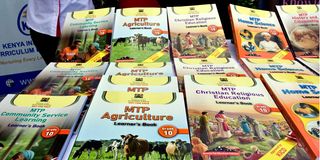
Some of the Grade 10 textbooks flagged off during the distribution of Grade 10 textbooks at English Press Ltd offices on January 22, 2026.
A special audit by Auditor-General Nancy Gathungu found that textbooks worth Sh90.8 million were supplied in excess during the 2020-2021 and 2023-2024 financial years. The review, commissioned by the National Assembly Public Accounts Committee, sampled 442 secondary schools, 339 junior schools, and 336 primary schools. In the schools sampled, the value of excess textbooks stood at Sh90.8 million.
While appearing before the National Assembly Education Committee, Basic Education Principal Secretary Prof Julius Bitok defended the placement process.
He said that initial placements were based strictly on declared capacities. However, after complaints from school heads that they were not sufficiently involved in the first phase, the ministry allowed principals to participate in adjustments.
Follow our WhatsApp channel for breaking news updates and more stories like this.