Millions of vulnerable learners are at risk of missing school after the school feeding programme was underfunded by Sh3.1 billion, even after a proposed Sh1.75 billion budget top-up.
The National Assembly Committee on Education has proposed an additional Sh1.75 billion in the Supplementary Estimates for the 2025/2026 financial year.
The programme, which supports children in arid and semi-arid lands (ASALs), informal settlements and other marginalised areas, requires Sh7.8 billion annually to adequately cater for 2.6 million learners.
However, it was allocated only Sh3 billion in the current financial year ending June 2026, leaving an initial Sh4.8 billion deficit. The shortfall persists at a time when budgetary allocations to the programme have largely stagnated over the years despite rising enrolment in basic education and worsening food insecurity in vulnerable regions.
Committee Chairperson Julius Melly defended the proposed increase, saying it would provide some relief to the most vulnerable learners.
“We propose an increment to the school meals programme of Sh1.75 billion to support vulnerable learners through school meals as well as fortified porridge to promote learners’ retention in schools especially in urban slum areas and ASAL regions,” Mr Melly said during submissions before the National Assembly Budget and Appropriations Committee.
The Budget and Appropriations Committee is expected to retreat and compile its report on the supplementary budget before tabling it in the House next week when MPs resume sittings after a short recess.
Budget documents show allocations to the School Feeding Programme under the State Department for Basic Education have remained inconsistent over the past five financial years, despite the growing number of learners and increased demand in vulnerable communities.
The programme was allocated Sh2.3 billion in 2021/22, before it dropped to Sh1.9 billion in the financial year 2022/2023. In 2023/24, the allocation rose to Sh4.9 billion, before falling to Sh3.6 billion in 2024/25 and then dropping further to Sh3 billion in 2025/26.
The trend shows that while there was a temporary increase to Sh4.9 billion in 2023/24, the allocation has since fallen back, plateauing at levels far below what is required to sustain nationwide demand.
In fact, in the financial year 2024/25, the programme was initially not factored into the national budget at all, only for the National Assembly Education Committee to intervene and push for the eventual allocation of Sh3.6 billion.
Basic Education Principal Secretary Julius Bitok has warned that at least 2.6 million learners could be exposed if the programme is not fully financed this financial year.
“We have a challenge there because 2.6 million children are exposed if we do not get this support,” Prof Bitok told the National Assembly Education Committee during consideration of the Supplementary Estimates I for the 2025/26 financial year.
Prof Bitok explained the current funding shortfall threatens the programme’s ability to provide meals for the full 180-day school calendar to 2,615,651 learners, many of whom depend on school meals as their most reliable source of daily nutrition.
In many drought-prone and food-insecure counties, the school feeding programme has become more than just a welfare intervention. It is increasingly viewed as a lifeline that keeps children in class, especially in regions where hunger often pushes learners out of school.
The funding squeeze comes against the backdrop of mixed but extreme climatic conditions, with parts of the country swinging from prolonged drought to heavy rains and flooding.
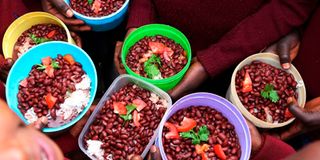
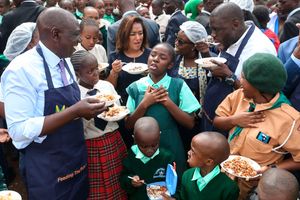
School children are served food under the school feeding programme. A feeding programne is in limbo after questions arose on the quality of food the education department bought for hungry schoolchildren in western Kenya.
Photo credit: File | Nation Media Group
Earlier this year, the United Nations reported that more than two million Kenyans were facing hunger, with northeastern pastoral communities among the hardest hit. Disturbing scenes of emaciated livestock near the Kenya-Somalia border underscored the depth of the food crisis after repeated failed rainy seasons devastated livelihoods across the region.
The wider Horn of Africa has endured multiple failed wet seasons in recent years, while eastern Kenya recorded some of its poorest short rains in decades, worsening already fragile food systems.
In January, the World Health Organisation (WHO) warned that food insecurity was deepening, with rising malnutrition, heightened disease risks and growing pressure on already stretched health services.
It is within this context that the school feeding programme has become central not only to education outcomes, but also to child nutrition, attendance and survival.
A 2023 performance audit found that school attendance improves significantly on days when meals are provided and drops when they are not, confirming the programme’s direct link to learner retention.
For many children in marginalised regions, the meal served at school is often the only dependable meal of the day, even as the chronic underfunding continues to undermine the programme’s consistency and reach.
The Office of the Auditor-General found that over a five-year period, only Sh7.7 billion was approved against a funding request of Sh17.32 billion, leaving the programme operating far below need.
That financing gap has weakened school feeding schedules, disrupted implementation and left schools struggling to support vulnerable learners, raising the risk of absenteeism, poor concentration and eventual dropout.
The funding crisis also comes at a time when concerns are growing over learning poverty and school participation in the very regions most dependent on the programme.
A recent report by Usawa Agenda found that one in three Grade Six learners in Kenya cannot read and comprehend a Grade Three-level English story, raising fresh questions about the country’s foundational learning outcomes.
The Foundational Literacy and Numeracy Assessment (FLANA) 2025 further showed that counties such as Garissa, Mandera and Turkana continue to record some of the highest numbers of out-of-school children, particularly among those aged four to five years.
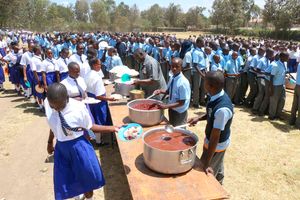
A school feeding programme in a school in Turkana.
Photo credit: File | Nation Media Group
Although national school participation remains relatively high, with an average 94.2 percent of children aged 4 to 17 years reported to be in school, the report notes that the 10 counties with enrolment rates below the national average are all in ASAL regions.