Hello

Your subscription is almost coming to an end. Don’t miss out on the great content on Nation.Africa

Ready to continue your informative journey with us?

Hello

Your premium access has ended, but the best of Nation.Africa is still within reach. Renew now to unlock exclusive stories and in-depth features.

Reclaim your full access. Click below to renew.

 Launch of Nairobi County School Feeding Programme at Roysambu Primary Schoo
Caption for the landscape image:

Over 2 million learners at risk of dropping out as school feeding taps dry

Scroll down to read the article

President William Ruto, Nairobi Governor Johnson Sakaja and Nairobi Women Representative Esther Passaris during the Launch of Nairobi County School Feeding Programme at Roysambu Primary School on June 20, 2023.
 

Photo credit: PCS

At least 2.6 million learners risk dropping out of school as the school feeding programme grapples with a Sh4.8 billion funding shortfall, exposing the fragility of a scheme that is essential in keeping children in class in vulnerable regions.

Basic Education Principal Secretary Julius Bitok has warned that without urgent intervention, millions of children, mostly in arid and semi-arid areas, could miss school due to a lack of food.

The feeding programme requires Sh7.8 billion annually but was allocated only Sh3 billion in the current financial year ending June 2026, leaving a deficit of Sh4.8 billion.

“We have a challenge there because 2.6 million children are exposed if we do not get this support,” he told the National Assembly Committee on Education during consideration of the Supplementary Estimates 1 for the financial year 2025/2026.

School feeding programme

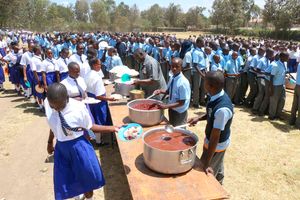
Students enjoy a meal provided through a school feeding programme.

Photo credit: File | Nation Media Group

Prof Bitok noted that the Sh4.8 billion funding gap threatens food provision for the full 180-day school calendar for 2,615,651 learners.

This comes as the country experiences mixed but extreme climatic conditions with a shift from prolonged drought to heavy rains and flooding.

Earlier in the year, the United Nations observed that more than two million Kenyans were facing hunger, with northeastern pastoral communities among the hardest hit.

Disturbing scenes of emaciated livestock near the Somali border underscored the scale of the crisis, as repeated failed rainy seasons continue to devastate livelihoods.

The Horn of Africa has endured four consecutive failed wet seasons, with the October–December 2025 rains ranking among the driest on record.

School feeding programme

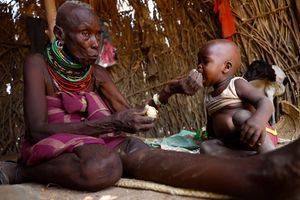
School feeding programme in a school in Turkana County.

Photo credit: File | Nation Media Group

Eastern Kenya experienced its worst short rains since 1981, worsening already dire conditions. In January, the World Health Organisation warned that food insecurity was deepening, with rising malnutrition, increased disease risk and strained health services.

In such conditions, the school feeding programme has become a lifeline, beyond just being a welfare intervention.

In the current financial year, the government allocated Sh3 billion for the school feeding program, a Sh600 million slash from the Sh3.6 billion allocated in the financial year 2024/2025.

A 2023 performance audit found that school attendance improves significantly on days when meals are provided, and drops when they are not.

For many children in marginalised regions, the meal offered at school is often the only reliable source of nutrition.

However, chronic underfunding has weakened the programme’s effectiveness with the Office of the Auditor-General Kenya establishing that over a five-year period, only Sh7.7 billion was approved against a request of Sh17.32 billion.

This severely limited coverage and consistency of the school feeding programme leaving schools struggling to sustain feeding schedules, with ripple effects across communities as school dropout rates increase.

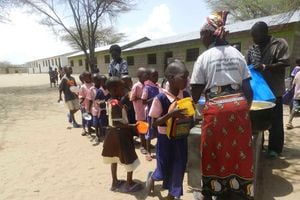
Food being served to school children at Shambani Primary school in Isiolo County.

A recent report by Usawa Agenda shows one in three Grade 6 learners in cannot read and comprehend a Grade 3-level English story raising serious concerns about readiness for junior school.

The Foundational literacy and numeracy assessment report (FLANA 2025) shows Garissa, Mandera and Turkana top list of counties with the most students out of school with those aged between four and five years being the most.

On average, 94.2 percent of children aged between four and 17 years are in school and that the 10 counties with enrolment rates below the national average are in the ASALs.

Follow our WhatsApp channel for breaking news updates and more stories like this.

Mr Mathiu is a communications consultant and farmer. [email protected]