Former University of Nairobi Chancellor Vijoo Rattansi whose death was announced on Thursday made history in 2013 when she was appointed first [and so far, only] female Chancellor of the institution. She also served as the chairperson of the UoN Foundation.
She was in office for a decade before being succeeded by the current chancellor, Prof. Dr. Patrick Verkooijen in 2023.
Born to a business family in Zanzibar in 1948, she married into the prominent Rattansi family, best known by Kenyans for its philanthropy, especially in education. At the time of her death, Vijoo was co-managing the Rattansi Educational Trust with her son Imran Rattansi.
The trust was established in 1956 by Mohamedally Rattansi and his wife Maniben and has offered millions of shillings in scholarships to thousands of needy students, irrespective of race. The couple were part of the many migrants from India who came to Kenya as workers during the construction of the Kenya-Uganda Railway.
Young Mohamedally had come to Kenya at the turn of the 20th Century on the invitation of his cousin who had a small shop in Mombasa. He found a job in Mombasa but was sent to run its shop in Nyeri. It was there that he raised his family before moving to Nairobi.
The successful businessman decided to give back to society by establishing a trust for the benefit of the community.
That decision gave birth to the Rattansi Educational Trust, whose most visible feature is a four-storey building on Koinange Street. Its management has remained within the family.
Vijoo took over leadership of the Rattansi Educational Trust after the death of her husband, Hassanally Rattansi in 2003 and continued with supporting students with scholarships and academic institutions with grants. Upon news of her death, leaders sent their messages of condolences to the family.
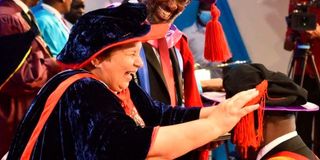
Dr Vijoo Rattansi caps a PhD graduand at a past graduation ceremony at the University of Nairobi.
Photo credit: File | Nation Media Group
“Dr Rattansi was an exceptional leader, a passionate advocate for education, and a woman of remarkable grace and integrity. Her unwavering commitment to academic excellence, leadership development, and the advancement of education inspired countless students, scholars, and leaders during her tenure of service at the University of Nairobi and beyond,” former President Uhuru Kenyatta wrote on his official X account.
“Her unwavering commitment to expanding access to higher education opened doors for thousands of bright but financially disadvantaged students, fundamentally changing the trajectory of their lives through scholarships and mentorship. The thousands of individuals whose lives she touched, whose dreams she financed, and whose futures she secured bear living testimony to a life beautifully lived in service to humanity. Kenya and indeed the University of Nairobi has lost a distinguished education advocate, an exceptional leader, and a compassionate mother to the less fortunate,” said Prof Verkooijen in a statement.
The young Vijoo had dreams of a career in medicine but that changed after the 1964 revolution in Zanzibar. She had just finished her secondary education, the Cambridge School certificate but her mother suggested that she visits her elder sister who was married in Nairobi then go back and proceed to the US.
She happily boarded a liner for the long trip and it was after they got to Tanga that they learnt of the revolution back home.
“I got to Mombasa on a ship, took a train to Nairobi and I never left,” she said in a past interview.
Her family eventually left Zanzibar; some relocated to the UK and some to Kenya. Vijoo would get into business by working at an Italian handicrafts shop. As she fell in love with Kenya, she also found her husband in Nairobi.
Apart from the Rattansi Educational Trust, she also served as chairperson of Daisy Eye Cancer Fund, Trustee to Michael Blundell Trust. Vijoo also served on the board of Highway Secondary School for a long time.
The Educational Trust has a rich history and Vijoo had a part in that story since she joined the Rattansi family. When Mohamedally set his mind upon establishing a trust to give back to a country he felt had offered him so much, he summoned a conference of family members, together with a few of his close friends.
“He announced that instructions had been given to lawyers to prepare a trust deed bequeathing all three of the prime properties that he owned on Sadler Street (now Koinange Street) to the people of Kenya in perpetuity, and dedicated them to educational ends. The Maniben and Mohamedally Rattansi Educational Trust Fund Deed was thus drawn up and signed on the 17th day of September 1956. On the second of day of November, 1956, Mohamedally formally handed over the title deeds of the properties to the Governor of Kenya, Sir Evelyn Baring, at a ceremony in Government House, today State House, attended by many of Nairobi’s then notables,” reads part of the book Fulfilling a Dream by the trust.
It was the first educational trust that did not discriminate its beneficiaries along racial lines. It is a legacy that has lived on, now for 70 years.