A report by the regulator of university education has revealed a shortage of professors in universities and teaching staff with doctorate qualifications, a situation that hinders teaching and supervision of students aspiring for higher academic studies.
The report also notes imbalance in the number of doctor of philosophy (PhD) holders in business and arts related courses as compared to those in science and technical academic fields. The report also decries cases of cheating in examinations, some of which have led to suspension from studies or expulsion from universities.
The report, based on data collected from universities in 2025 also shows a worsening student to academic staff ratios in public universities as private universities maintain numbers relatively within the recommended ranges.
According to data from the Commission for University Education (CUE) there are only 631 professors (3.84 per cent of academic staff) teaching in the 38 chartered public universities, 32 chartered private universities, three private universities with Letters of Interim Authority, eight public university constituent colleges and two private university constituent colleges.
“We don’t have a recommended number of professors in a university but ideally, anyone teaching in a university should have a PhD and everyone teaching in a university should aim to become a professor. When we don’t have many of them, it affects supervision of PhDs,” the chief executive of the CUE Prof Mike Kuria told the Daily Nation.
“Our recommendation is that to teach at a particular level, you should have a higher rank. To supervise a PhD, you should be a professor,” he added.
In 2014, CUE had developed guidelines that required anyone teaching in a university to have a PhD qualification and set an October 2019 deadline to comply or quit.
However, the Universities Academic Staff Union challenged the guidelines in court and successfully prosecuted the case. The court nullified the guidelines in December of that year.
That ambition by CUE has not been achieved 12 years later. In its latest report, out of the total 16,341 academic staff, PhD holders account for 63.52 per cent (8,372) followed by master’s holders (7,180), bachelor’s degree holders and 758 with post-graduate diploma holders.
Public chartered universities account for most of the workforce. Out of total staff, Public chartered institutions contribute 10,380 (63.52 per cent). Private Chartered universities form the second largest with 5,310 staff (32.49 per cent).
The remaining categories – public constituent colleges (1.17 per cent), private constituent (0.35 per cent), and LIA (2.47 percent) collectively contribute only 3.99 per cent.
“Since doctoral qualification is often a proxy for advanced research capability and eligibility for postgraduate supervision, the fact that roughly three-quarters of all Doctorate holders are in Public Chartered universities suggests that research output and doctoral training potential may be structurally anchored in this category. This has implications for equity in research capacity across the sector,” the report observes.
The distribution of professors, in terms of gender, is also a concern. Out of the 631 professors teaching in the universities, only 122 are female.
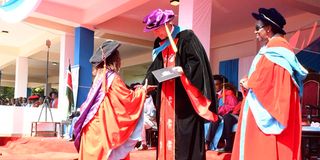
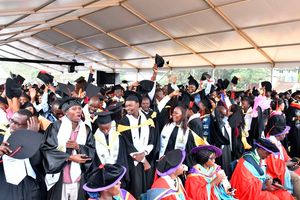
Graduands during a graduation ceremony at Kabarak University on December 19, 2025.
Photo credit: Boniface Mwangi | Nation Media Group
However, it was an increase from the 93 reported in 2024. There are also less females than males at the associate professor level (290 against 803).
The report also observes that the rising student to academic staff ratios in public universities and constituent colleges indicates a deterioration in staffing efficiency, and strain in terms of human resource capacity.
“The implications for academic quality and institutional health are immediate. In categories where ratios have surged—most notably in public constituent colleges—academic capacity is failing to keep pace with enrolment. This translates into oversized lecture cohorts, unsustainable marking and supervision loads, and diminished faculty availability for student mentoring.
Crucially, such high ratios constrain the time available for faculty research and professional development, potentially undermining long-term institutional competitiveness,” it reads.
At the same time, the CUE report highlights cheating in university examinations as a challenge facing the sector. There were 2,803 cases of cheating in examinations recorded in 2025 accounted for 92.9 per cent of all the 3,017 cases of indiscipline reported.
The nature of the other cases reported include gross misconduct and other violations (154 cases), theft, robbery, fraud and forgery (40 cases), drug and substance abuse (12 cases), gender-based violence (6 cases), and breach of hall and election rules (2 cases).
“Examination malpractice is the defining discipline challenge in Kenya’s universities. Common violations include cheating using unauthorised written materials, possession of electronic devices (mobile phones) during examinations, impersonation, and sitting examinations for units in which the student is not duly registered. It underscores the urgency of investing in examination integrity infrastructure,” the report observes.
It recommends strengthening of examination integrity infrastructure and that universities should adopt minimum standards for examination supervision like randomised seating plans, systematic pre-examination device checks, and the use of electronic signal-suppression measures, where legally permissible.
“CUE should incorporate examination integrity protocols into its institutional monitoring framework,” it reads.
It adds that CUE should require all institutions to resolve student discipline appeals within 90 days of filing and review whether disciplinary decisions at these institutions are consistent with the gravity of the offences reported and the requirements of the Universities Act.
“Every university should have a policy on how handle cases of cheating. The cases could be higher since the reported ones are the ones who were caught. Ideally, no one should cheat but this is the reality,” Prof Kuria told the Daily Nation.