Along Nairobi’s Koinange Street stands a four-storey building bearing the name Rattansi Educational Trust. To most passers-by, it is another commercial property in the capital. But for decades, the rent collected from that building has paid university fees, purchased books, equipped lecture rooms and kept financially distressed students from abandoning their studies.
That building is perhaps the most fitting monument to Dr Vijoo Rattansi, the former University of Nairobi Chancellor who died on July 30, 2026.
Her legacy is not principally captured in statues or ceremonial titles but lives in the education of thousands of Kenyans whose ambitions might otherwise have ended at the door of a university bursar’s office.
Then Public Service Youth and Gender Affairs Cabinet Secretary Prof Margaret Kobia (right) with the University of Nairobi Chancellor Dr Vijoo Rattansi (centre) and Vice-Chancellor Prof Stephen Gitahi Kiama during the launch of the UoN Council strategic plan 2019-2024 in Nairobi on January 6, 2020.
Photo credit: File | Nation Media Group
Dr Rattansi was a philanthropist, educationist and institutional leader. In 2013, she became the first woman appointed Chancellor of the University of Nairobi, the country’s oldest university. While she served for 10 years, leaving office in 2023, her contribution to Kenya’s education began long before she entered the chancellor’s office.
Born in Zanzibar in 1948, Vijoo Punjwani had hoped to study medicine in the United States. Those plans were disrupted by the Zanzibar Revolution of 1964, which overturned the island’s political and social order and forced many families to reconsider their futures.
She eventually settled in Kenya and married Dr Hassanally Rattansi, a physician, sportsman and son of Mohamedally and Maniben Rattansi. Her marriage brought her into one of Kenya’s most remarkable traditions of private philanthropy.
The story had begun in 1956, during the final years of colonial rule. Mohamedally Rattansi, who had arrived in East Africa from Kathiawar, India, decided that the wealth his family had accumulated should be used to educate the people of the country that had become their home. Together with his wife, Maniben, he established the Mohamedally and Maniben Rattansi Educational Trust.
Mohamedally, who had first settled in Nyeri, placed three prime properties on what was then Sadler Street—today’s Koinange Street—into the trust. The trust deed was signed on September 17, 1956, and the title deeds were formally handed to Governor Sir Evelyn Baring at Government House on November 2.
The ceremony carried an uncomfortable colonial symbolism: an Asian businessman handing property intended for public benefit to the representative of an administration then suppressing the Mau Mau rebellion. Yet the trust itself embodied a different vision of Kenya’s future.
Colonial Kenya was organised along racial lines, with separate institutions and opportunities for Europeans, Asians and Africans. The Rattansi Trust was structured to assist students from African, European, Ismaili, Muslim and non-Muslim Asian communities. Each was initially allocated a share of its income.
After independence dismantled the formal racial order, the trust deed was amended. In 1967, the High Court permitted its funds to be distributed without racial division, transforming it into a more inclusive national institution.
That history is essential to understanding Vijoo Rattansi’s legacy. She did not establish the trust, but she became one of its most determined custodians. She helped convert a family inheritance into an enduring Kenyan institution.
After Mohamedally’s death in 1957, his son Hassanally became closely involved in administering and expanding the trust. The original single-storey property was redeveloped into a larger commercial building, creating a sustainable stream of rental income. The model was simple but farsighted: preserve the asset, invest in it and use the income, rather than exhaust the capital, to finance education indefinitely.
Vijoo worked alongside her husband in managing and enlarging the philanthropic enterprise. When Hassanally died in 2003, she assumed its chairmanship and carried the family’s educational mission into another generation.
Her achievement lay partly in continuity of the legacy left. While many charitable projects disappear with their founders, family disputes, poor management, changing priorities or depletion of capital, Dr Rattansi protected the institution, expanded its partnerships and retained its focus on financially disadvantaged students.
Then University of Nairobi Chancellor Dr Vijoo Rattansi (centre) cuts a ribbon during the commissioning of University of Nairobi Kisumu Campus Complex on April 20, 2018.
Photo credit: File | Nation Media Group
The trust worked mainly through universities and colleges, allowing the institutions to identify students in financial distress. Its beneficiaries came from across Kenya and from every community. Public universities, technical colleges, medical training institutions and some private universities received money for bursaries, books and learning facilities.
Over one ten-year period, the trust provided more than Sh120 million to Kenya’s higher-education sector. The University of Nairobi reportedly received more than Sh70 million through scholarships, books, furniture and learning equipment. In one intervention, the trust provided 200 folding tables and 400 chairs, furnishing four classrooms in the University of Nairobi Towers.
The figures tell only part of the story. Dr Rattansi’s philosophy was expressed in the trust’s motto: “Education lights the path to development.” It was philanthropy based not merely on compassion but on the conviction that poverty could be confronted by enlarging individual opportunity.
Her approach also challenged the personalised giving that characterises much of Kenyan public life. While political benefactors frequently distribute money publicly, converting assistance into political loyalty and publicity, the Rattansi model attempted to institutionalise generosity.
The donor did not need to know the ethnicity, religion or political opinions of the student who benefited. Hers was philanthropy without the demand for political allegiance.
Dr Rattansi also understood that bursaries alone could not solve the problems confronting young people. She chaired the Slums Information Development and Resource Centre, which worked to expand access to information and leadership opportunities in informal settlements. She was also associated with the Daisy Eye Cancer Fund, Kenya Community Development Foundation, East Africa Association of Grantmakers, Sir Michael Blundell Trust and Highway Secondary School.
Her appointment as Chancellor of the University of Nairobi in 2013 marked a significant break with the institution’s past. The chancellorship had previously been occupied by powerful men, including Jomo Kenyatta, Daniel arap Moi, Mwai Kibaki and businessman Joseph Wanjui. Dr Rattansi became its fifth Chancellor—and the first woman to occupy the office.
Her appointment was important not simply because of gender. She represented a different form of authority for she had not risen through party politics or used the university as an extension of presidential power. Her standing came from service to education and from the moral authority accumulated through decades of philanthropy.
During her tenure, she attempted to move the chancellorship beyond graduation ceremonies. In September 2015, she launched an endowment fund to support bright but needy students and nurture future African leaders. In 2018, she hosted the inaugural Chancellor’s Career Fair, bringing students into contact with employers and professional mentors.
She later helped establish and chaired the University of Nairobi Foundation, intended to mobilise private and alumni resources for an institution facing persistent financial difficulties.
Her tenure coincided with a difficult period for Kenya’s public universities. Rapid expansion, declining government support, accumulated debts, student unrest and governance disputes placed enormous pressure on the institutions. The Chancellor’s office was largely ceremonial, and it would be an exaggeration to attribute the university’s academic or administrative direction to her alone. Nevertheless, she used the position to advocate fundraising, partnerships and student support.
Her public service received national and international recognition. She was awarded the Order of the Grand Warrior in 2006. Moi University awarded her an honorary Doctor of Letters for her contribution to education, while the University of Nairobi conferred another honorary Doctor of Letters upon her in 2014.
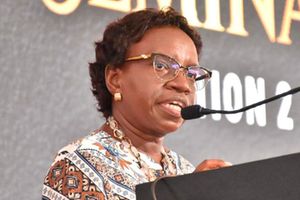
Then University of Nairobi Chancellor Vijoo Rattansi (left) greets the Indian High Commissioner to Kenya Suchitra Durai during the celebrations to mark the 11th International Day of Non Violence held at the University of Nairobi Center for Performing Arts on October 5, 2017.
Photo credit: File | Nation Media Group
Dr Rattansi’s deeper legacy lies in the idea of trusteeship. Her husband, Hassanally, once argued that if a person possessed more money or talent than they needed, they were merely its trustee and should give the remainder to others.
Dr Vijoo Rattansi inherited that principle but did not treat it as a family slogan. She administered it, protected it and gave it institutional longevity. She demonstrated that an inheritance need not remain a mechanism for reproducing family privilege; it could become a public resource.
Dr Rattansi’s death therefore closes more than a distinguished personal career. It removes one of the principal custodians of a philanthropic tradition stretching back seven decades.
If the trust continues educating needy Kenyans, preserving its assets and remaining faithful to its inclusive mission, her work will not have ended with her death. Every year, another student will enter a lecture hall because one family decided its property carried a duty to the people of Kenya.
And behind that student will remain the quiet hand of Vijoo Rattansi—the woman who understood that the most enduring inheritance is the opportunity one leaves to others.