Teachers are set to get a new career progression framework within the next two weeks, with President William Ruto saying the Salaries and Remuneration Commission (SRC) had concluded its evaluation of the proposed guidelines.
The revised Career Progression Guidelines (CPG), which introduce dual career pathways and cut the time required to reach the highest grade from 30 years to 18, are expected to address years of stagnation among teachers in various cadres.
Under the proposed 2026 CPG, teachers will, for the first time be able to rise to the highest classroom grade without leaving teaching, with separate career tracks for classroom practitioners and those pursuing leadership and administrative roles.
The guidelines were submitted to the SRC after the Teachers Service Commission (TSC) and the three teachers’ unions.
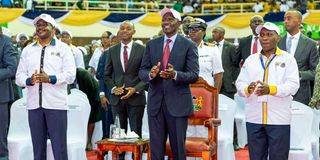
President William Ruto presents the Most Resilient Teacher award to Nzivo George Mwololo from Kathonzweni Secondary School during the World Teachers’ Day celebrations at Kasarani Gymnasium in Nairobi on October 05, 2026.
Photo credit: PCS
Kenya National Union of Teachers (Knut), the Kenya Union of Post Primary Education Teachers (Kuppet) and the Kenya Union of Special Needs Education Teachers (Kusnet) signed them in June 2026 for job evaluation which determines the relative value of different teaching roles and informs the remuneration structure.
“And I have it on the authority of the chairman of the SRC that that exercise will be concluded in the next two weeks,” President Ruto said at the Kasarani Gymnasium during celebrations to mark World Teachers’ Day.
Dr Ruto said the review was in line with a commitment he made to teachers when he hosted their representatives at State House in September last year.
He noted that the Kenya Kwanza administration had doubled the budget for teacher promotions from Sh1 billion to Sh2 billion and created slots for the promotion of 34,016 teachers this year alone.
“Today I am directing that this number be increased to 50,000, and the government will provide the additional funding to make this possible,” he said.
Since taking office, his administration has promoted 126,462 teachers and recruited 100,000 teachers over the past four years.
Another 20,000 teachers are expected to be recruited by December 2026,which Mr Ruto described as the largest expansion of the teaching workforce in the country’s history.
The President also said the government had allocated Sh4.9 billion to move 20,000 teachers who have completed two-year internships to permanent and pensionable terms in January 2027.
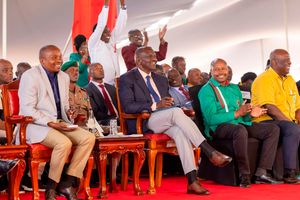
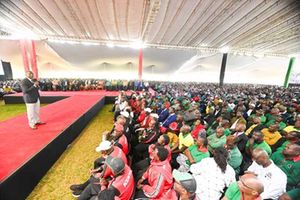
Thousands of educators during the World Teachers’ Day celebrations at Kasarani Gymnasium in Nairobi on October 05, 2026.
Photo credit: PCS
Dr Ruto, who was accompanied by Education Cabinet Secretary Julius Ogamba, said the government had also expanded teachers’ medical cover under the Social Health Authority (SHA).
He said inpatient access for teachers had doubled from seven per cent to 14 per cent, bringing their medical cover at par with that of other civil servants.
“Before, teachers could receive inpatient care in only 900 facilities. Today, you can do so in 3,871 facilities across national and county government, faith-based and private providers,” he said.
On home ownership, Dr Ruto said 20 per cent of affordable homes had been reserved for teachers under an agreement signed in September 2025 between the Affordable Housing Board, Knut and Kuppet.
Under the agreement, one in every five homes in affordable housing developments is reserved for teachers.
The President said the Affordable Housing Board was working with the TSC to establish a salary check-off system that would allow teachers to pay for their homes directly from their salaries.
President Ruto: 20pc of affordable houses reserved for teachers
“The Affordable Housing Board is working with the TSC on a check-off system so that you can pay for your home directly through your salary,” he said.
He added that the government was partnering with SACCOs to develop financing packages suited to teachers’ incomes, with teachers able to apply for their preferred housing units through the Boma Yangu platform.
On retirement benefits, Mr Ruto said teachers should receive their pensions promptly and with dignity after completing their service.
He said the TSC and the National Treasury began rolling out the Pension Management Information System on July 1, 2026, to speed up the processing of retirement benefits.
Teachers’ records are already being uploaded into the system, he said.
“The agencies responsible have assured me that within three months, we will be able to pay a teacher’s benefits within 10 days of retirement,” Mr Ruto said.
On school capitation, the President said his administration had disbursed funds before the start of every term this year and that this would remain the government’s commitment.
He acknowledged concerns over the amount allocated per learner, saying the government would review the funding after completing work on the Tertiary Education, Placement and Funding Bill, 2026, which is currently before Parliament.
“I know there are concerns on the amount per learner. My instruction to the ministry and to all the stakeholders, including the TSC, is that immediately we finish with the Tertiary Education, Placement and Funding Bill, we will embark on reviewing the amount that is required for the teaching of our children,” he said.
Dr Ruto said the government was considering increasing the annual allocation of Sh22,244 per learner for senior school, Sh15,000 for junior school and Sh2,300 for primary school.
Knut Sec Gen Collins Oyuu commended President Ruto’s track record in the education sector, citing the employment of more than 100,000 teachers.
“Over the recent past, the trend has been employment of 5,000 teachers yearly. However, in the last three financial years, over 100,000 teachers have been employed on permanent and pensionable terms,” Mr Oyuu said.
According to Kuppet deputy chair Moses Nturima, granting Junior secondary schools independent management will help ease tensions and clarify line of authority and create harmonious environment for learning for learners.
“We kindly urge your administration to consider giving junior secondary school complete autonomy in their administration. Presently there is bad blood and administrative friction between primary school heads and junior school teachers,” he said.