The Registrar of Trade Unions has dealt a blow to senior officials of the Kenya Union of Post-Primary Education Teachers (Kuppet) and the Universities Academic Staff Union (Uasu) after directing that amended constitutions that have been barred by court orders will not be used in the union elections early next year.
In a circular, the acting registrar, Ann Kanake, directed all trade unions, employer organisations, and federations to strictly conduct their 2026 elections under the constitutions already recognised and registered with the Labour Office.
“Any amended constitutions whose implementation has been barred by a court order are not to be used for these elections unless the court issues an alternative order,” the notice reads in part.
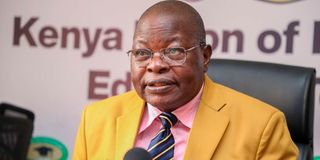
The directive will have an impact on Kuppet secretary-general Akello Misori, who has been at the centre of controversy after pushing through changes to Kuppets's constitution, including the removal of the age limit for top officials.
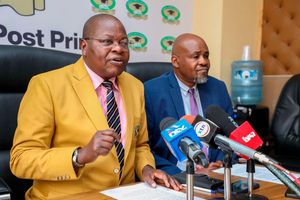
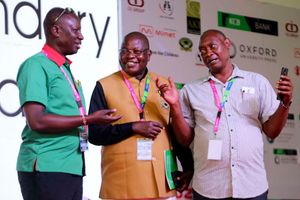
Kenya Union of Post-Primary Education Teachers (Kuppet) Secretary-General Akelo Misori (left) and Deputy Secretary-General Moses Nthurima address the media at the union’s headquarters in Nairobi on Monday, August 11, 2025.
Photo credit: Dennis Onsongo | Nation
According to the amended Kuppet constitution, which is the subject of a court case, only branch officials can vote at the national level, a move seen as paving the way for long-serving leaders to extend their stay in office.
However, the Employment and Labour Relations Court has issued conservatory orders halting the implementation of the changes.
The Secretary-General of Uasu Dr Constantine Wasonga, will also be affected by the conditions set by the registrar.
Some union officials had tried to push through changes to the constitution seeking to remove the two-term limit for the secretary-general. This was, however, halted by the court. Dr Wasonga has already served two terms as secretary-general.
The directive means Kuppet and Uasu will proceed with elections under their old constitutions unless the court lifts the ban. That would knock Mr Misori and Dr Wasonga out of the contest.
Kuppet Vihiga Branch Executive Secretary Sabala Inyeni, who will be contesting for the position of national organising secretary, faulted the national office for what he termed as “playing ping-pong” with members over the amended constitution, noting that while the matter is still in court, the leadership has been misleading members with claims of injunctions and rulings.
He maintained that the real issue is not whether the constitution was amended, but how the process was conducted.
He alleged that the minutes of the meeting were manipulated to show members had voted when, he claims, the process lacked transparency.
“The problem is not the new constitution itself, because there are parts we like and parts we don’t. The problem is the process. The voting was never done, yet cooked minutes were presented to show we participated. That is unfair, dishonest, and unacceptable. This is not about clout, it is about justice and fairness,” he said.
My Inyeni further criticised the proposed removal of age limit, saying it was a ploy by those in power to cling onto office indefinitely. He questioned why leaders were pushing to remain in office beyond 60 years while ordinary teachers are compelled to retire at that age.
He also condemned an amendment that individuals vying for national positions resign their current ones, describing it as a weapon by the national office to lock out rivals.
“They want to scrap the age limit so they can stay in power forever, yet teachers must retire at 60. Why don’t they also resign at 60? What is so special about them being above 60?
This is a deliberate attempt to entrench themselves in office. In 2021, they forced people to resign before contesting, and because no one challenged them, they got away with it.
This time, we are going against them, and we are ready to fight for ourselves,” he asserted.
Robert Miano, Executive Secretary for the Laikipia branch, opposed the push to scrap age limits for leadership positions, arguing that it undermines fair representation and democratic principles. He pointed out that the majority of teachers currently in schools are young and deserve leaders who reflect their age and experiences.
According to him, allowing individuals over 60 years old to dominate leadership while sidelining younger professionals would amount to misrepresentation and an erosion of democracy.
“I am not going to step down. I will not defy, but I will defend my position. The constitution is still under court process. We had issues with voting by acclamation. We were supposed to vote but no voting took place. The process was a fraud. There was no consultation, and we never voted,” he added.
Branch elections are scheduled for January 5 to March 31 2026, while national polls will run from April 1 to June 30, 2026. The registrar has further reminded unions that only fully paid-up members will be eligible to vote, and internal election boards must be constituted in line with existing constitutions.
In August, the Employment and Labour Relations Court blocked Dr Wasonga from amending the union’s constitution to remove term limits — a move that would have allowed him to remain in office indefinitely.
The judgment has renewed focus on a growing trend among union leaders seeking to extend their tenure, prompting concerns about the erosion of internal democracy and the creeping influence of political-style manoeuvres in union governance.
In a letter dated August 7, 2025, the Ministry of Labour and Social Protection’s Trade Unions Department, through Ms Kanake, recalled the Certificate of Alteration of Constitution issued to Uasu on August 6, 2025. The office observed that the amendments were procedurally and legally invalid.
"The review of the Labour Officer’s report has clarified that the constitutional amendment did not meet the required two-thirds majority as stipulated under the Uasu constitution. Only 278 delegates voted ‘yes’ out of 449, short of the 299 required to adopt the amendments," Ms Kanake stated.
The proposed amendments were wide-ranging. They allowed candidates for national positions to automatically become delegates, bypassing the previous requirement to seek a mandate from their respective chapters. They also introduced new positions, such as a woman representative, which some members argued added little value.