Lecturers in public university have threatened to return to the streets if the government fails to address concerns over funding and provide a clear plan for settling pending bills.
Universities Academic Staff Union (Uasu) Secretary-General Constantine Wasonga told a joint parliamentary committee that the return-to-work formula they signed a week ago had left two key issues in the union’s earlier demands unresolved.
The lecturers resumed duty this week after a month-long strike that ended with a Sh20 billion deal with the government on the 2025–2029 collective bargaining agreement (CBA).
“The storm might have subsided because of this return-to-work formula, but there are two issues that will make us rise again and they are funding from student fees and non-paid remittances of Sh100 billion,” he told a joint sitting of the National Assembly’s Labour and Education committees.
Universities Academic Staff Union Secretary-General Dr Constantine Wasonga (left) and his Kenya Universities Staff Union counterpart Dr Charles Mukhwaya during negotiations between the government and university workers' unions at the NSSF Building in Nairobi on October 26, 2026.
Photo credit: Lucy Wanjiru | Nation Media Group
The union wants the government to give clear legal and budgetary commitments that staff salaries and other employment obligations at universities will be funded through the National Exchequer and supported by parliamentary appropriations.
Dr Wasonga said the union remained concerned by indications that lecturers’ salaries could be funded through student fees, arguing that this would contradict the Universities Act, 2012, which provides for university funding through allocations approved by Parliament.
The Salaries and Remuneration Commission (SRC), in its submission before the committees, said the State Department for Higher Education had confirmed that funding for the proposed 2025–2029 CBA would be provided by the National Treasury through the student-centred university funding model.
“When SRC says it has received a letter from the Treasury and is already talking about funding through students’ fees, it makes us worried. That is not the law,” Dr Wasonga said.
The nationwide strike, which began on October 2, was called off on October 30. The lecturers agreed to return to work as negotiations continue on the second part of the CBA, which involved non-financial issues.
Labour Principal Secretary Shadrack Mwadime said the government intended to conclude negotiations on the non-financial components of the CBA by February 20, after which the agreement would be registered in court.
“We have been putting administrative measures in place and discussions on the non-financial aspects of the CBA would begin before the end of this week,” Mr Mwadime said.
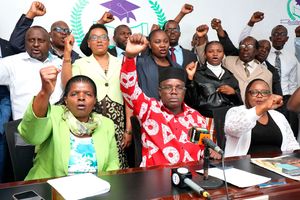
From left: Universities Academic Staff Union (UASU) National Chairperson Dr Grace Nyongesa, Secretary-General Dr Constantine Wasonga and National Trustee Jane Michael raise their fists in solidarity during a press briefing at the union headquarters in Nairobi on September 24, 2026.
Photo credit: Boniface Bogita | Nation Media Group
However, Dr Wasonga said the agreement had only eased the immediate dispute, leaving unresolved the question of sustainable funding for public universities and outstanding payments to staff.
SRC Chief Executive Officer Ali Abdullahi said the commission was ready to facilitate the registration of the CBA once the government confirmed the availability of the funds.
“After the government avails the Sh20 billion, the CBA will be brought to the SRC for a letter of no objection, after which it will be registered in court,” he said.
Inter-Public Universities Consultative Forum Chairperson Fred Barasa said the capacity of public universities to implement negotiated CBAs depended substantially on government funding.
“University councils cannot sustainably undertake additional recurrent financial commitments without corresponding provision for their implementation,” he said.