The Monday announcement by the Independent Electoral and Boundaries Commission (IEBC) that it is expanding diaspora voter registration to 14 new countries to make a total of 26 is set to open a new battleground for the 2027 presidential contest.
In a country where elections are won by just over 200,000 votes and the constitutional requirement is a 50 per cent+1 threshold, the diaspora constituency is set to provide a critical voting bloc for those in the State House race.
In the 2022 presidential contest, William Ruto garnered 7,176,141 votes (50.49 per cent) against Raila Odinga’s 6,942,930 votes (48.85 per cent) — a margin of only 233,000 votes, making it one of the closest presidential races in the country’s history.
With the numbers being close, the diaspora vote, if brought on board, may play a significant role in determining the winner in the presidential contest in 2027.
According to documents the electoral agency presented in Parliament, the commission intends to expand diaspora registration and voting to include Saudi Arabia, Botswana, Oman, Australia, Sweden, Switzerland, the Netherlands, Ghana, Italy, Democratic Republic of Congo (DRC), Nigeria, Ireland, Turkey, Ethiopia, China (Guangzhou) and Mozambique, as well as mobile centres in South Africa, Canada, the UK and the US.
Kenya’s population in the diaspora has been on the rise, with the United States having the highest number, estimated at 600,000 as of earlier this year. The United Kingdom has 200,000 Kenyans, while the Middle East — Saudi Arabia, United Arab Emirates (UAE) and Qatar — has at least 55,000 Kenyans.
Canada, Germany and Australia have at least 13,000 Kenyans.
There are also thousands of Kenyans living in neighbouring countries such as Tanzania, which hosts at least 50,000 Kenyans, and Uganda, with 60,000, while others are spread across Rwanda, Burundi and other East African countries.
The porous borders within the East African Community facilitate the movement of many undocumented persons.
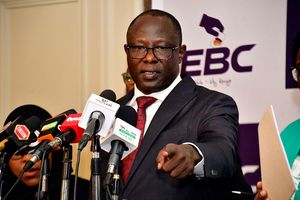
The Independent Electoral and Boundaries Commission Chairperson, Erastus Ethekon.
Photo credit: File | Nation
In a bid to achieve the registration of new diaspora voters, the commission said it needs Sh502 million but has only been allocated Sh400 million, warning that the deficit risks jeopardising the commission’s plans for diaspora activities.
The commission chairman, Erastus Ethekon, said that Kenyans residing outside the country have a constitutional right to participate in the electoral process.
In expanding diaspora registration, Mr Ethekon said the move is in line with Article 82(1)(e) of the Constitution, which requires the progressive registration of citizens residing outside Kenya and the progressive realisation of their right to vote.
“The Commission has approved the process for mapping additional countries to enhance participation of Kenyans abroad, with diaspora registration scheduled to be undertaken upon the launch of Enhanced Continuous Voter Registration Phase II (ECVR II), in accordance with the applicable legal and operational framework,” Mr Ethekon said.
Voter registration of Kenyan citizens residing outside Kenya was initially undertaken in a limited number of countries during the 2013 General Election, and the reach was subsequently expanded in successive General Elections, extending to 12 countries in the 2022 General Election.
“The Commission therefore wishes to clarify that diaspora voter registration is not a surreptitious or informal process. It is a constitutionally contemplated and progressively implemented electoral function, undertaken through designated mechanisms and under the supervision of the Commission,” Mr Ethekon said.
In April this year, the commission urged the National Assembly to either amend Regulation 34(2) of the Elections (Registration of Voters) Regulations, 2012, in order to allow it to register Kenyans in the diaspora outside the current designated areas.
Currently, the regulations limit voting and registration of voters to Kenyan embassies, high commissions and consulates.
Article 38 of the Constitution guarantees every adult the right to be registered as a voter and to vote without restrictions.
Further, Article 82 requires electoral law to provide for the progressive registration of citizens residing outside the country and the progressive realisation of their right to vote.
As of 2025, data from the Ministry of Foreign and Diaspora Affairs indicates that there are an estimated 1,464,676 registered Kenyans spread across 111 countries.
The commission, however, says that out of the 1,464,676, only 62,688 are registered with Kenyan diplomatic missions and just 10,443 as voters, leaving out 1,454,233 eligible Kenyans who are locked out of participating in elections.
Regulation 34(2) of the Elections (Registration of Voters) Regulations only allows voter registration and elections abroad in countries where Kenya maintains an embassy, high commission or consulate.
In June this year, a section of Kenyans in the diaspora challenged the provision, calling for an expansion of the electoral areas to accommodate more diaspora voters.
The petitioners told the court that the restriction created indirect discrimination by favouring those living near diplomatic missions while disadvantaging those residing far away from the officially designated voting places.
The High Court, however, dismissed the petition and instead called on IEBC to ensure gradual expansion of the diaspora voting framework.
Kenyans residing in large countries such as the United States, Canada and Australia are forced to travel thousands of kilometres to get to designated voting areas, a factor that locks out many from exercising their political rights.
Registered diaspora voters increased from 4,223 in 2017 to 10,444 in 2022.
IEBC officials compile data at the national tallying centre at Bomas of Kenya on August 11, 2017.
Photo credit: File | Nation Media Group
Kesses MP Julius Rutto challenged IEBC to ensure that all eligible Kenyans living in the diaspora are registered as voters and participate in the 2027 elections.
“There are many Kenyans outside the country who can participate in meeting the 50+1 threshold. The question we must ask is whether IEBC is prepared to bring them on board,” Mr Rutto said.
“We need IEBC to register those Kenyans abroad who have shown interest in participating in the 2027 elections, whether they are in Australia or any part of the world,” he added.
Already, the National Assembly Justice and Legal Affairs Committee is pushing for an amendment to the Elections Act to allow holders of expired passports to vote if they used the document for registration as voters.
“If you have a passport, even if it has expired, you don’t cease being a Kenyan. It is only that you cannot travel using it, but for the purposes of elections, we can’t disenfranchise you by saying you can’t vote,” said committee chairman George Murugara.
Currently, Regulation 37 of the Elections (Registration of Voters) Regulations, 2012, requires Kenyans living outside the country to be holders of valid passports to apply for voter registration.
However, Kenyans residing within the East African Community are exempted from the provision and are allowed to register using their identity cards (IDs).
Interior Cabinet Secretary Kipchumba Murkomen has maintained that every Kenyan, regardless of where they are staying or where they are doing business, so long as they are Kenyans, has a right to be given an identity card and to vote in the next elections.
“Those who went to work in Uganda haven’t ceased being Kenyans. Even those in the USA should be given IDs and vote in our Embassies,” Mr Murkomen said.
“We want to urge IEBC to give Kenyans an opportunity regardless of where they are in the world because it’s their constitutional right to choose a president of their choice regardless of where they are, and that’s why we have a diaspora vote,” he added.
Diaspora remittances hit a record Sh931.8 billion in 2025, up from Sh637.3 billion in 2024, making overseas Kenyans one of the country’s largest sources of foreign exchange. Hence, the diaspora constituency cannot be ignored by any presidential hopeful.