Presidential election challengers must prove more than voting irregularities to overturn a declared result, Supreme Court Judge William Ouko has said, stressing that serious breaches require credible evidence.
Justice Ouko said petitioners must demonstrate that alleged illegalities either affected the result or damaged the election’s integrity so fundamentally that no reasonable court could uphold it.
“The onus is on the Petitioner to prove that the election was so badly conducted and marred with irregularities and illegalities that it does not matter who was declared the winner. In other words, the election was marred by many irregularities, the cumulative effect of which fundamentally and negatively impacted the integrity of the election,” he said.
“It is not every infraction of the law that will lead to nullification of an election,” he added, recalling that before the 2010 Constitution, presidential disputes faced procedural obstacles.
In the 1997 challenge, Mwai Kibaki’s petition against President Daniel arap Moi was dismissed for want of personal service.
Justice Ouko said the decision illustrated a system unable to offer a substantive avenue for resolving disputes over the presidential mandate.
The weaknesses became more serious after the disputed 2007 election and the violence that followed. The Kriegler Commission reported concerns over public confidence in electoral and judicial institutions.
Mr Ouko said the crisis showed that unresolved electoral disputes could move from constitutional institutions into the political arena.
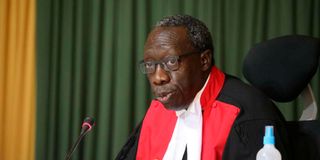
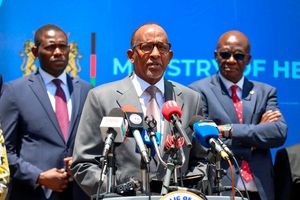
Supreme Court judge William Ouko.
Photo credit: File | Nation Media Group
The 2010 Constitution responded by giving the Supreme Court exclusive original jurisdiction over presidential-election petitions. Judge Ouko described this as a deliberate design intended to provide authority and finality when the country’s highest office is contested.
The legal framework requires a petition to be filed within seven days of the declaration of results. The court must determine it within 14 days, while a fresh election must be held within 60 days if the election is invalidated.
“Expedition, however, must not be conflated with haste,” Mr Ouko said, adding that speed must be balanced with fair hearing and due process.
The judge said the petitioner carries the legal burden throughout. However, the evidential burden may shift when a party presents enough material to require a response from the opposing side.
He distinguished ordinary civil proof from the higher threshold used in presidential election litigation. Where criminal or quasi-criminal conduct is alleged, proof beyond reasonable doubt applies. In other claims, the threshold is higher than a balance of probabilities but lower than the criminal standard.
Mr Ouko acknowledged that this approach remains debated. He questioned whether requiring criminal-level proof in election proceedings creates difficulties where the same conduct may later be considered by a criminal court. He also noted that election courts should not conduct criminal trials or determine criminal guilt.
The lecture revisited Section 83 of the Elections Act, which sets out the circumstances under which an election may be nullified. The provision became contentious after Parliament amended the wording in 2017, replacing the disjunctive test of “or” with the conjunctive “and”.
Kenyan voters wait in line to cast their ballots on August 9, 2022.
Photo credit: File | Nation Media Group
This meant that a petitioner would seemingly have to prove both a breach of constitutional or electoral law and that the breach substantially affected the election result. The amendment was later challenged in court and declared unconstitutional, restoring the original wording.
Under that test, a petitioner can succeed by proving either that the election violated constitutional or legal principles, or that non-compliance substantially affected the result. The Supreme Court’s official 2022 judgment similarly held that alleged irregularities must be of sufficient magnitude to affect the final result.
Justice Ouko said courts must examine both the existence of irregularities and their effect. “It is not every infraction of the law that will lead to nullification of an election,” he said.
He warned that broad accusations and multiplying claims do not strengthen a petition. Allegations must be pleaded with specificity and supported by cogent, credible and probative material.
A flawed process may survive scrutiny if breaches do not undermine constitutional standards or materially affect the outcome. Conversely, a combination of failures may invalidate an election where their cumulative effect destroys confidence in its integrity.
Mr Ouko said that the presidential-election jurisprudence remains evolving rather than complete. He said the Supreme Court’s enduring task is to ensure that every dispute leaves the constitutional order stronger, allowing political power to be settled through the ballot and the law.