Even as police paraded three arrested goons over the attack on Vihiga Senator Godfrey Osotsi in Kisumu on Wednesday, the real architects of Kenya’s rising wave of organised violence remain in the shadows.
Behind every stone thrown, every church invasion, every property raid and every attack lies a well-organised chain of command—financiers, handlers and perpetrators—shielded by power, politics and entrenched impunity.
The question is no longer who the goons are, but who sends them, funds them and protects them.
Mr Osotsi was cornered and assaulted in broad daylight at a Kisumu shopping mall, an incident that has since become a metaphor for a country steadily normalising organised political violence.
The attack, captured on CCTV and corroborated by witness accounts, was not an isolated eruption of rage but a calculated act executed with cold efficiency, pointing to a system that has grown bolder and more entrenched.
Within hours, detectives from the Directorate of Criminal Investigations (DCI) arrested three suspects: Carlos Owiti alias Kalonje (24) from Nyalenda, Eric Otieno alias Dude (39) from Manyatta, and Vincent Odhiambo alias Tinga (27), also from Nyalenda in Kisumu.
“It was a very unfortunate incident and a primitive act against an honourable member,” DCI Director Mohamed Amin said.
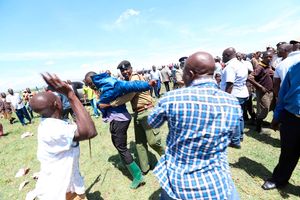
CCTV footage shows Vihiga Senator Godfrey Osotsi being attacked by a group of assailants at a coffee shop in Kisumu on April 8, 2026.
Photo credit: Video Grab
But the arrests appear to have only scratched the surface of a much larger problem: a sprawling underground network in which young men are recruited, deployed and discarded in a thriving economy of coercion and political violence.
Kenya’s recent political history has been punctuated by brazen attacks that expose the normalisation of organised violence.
In March 2023, goons invaded Northlands farm belonging to former president Uhuru Kenyatta in Ruiru, looting property and setting sections ablaze in a politically charged assault widely condemned.
Hours later, suspected gangs struck the Spectre gas plant linked to the late Raila Odinga in Nairobi’s Industrial Area, reinforcing fears of coordinated retaliation politics.
The pattern is not new. On November 10, 2021, during a tense political season, President William Ruto, then Deputy President, was forced to cut short a visit to Kondele in Kisumu after his convoy came under sustained attack from stone-throwing youths.
In 2026, similar scenes were witnessed outside Kisumu International Airport, where charged groups bayed for leaders’ blood, pushing security agencies into reactive mode.
Together, these incidents paint a troubling picture of a country where political rivalry increasingly spills into organised street violence executed by hired gangs operating with precision and impunity.
Last month, properties linked to former Cabinet Minister Raphael Tuju and ex-Principal Secretary Irungu Nyakera were targeted by marauding groups.
Church services from Mwiki to Kariobangi were disrupted by armed gangs, while in Nyeri’s Othaya area, security officers stormed ACK Witima church, leaving women and children injured.
Former Deputy President Rigathi Gachagua has publicly decried the attacks on places of worship, warning of a dangerous erosion of social order and moral fabric.
Residents scamper for safety after tear gas canisters were lobbed at Witima ACK Church in Nyeri County during a Sunday service that was attended by Rigathi Gachagua on January 25, 2026.
Photo credit: Pool
Interior Cabinet Secretary Kipchumba Murkomen has promised a crackdown, vowing to dismantle criminal gangs and prosecute both perpetrators and their financiers, but rights activists say little tangible action has followed.
Saturday Nation sent detailed questions to senior government officials charged with tackling the menace.
We sought comments from Mr Murkomen, Interior Principal Secretary Raymond Omollo, Inspector General of Police Douglas Kanja, government spokesperson Isaac Mwaura and police spokesperson Michael Muchiri.
We asked whether the government was aware of the trend, what measures were being taken, and allegations that politicians are using organised goons for political ends.
We also sought comment from National Intelligence Service Director General Noordin Haji on whether the agency had been caught flat-footed amid the recent wave of coordinated attacks.
The questions, and follow-up reminders sent to their known contacts, had not been answered by the time of going to press.
Speaking in Nakuru, Mr Murkomen promised decisive action.
“I condemn what happened to Senator Osotsi in Kisumu. It is unacceptable. I urge all leaders to put aside the politics of violence, goons and guns,” he said.
Mr Murkomen also defended Dr Omollo, who had been accused by the opposition of being linked to some of the goon attacks.
“I saw some opposition leaders mentioning my PS. I dare them to come out openly and denounce goons, guns and the people they are working with. I also ask the police to move with speed and arrest all those individuals the opposition is using, so that it becomes clear they are committed to fighting goon violence,” said Mr Murkomen in Nakuru.
Speaking in Lodwar, Dr Omollo said decisive action would be taken against all individuals involved in criminal gangs and political violence, describing it as a national security challenge.
“Criminal gangs and political goonism will not be tolerated. Any individual or leader involved will be held accountable in accordance with the law,” he said.
Critics, however, argue that the State’s response has been inconsistent—swift in rhetoric but weak in execution.
Ms Betty Okero, team leader of a civil society network, describes the crisis as self-inflicted and sustained by political patronage networks that have grown unchecked.
Inspector General of Police Douglas Kanja (left) and Interior Cabinet Secretary Kipchumba Murkomen.
Photo credit: Evans Habil | Nation Media Group
She says young men are mobilised, transported and sometimes deployed across counties with tacit approval from powerful actors seeking to project influence and intimidation.
“These youths are not acting in a vacuum,” she says. “They are organised, facilitated and sometimes even protected.”
To understand the present crisis, especially in Nyanza, one must return to Kisumu in the run-up to the 2013 General Election.
Two rival youth groups—the ‘American Marines’ and the ‘China Squad’—emerged, their names reflecting political identity and street notoriety.
The Marines publicly claimed to be a fitness-driven group, but residents say they were involved in extortion, turf wars and violent clashes that destabilised neighbourhoods.
The China Squad was widely believed to be aligned with supporters of former president Uhuru Kenyatta’s TNA, while the Marines were associated with Raila Odinga’s ODM. The violence was not merely criminal—it was political theatre staged through youthful militancy.
Boniface Mwangi, a rights activist, argues that the 2023 Northlands attack and Gen Z protests in 2024 and 2025 emboldened perpetrators.
Chris Owala describes goons as an “industry” fuelled by politicians and state systems that thrive on violence and inequality.
He says they kill, maim and intimidate with little consequence, undermining development and investor confidence.
The National Crime Research Centre reports that Kenya has at least 309 criminal gangs operating across counties, with Kisumu, Nairobi and Mombasa among the hardest hit.
These groups, the report notes, are no longer temporary tools but embedded institutions within communities.
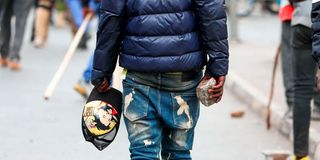
Armed goons run after demonstrators in Nairobi on June 17, 2025. The protesters were demanding justice for Albert Ojwang.
Photo credit: Evans Habil | Nation Media Group
The goon economy has evolved digitally, with so-called “goon-fluencers” using platforms such as X, TikTok and Facebook to showcase intimidation and coordinated violence.
A study by OdipoDev and Tribeless Youth notes that violence is increasingly packaged as content, merging propaganda with coercion.
This visibility has increased their influence, allowing political and business actors to leverage their online reach.
Experts warn that political patronage has made enforcement difficult, with arrests often followed by quiet releases.
They argue that dismantling the networks requires targeting financiers rather than foot soldiers alone.
Analysts warn that Kenya risks normalising violence as a legitimate tool of negotiation in politics and business.
Businesses face extortion, investors are deterred, and communities remain fractured under intimidation.
Experts recommend multi-sectoral reforms including youth employment, institutional strengthening, campaign finance transparency and strict enforcement of the law.
Rehabilitation programmes alone, they warn, are insufficient without economic reintegration.
As the country moves closer to another election cycle, parallels with the 2007 post-election violence and 2013 clashes are becoming increasingly evident.
Rights activist Audi Ogada says the networks are now more organised, more entrenched and more visible than ever before.