The government will have to spend up to Sh16 billion to keep fuel prices unchanged in April, as suppliers say the cost will go even higher for consignments covering the May-August period.
Projections by the Energy ministry and correspondence from a supplier under the Government-to-Government arrangement indicate that the US-Iran war could raise the cost of living for Kenyans.
Aramco Trading Fujairah (ATF) has written to Kenya, stating that the petroleum it has been supplying Kenya since Iran closed the Strait of Hormuz was sourced from locations outside the United Arab Emirates (UAE), where it is headquartered.
ATF is a UAE-based subsidiary of Saudi Aramco. The Saudi government is the majority owner of Saudi Aramco.
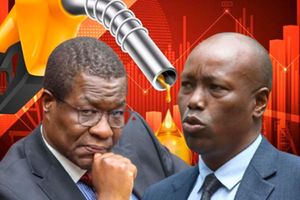
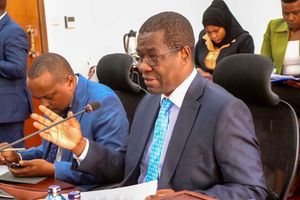
An internal brief prepared by then-Energy PS Mohamed Liban a day after the ATF letter indicates that the government will need Sh16 billion if it is to fully subsidise fuel prices and retain the current pump prices.
In the March cycle, which ends on Tuesday, the government subsidised fuel costs at the pump, leading to a retention of the previous prices.
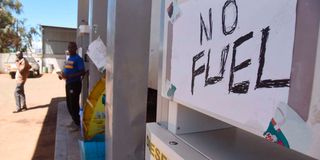
Empty fuel tankers queue near Shimanzi Depot in Mombasa on April 8, 2026 after fuel shortages hit the country.
Photo credit: Kevin Odit | Nation Media Group
Under subsidy, oil dealers retain the pump price announced by the Energy and Petroleum Regulatory Authority (Epra). The government then pays them the additional cost, with the money drawn from the Petroleum Development Levy.
In the March cycle, the landing cost of super petrol rose by $5.77 (Sh745.20) per cubic metre, while that of diesel increased by $49.65 (Sh6, 412.30). Kerosene increased by $40.66 (Sh5, 251.24) per cubic metre.
Epra said pump prices would remain unchanged for the March 14 to April 14 period, indicating the government subsidised prices for that cycle.
In his brief, Mr Liban said the Ministry of Energy and Petroleum had paid oil dealers money owed from the March cycle.
It means that for the government to retain the March cycle pump prices, it will have to nearly wipe out the Petroleum Development Levy kitty.
In a letter to Mr Liban on April 1, ATF said its sourcing of petroleum products from “other locations” has come at higher costs, which it would push to Kenya.
The Saudi firm did not, however, indicate which countries it has sourced the petroleum for since the closure of the Strait of Hormuz.
The letter did not specify by how much the prices will rise, but indicated that Government-to-Government shipments arriving in Mombasa from April 26 would be affected.
The letter has revealed some of the fine print contained in the Government-to-Government agreements Kenya signed with the UAE and Saudi Arabia.
Some clauses of provide for Saudi Arabia and UAE to push up the cost of petroleum sold to Kenya in the event of Material Adverse Change (MAC).
MAC events are significant developments which affect the execution of contracts. Such include war, route closures, extreme rise in cost of sourcing products among others.
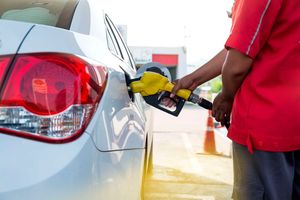
An attendant at Eon Petrol station in Homa Bay Town puts fuel in a plastic water bottle on April 8,2026. Fuel shortage has hit the town.
Photo credit: George Odiwuor | Nation Media Group
The Iran war has allowed the two Gulf states to initiate price increases to cushion themselves from the higher costs of sourcing for fuel from other countries, and the resultant higher freight and premium costs.
It is emerging that conflicts are among factors that allow the Gulf states to abandon price caps under the contracts and increase fuel costs.
“The situation (Iran war) has forced us to secure cargo from alternative locations in order to meet our contractual obligations. Sourcing from these locations will extend delivery timelines and, when combined with the current elevated price environment, will directly and materially affect the price at which we source our cargo,” the firm said in its April 1 letter to Kenya’s State Department of Petroleum.
“We are of the view that the above constitute a MAC Event as defined under the Master Framework Agreement. We would like to formally request that the prices of the following upcoming shipments be amended as follows…”
The letter lists six consignments of diesel, each 85,000 metric tonnes and which are to land in Mombasa between April 26 and June 26 as those that will be affected.
The brief also indicates that Mr Liban, then-Epra Director-General Daniel Kiptoo and then-Kenya Pipeline Company (KPC) boss Joe Sang defied a directive by Energy Cabinet Secretary Opiyo Wandayi to stick to the Government-to-Government framework with all imports.
Mr Liban, Mr Sang and Mr Kiptoo resigned amid an investigation into them, One Petroleum Ltd and Oryx Energies over the importation of petroleum outside the Government-to-Government framework.
Mr Liban explained in the brief that a Sh12 billion consignment of super petrol imported by One Petroleum arrived in Kenya on March 27 to avert a stock run out. He added that another consignment imported by Oryx Energies was en-route.
Mr Liban then stated that Mr Wandayi had directed that petroleum imports be done exclusively under the Government-to-Government plan.
“The Cabinet Secretary ... has directed that even as appropriate stop gap measures are taken to mitigate the situation as it evolves, all the imports are to be within the G-to-G framework,” he said in his brief.