Despite frozen bank accounts abroad, indictments of arms traffickers in Western courts, and Kenyan police patrols now escorting convoys through Port-au-Prince’s most dangerous neighbourhoods, Haiti’s gangs remain rich — and growing richer.
Each time one revenue stream is squeezed, another opens.
When international forces secure ports, gangs intensify kidnappings. Fuel deliveries guarded by Kenyan patrols lead to higher extortion fees for traders and bus drivers. And when ransom networks are disrupted overseas, payments simply shift into cash exchanges inside Haiti’s slums.
This cycle underscores a sobering truth: global crackdowns struggle to keep pace with the street economies that sustain Haiti’s armed groups.
Haiti’s Finance Minister Alfred Metellus estimates gangs collect between Sh7.7 billion and Sh9 billion annually from extortion on cargo containers alone.
A report by the United Nations Integrated Office in Haiti (BINUH) shows gangs continue to set up illegal checkpoints on major roads.
A man holds placards near a burning barricade during a protest against gang-related violence and to demand the resignation of Haiti's transitional presidential council, in Port-au-Prince, Haiti, May 15, 2025.
Photo credit: Jean Feguens Regala
“According to local sources, trucks transporting food products or fuel from the capital to the southern departments of the country were forced to pay “passage fees” of up to 3,000,000 HTG (around 22,600 USD) for each journey,” the report reads in part.
Whenever disorder erupts, gangs profit and they choke off roads, seize ports, or kidnap in broad daylight. Every flash of insecurity translates directly into revenue.
Security expert George Musamali, who has followed the Multinational Security Support (MSS) mission since its launch, says gangs step in where the state is absent.
“Where the state is absent, gangs become the government. They issue taxes, regulate trade and profit from fear,” he said.
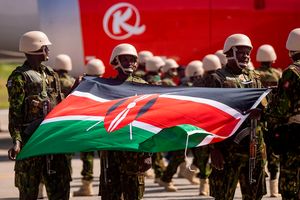
Kenya agreed to lead the MSS mission after appeals from Haiti’s then-Prime Minister Ariel Henry. For Nairobi, the deployment is both a chance to showcase African leadership in peacekeeping and a risky bet far from home.
Kenyan officers have gone beyond firefights. They have reopened blocked roads, secured fuel depots, and enabled trade without “gang taxes.”
“Kenya is interested in ensuring that Haiti is peaceful. That is the agenda,” Foreign Affairs PS Abraham Sing’oei said.
But the mission faces serious challenges: underfunding, slow logistics, and a limited mandate. The MSS was extended for a year but is now set to end in early October. Plans are underway to replace it with a new unit — the Gang Suppression Force (GSF) — tasked with directly dismantling Haiti’s criminal networks.
Meanwhile, Western governments have intensified financial pressure.
The US, Canada, and the EU have frozen assets, blocked visas and sanctioned Haitian gang leaders. In early 2025, Washington went further by designating two of the most violent gangs as terrorist organizations, criminalising any support from abroad.
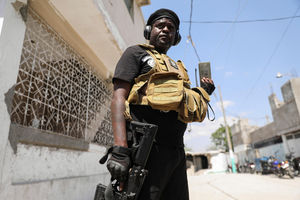
Haitian security forces patrol during a protest against insecurity, in Port-au-Prince, Haiti, April 16, 2025.
Photo credit: Fildor Pq Egeder | Reuters
American prosecutors have indicted middlemen accused of laundering ransom money through banks and remittance systems. Rewards have been placed on notorious gang leaders.
Yet most of these measures fail to touch the gangs’ core economy. Ransom and extortion payments are almost always made in cash and circulate locally — buying weapons, paying recruits, and bribing officials.
“Sanctions can hurt elites who hide money overseas. But the gangs live and spend in Port-au-Prince. They are immune to banking pressure,” explained Haitian human rights group Movement Unforgettable Dessalines Jean.
Corruption within Haiti’s political system also shields gangs. For decades, politicians have relied on them as enforcers, while officials quietly profit from smuggling and protection rackets. That symbiosis often blunts international efforts.
In August, police arrested former senator Nenel Cassy, accusing him of conspiring against the state and financing gangs. Images shared on Facebook showed him in handcuffs, flanked by heavily armed officers.
Former police officer Jimmy "Barbecue" Cherizier, and leader of an alliance of armed groups, speaks to a news outlet on a mobile phone during a news conference, in Port-au-Prince, Haiti, March 11, 2024.
Photo credit: Reuters
Cassy had already been designated a corrupt actor by the US in 2023 and was accused earlier this year of backing gangs behind deadly attacks in Kenscoff, an elite enclave near the capital.
For ordinary Haitians, the cost is devastating. Refusing to pay protection can mean arson or death. Families unable to raise ransom lose loved ones. Aid groups avoid gang-held neighbourhoods, leaving residents hungry and dependent on the very criminals who exploit them.
Kenya’s leadership of the MSS carries both promise and peril. A successful mission could cement Nairobi’s reputation as a peacekeeping powerhouse. Failure could damage its standing, drain resources, and put Kenyan officers at serious risk.
For now, the focus is on securing lifelines — roads, ports, and depots — to give Haiti’s police and judiciary space to rebuild. But analysts warn that unless these efforts are paired with deep reforms and humanitarian aid, gangs will simply adapt and keep finding ways to fund themselves.
In Haiti, victories are often won in daylight but undone by nightfall. For Kenya and its allies, the mission remains clear but complex: to prove that the combined weight of sanctions, patrols, and aid can one day outweigh the gangs’ grip on money and fear.
Until then, global crackdowns will keep colliding with local realities — and Haiti’s gangs will keep counting their cash.