Nearly two decades after Kenya signed an international treaty against enforced disappearances, rights groups and victims' families are pressing the government to criminalise the practice, saying the absence of a specific law has hindered efforts to hold security officers accountable when they are suspected to be involved.
They argue that the legal vacuum has complicated efforts to prosecute police officers and other state agents implicated in dozens of unresolved disappearance cases.
The push comes after rights groups documented a sharp rise in disappearances, with the Missing Voices coalition recording 55 cases in 2024, up from 10 the previous year, while the Kenya National Commission on Human Rights reported 82 cases since June 2024.
The campaign has intensified amid renewed scrutiny of abductions and disappearances that have sparked public concern and drawn condemnation from oversight bodies and international organisations.
Lawyers, victims' families and civil society organisations argue that Kenya's legal framework has failed to keep pace with the problem despite years of recommendations from justice-sector agencies and Parliament.
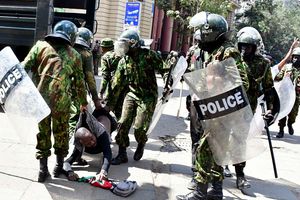
Police officers arrest a protester on Kenyatta Avenue in Nairobi during anti-Finance Bill protests on June 27, 2024.
Photo credit: Bonface Bogita | Nation Media Group
At the centre of the debate is Kenya's failure to enact a standalone law criminalising enforced disappearances despite signing the International Convention for the Protection of All Persons from Enforced Disappearance in 2007.
"We have no law in Kenya on enforced disappearance," said Julius Nyaga, a lawyer with International Justice Mission (IJM) Kenya. "So when people disappear through abduction by state security agents, it becomes difficult to push for accountability."
The lawyer says this means that the government is not legally bound by the international convention's provisions until it is ratified.
Mr Nyaga said prosecutors are forced to rely on offences such as abduction, kidnapping and torture, which do not specifically address disappearances allegedly involving state actors.
"The officers or persons arrested are charged with abduction with intention to kill under the Penal Code, which carries a small penalty of seven years. That is like a slap on the wrist," he said.
Rights groups say that the legal gap has complicated efforts to investigate cases in which people disappeared after being arrested or detained by security officers.
One of the cases cited by campaigners is that of Philip Otieno, who disappeared in February 2015 after an arrest by police officers in Nairobi's Kiamaiko area.
Investigations by the Independent Policing Oversight Authority led to recommendations that four police be charged with abducting him with intent to murder.
Activist Julius Kamau holds a placard reading “End State Abductions Now” as he protests along Kimathi Street in Nairobi on December 28, 2024. His demonstration aims to raise awareness about human rights abuses and demand accountability from government authorities.
Photo credit: Bonface Bogita | Nation
Another case involved businessman Daniel Baru, who disappeared in 2017 after being held at Kehancha Police Station in Kisii.
A High Court judge later found that six police officers were responsible for his disappearance and cited attempts to alter records relating to his detention. Baru remains missing.
For families, the unresolved cases have become symbols of a broader struggle for accountability. To rights groups, they illustrate what happens when a country lacks a law specifically defining and punishing enforced disappearance.
Civil society organisations, including IJM, the Kenya National Commission on Human Rights, the Missing Voices coalition and other advocacy groups, have spent years lobbying for legislative reforms.
Their push has included petitions, public campaigns, parliamentary engagement and consultations with justice-sector agencies.
According to Mr Nyaga, civil society groups prepared draft legislation and submitted proposals through the Attorney-General's office, but the process has stalled before reaching Parliament.
"The Attorney-General should be accountable. The Attorney-General is responsible for introducing a bill to Parliament to domesticate the international treaty that Kenya signed," he stated.
He said stakeholders, including the Office of the Director of Public Prosecutions, agreed as early as 2021 that enforced disappearance should be criminalised.
"The lack of a substantive law is encouraging security agencies to continue with enforced disappearances," Mr Nyaga said.
The debate comes against the backdrop of data showing disappearances remain a concern despite fluctuations in reported cases.
Plainclothes police officers arrest demonstrators in Nairobi on June 6, 2023, during protests against the Finance Bill 2023.
Photo credit: Evans Habil | Nation Media Group
The Missing Voices coalition documented 55 enforced disappearance cases in 2024, compared with six in 2025. The Kenya National Commission on Human Rights (KNCHR) has separately reported dozens of verified disappearance cases over the years.
The issue has also attracted the attention of lawmakers. A Senate committee that investigated extrajudicial executions and enforced disappearances previously recommended that the government begin the process of ratifying and implementing the international convention. That recommendation has not been implemented.
For victims' families, the delay means continuing uncertainty over missing relatives and unanswered questions in cases that have stretched for years.
The campaigners say it means the struggle has shifted from documenting disappearances to persuading the political establishment to create a legal framework they say is essential for accountability.
Until that happens, they argue, Kenya will continue relying on laws designed to punish ordinary abductions rather than a crime that rights groups say strikes at the heart of constitutional protections against arbitrary detention, torture and unlawful deprivation of liberty.
"Kenya signed an international treaty nearly, yet Parliament has never enacted a law criminalising enforced disappearances, leaving families without justice and prosecutors relying on lesser offences while alleged perpetrators walk free," said Mr Nyaga.