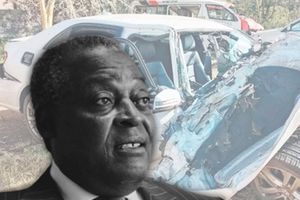
Cyrus Jirongo shot to national prominence through the notorious Youth for Kanu 92 (YK92), the vehicle that former President Daniel Moi used to campaign for re-election into office following re-introduction of multiparty democracy in the country.
To many, he stood as the epitome of all that was wrong and rotten with Kenya’s politics. The mention of his name stirred the bitter memories of the economic decadence triggered by the printing of campaign funds to finance Moi’s re-election in 1992, triggering massive inflation. To his family and friends, however, he was a brilliant businessman and dealmaker who sniffed out opportunities from a mile , and generous to a fault.
Hounded by powerful interests in government whose paths he had crossed and fearing for his life, Jirongo decided to write his personal account of how the infamous Sololo Outlets Limited, which nearly bankrupted the National Social Security Fund (NSSF) was formed.
In a two-part series, we publish excerpts of this personal statement:
As the fire burnt politically, the Sololo contract with NSSF also started burning, with the head of civil service and secretary to the cabinet, Prof Philip Mbithi, taking advantage of my disagreement with those in high offices in the government.
Former head of civil service and secretary to the cabinet Prof Philip Mbithi.
Photo credit: File | Nation Media Group
The Head of State relied heavily on the offices occupied by my enemies, who were used to the maximum by Mbithi to perpetuate a personal vendetta against me.
How else could I have overnight become a debtor to Post Bank, have a contract terminated for no reason at all, be a wanted man by the security forces of the country as if I were a thief? I became the most dangerous political enemy to his excellency President Daniel Arap Moi, a man who had promised to protect me and a man I had worked for with all my devotion.
I was telephoned by the State House Comptroller Abraham Kiptanui. He informed me that the Head of State wanted me, together with senior officials of the YK'92 lobby group, whose chairman I was, to meet him early afternoon. The phone call was in mid-morning.
Former State House comptroller Abraham Kiptanui addresses journalists in Eldoret, Uasin Gishu County, on March 12, 2014.
Photo credit: File | Nation Media Group
I quickly summoned those available, and at 2.30pm we were all at State House. Those who were present at State House on the YK92 side included the Late Victor Kebeney, Jim Choge, Fred Amayo, Sam Nyamweya, Kim Kung, Caleb Kositany, Bartonjo Chesaina, Abdulrahman Bafadhil and myself.
At the meeting, the Head of State was in the company of Kanu Secretary-General J. J. Kamotho and Mr Kiptanui.
The meeting turned into one of the nastiest experiences in my life. One of the YK'92 members had been enlisted by those opposed to me. He had been given some alarming information against the country. He talked about the issue, which was taken very badly by the Head of State.
The actions that followed are the basis of the dispute between Sololo Outlets Limited and NSSF. They are also the basis of numerous law suits and many attempts by me to salvage the situation and numerous proposals made by me that would, in some cases, seem as if Sololo Outlets Limited borrowed from Post Bank.
In the meantime, the supervision agreement that was to have been prepared by Onalo and Company Advocates was not forwarded to us until the 17th of March 1993. It is in my view a reflection of the manner in which the NSSF board was operating that their lawyers took so long to come up with this agreement for supervision just when the project was nearing completion.
The economic situation in the country at this time was critical, and the finances of the whole of the banking sector were under critical scrutiny by the World Bank. Inspectors from the Central Bank of Kenya were in the process of inspecting records of all banks in the country to determine their viability.
This, coupled with the dispute between Postbank Credit Limited (PCL) and NSSF, resulted in the General Manager of PCL 'requesting’ Sololo to assist them in covering up the unsecured overdraft of Sh600 million given to Sololo.
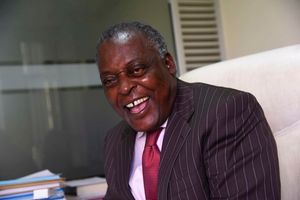
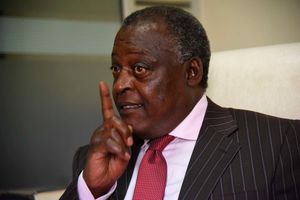
Cyrus Jirongo during an interview at his Mayfair Suites offices in Nairobi on October 28, 2021.
Photo credit: File | Nation Media Group
Sololo was requested to sign debenture documents in favour of Postbank so that when the inspectors came, they would be satisfied that the amounts advanced were properly secured. My contention is supported by the fact that at the time these debentures were being signed, the only property owned by Sololo was the land and the buildings that were being developed.
A debenture, therefore, was not valid as there was no property over which it would crystallise. The titles of the Sololo property were already in the hands of PCL, in favour of NSSF. The request to sign these debentures was made in a letter dated 17th March 1993. At the time, I was being coerced by the Postbank Credit Limited to sign the debenture; the fraudulent and flimsy reason given was that the political situation was running out of control.
All sorts of accusations were being levelled against me to the president. His son and a close friend of mine came to my house. He pointed out to me that whatever had been planned against me was extremely dangerous. He told me that even he was unable to help and that I had run out of time.
A close friend who was then the Presidential Escort Commander also explained to me how tapes were being manifested to show or prove to the Head of State that I was against him and of no respect at all for him.
The director of intelligence and the intelligence officer in charge of Nairobi had erased words from the following statements on tape to bring out a completely different meaning:
"Mr Jirongo, what do you think Mzee should do with the Cabinet appointments, its taking too long before one is appointed?
"Mr Jirongo, how much money does Mzee owe you?"
This was then presented to the president by the Nairobi Intelligence boss, who informed the president that I was shouting my purported remarks in a bar while totally drunk.
It is important to know that the director of intelligence and also the Nairobi Area intelligence boss were all loyal to Mbithi.
At that moment, I never connected all these events to the signing of a debenture and the purpose of the debenture.
While the dispute regarding the Sh600 million was simmering, Postbank Credit Limited, in a letter dated 2nd April 1993, sent a valuation report of the project to the board of trustees, which report was received and a confirmation given on 6th April 1993. This was followed by a demand by PCL for a further sum of Sh300 million in the letter dated 7th April 1993. This would have made a total of Sh1.2 billion, which was the original contract sum.
This money was not forthcoming. Instead, we received a letter on 29th April 1993 demanding over Sh1.4 billion and further threatening to enforce the terms of the “debenture". This took us by complete surprise. By this time the project had stalled due to the dispute between the various parties over money.
I had also quarreled with an aide to the president, whose title and work at State House was difficult to explain. He was quite close to the president. He had warned me to watch my steps and that he was going to deal with my shadow Cabinet. He told me that taking over a government was not easy and that the people I was planning with were known.
I was in utter shock and disbelief. My only reaction was to explain to him exactly what I thought he was. I told him that as far as I was concerned, if it were not for the president, he would have been a tout in town, and that his allegations could only be sold and believed by people of his calibre.
The aide was quite close to Prof Mbithi. It was now clear to me that Mbithi was determined to see me finished at whatever cost. I made desperate efforts to see the Head of State to explain my side of the story, but it was totally impossible. I came to terms with the situation and decided to deal with the events as they came.
I wrote to the NSSF board on 4th May 1993 outlining the problems I was experiencing because of the financial constraints. This was followed by another letter of 7th May 1993, again pleading for funds to get the project off the ground. Again, full particulars of the project estimates were forwarded to the fund.
Throughout the first weeks of May, we received constant demands to regularise the accounts with Post Bank Credit Ltd.
In my letter to PCL dated 19th May 1993, I requested the bank to hold any precipitate action pending a decision from the NSSF board, which was to meet on the 20th May 1993. I also expressed my concern to PCL that they did not appear to be keen on enforcing payments due to them from NSSF pursuant to the memorandum of understanding. Instead, they were more interested in enforcing a debenture whose original purpose had nothing to do with the disbursement of these funds.
At this moment, every machinery put in place to destroy me was now at full throttle.
The then deputy director of intelligence, who was a good friend, told me that the Nairobi area Intelligence boss had a report that I was importing arms to cause chaos and assassinate the Head of State, among other things.
The intelligence had picked a conversation between myself and a Mr Pip Birtwhistle, a British national who dealt in security equipment and hardware. The British gentleman had sought to know whether there was a good chance to sell small arms to the Department of Defence.
The whole tape had been edited to imply that I was importing arms. The said gentleman was a personal friend, and he had done many previous deals with the government. In many cases, I was never even involved. He sold a lot of equipment to the Kenya Wildlife Service, he sold rifles to the General Service Unit, and he did business with various government departments. The various branches of the police force descended on me.
I was first picked up from my office by a team of police officers from C.I.D. headquarters. I was to make a statement on the issues discussed between YK'92 officials and the Head of State.
Then I was again picked up to go to all the houses I lived in with a team of CID officers to "search for arms".
The officers were under instruction to plant arms in my houses and arrest me for possession of illegal arms. The leakage of this news to me by a close friend helped me to insist that the search would be carried out in the presence of the Press. I had already made arrangements for the Press to be called in when the officers came to arrest me. Fortunately for me, the Press arrived in time, and the search was conducted in their presence. Nothing was found.
Again, a lady by the name of Mary Wakhungu called me and informed me that she had been recruited by the late Victor Kebeney and the then Commandant of the Presidential Press Unit to purchase illegal arms from the Kenya-Uganda border and bring them to Nairobi.
The arms were to be thrown over the fence to my compound, where they would be found, and Mary would have "admitted" having been sent by me to purchase the arms.
She was also to testify in court that the arms were to be used by me to assassinate the Vice President George Saitoti, Mr Nicholas Biwott and Mr Gideon Moi.
l decided to make contact with anyone I believed was my friend, including the Press, to pre-empt the intended plot.
The lady was later charged in court with giving false evidence to the police, despite the fact that I had made the report to the police myself, revealing to them the whole plot. She was found "guilty" and fined Sh10,000.
If this was not enough, again the police decided to raid me at six in the morning, starting from my house in Runda. I was telephoned by my wife in my other house in Lavington, where I had spent the night.
This time, I had no prior information on their strategy, and I decided to take off and hide as I tried to find out their latest strategy.
As this was happening to me, the Sololo site in South B had been taken over, and a team of 70 quantity surveyors, engineers and architects from the Ministry of Public Works were busy measuring the works undertaken by me.
I was at the same time expected to be on the site with my team of representatives! This is how fraudulent the whole issue was being handled by Mbithi and his allies. The NSSF had given me 48 hours to avail myself on a site guarded by the Kenya Police, who at the same time were more than thirsty for my blood.
After the attempted arrests had failed and I was now in hiding, I decided to make my last attempt to contact the Head of State. Using my cellular phone, I telephoned Kabarak, the president's residence. I was transferred to the then deputy comptroller of State House, who at the time was working closely with Mbithi. He talked to me, and the only thing he could tell me mockingly was: "Aah, you mean it is possible for what you are saying to happen to the mighty Jirongo". I was disheartened. The world seemed to have collapsed on me. I remained in hiding for about one week. I decided to do something about the whole episode. By this time, I was being looked for everywhere in the country.
I decided to call my lawyers at the time, who were Mr Muthoga and Mr A. R. Kapila. The two were senior lawyers in the country. Kapila had appeared for the late President Kenyatta in the infamous Kapenguria trial. After lengthy discussions with the lawyers at A. R. Kapila's house, we decided that instead of going to court to obtain bail, we go to CID headquarters and confront the director of ClD.
This was around the 26th May 1993. The director of CID agreed with my lawyers that there was no crime I had committed, and that he didn't understand what was actually going on. He requested that we wait outside as he consulted both the Head of State and the head of civil service.
We waited from 8am to 6pm when he called us into his office. He informed my lawyers that I could only be released on the undertaking that they would bring me back first thing the following morning.
In the meantime, the newspapers were screaming with all sorts of headlines. We returned the following day as directed by the CID director.
We were kept waiting without any communication as to what was being planned. This went on for about eight days. I would report every day and wait the whole day, and then be asked to report the following day.
On 3rd June 1993, my lawyers were asked to undertake to hold all my properties on behalf of the director of CID I had been requested on 31st May 1993 to authorise Muthoga to release all title documents of any properties to the director of CID.
I then continued reporting to the C.l.D offices and their headquarters on a daily basis. I was sometimes engaged in writing numerous statements on all sorts of subjects under the directives of the then assistant Commissioner of Police Peter Kimundi.
This went on and on 30th June 1993, or around that time, the head of civil service went on air and announced that 75 percent of the Sololo Outlets project was confirmed complete. He explained that a team of 70 professionals in the construction industry from the Ministry of Public Works had undertaken the measurements and confirmed them.
In summary, I wish to clearly state that at no time did Sololo Outlets Limited ever borrow from Post Bank Credit Limited. Any facilities extended to Sololo were always on behalf of the NSSF. All the letters of authority from the Treasury are clear on whose behalf any overdraft or any accommodation were done.