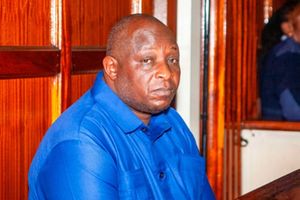
Deputy Inspector-General of Police Eliud Lagat never stepped aside from office following his alleged involvement in the death of teacher Albert Ojwang last month, fresh court filings reveal.
Instead, Mr Lagat says he only took administrative leave from work for 18 days, dismissing widely circulated reports that he had stepped down from his position as DIG of the Kenya Police Service.
He says the temporary leave of absence was to allow the Independent Policing Oversight Authority (Ipoa) to conduct investigations after mounting public pressure over Ojwang’s death at Nairobi’s Central Police Station.
In his response to a petition seeking his removal from office on grounds that the “stepping aside” was equivalent to resignation, Mr Lagat states that the leave was lawfully approved by his boss, Inspector-General of Police Douglas Kanja.
The petition was filed by rights advocate Eliud Karanja Matindi, a Kenyan residing in the United Kingdom.
“I categorically deny and rebut the allegations, insinuations, and inferences drawn by the petitioner to the effect that I unlawfully relinquished or vacated my office as Deputy Inspector-General or that I purported to appoint a successor, contrary to the Constitution or any written law,” says Mr Lagat in a replying affidavit.
Through his lawyer Cecil Miller, Mr Lagat explains that he formally applied for temporary administrative leave in light of the ongoing investigations which had attracted significant public concern and speculation.
Lawyer Cecil Miller. He is representing DIG Lagat.
To support his case, he has attached a copy of the leave application dated June 16, 2025 and a letter by IG Kanja dated the same day, granting the said leave.
“The said application was made voluntarily and in good faith, in line with the principles of public accountability, institutional integrity and preservation of public confidence in the police service. I reiterate that there was no misconduct on my part. No disciplinary process has been initiated against me by the National Police Service Commission (NPSC) or any other competent body,” he adds.
Mr Lagat wants the petition dismissed arguing that granting the orders sought would unjustly impede his discharge of duties, undermine operational continuity and go against public interest in effective law enforcement.
According to him, the application and petition for his removal are “mischievous, speculative and amount to an abuse of the process of the court.”
"The orders sought, if granted, would paralyse the effective functioning of the Kenya Police Service, especially in the absence of any credible evidence that I or the second interested party, Patrick Tito have acted unlawfully or unconstitutionally,” he argues.
Among the orders sought by the petitioner is the prohibition of Mr Lagat and Mr Tito from carrying out the functions of DIG pending the determination of the case.
The petitioner also wants the court to declare that the NPSC and the Attorney-General failed to fulfil their constitutional and statutory duties in the circumstances that led to Mr Lagat’s “stepping aside” and the appointment of Mr Tito to act as DIG, as notified in a letter dated June 16, 2025.
Mr Matindi further argues that Mr Lagat’s decision to “step aside” had no basis in the Constitution or any other legal provision, and therefore, should be interpreted as resignation.
However, Mr Lagat maintains that administrative leave is not a resignation, nor does it constitute abandonment or cessation of office.
He says the petitioner’s interpretation, that he resigned by implication, is baseless in law.
“The petitioner’s attempt to judicially interpret administrative leave as de facto resignation is legally untenable, speculative, and contrary to the binding legal and policy framework. Taking authorised leave, which is a statutory entitlement, cannot constitute a violation of the Constitution or of any petitioner's rights,” says Mr Lagat.
Milimani Law Courts in Nairobi.
Photo credit: File | Nation Media Group
He also says that his public statement which was widely interpreted to mean he had “stepped aside” was simply a communication informing the public of his temporary absence and clarifying continuity of command in the police service.
In the same announcement, he delegated his responsibilities to his principal assistant, Mr Tito.
The petitioner argues that Mr Lagat’s actions created a constitutional crisis and administrative confusion within the National Police Service.
But Mr Lagat says his delegation of duties did not amount to an appointment nor did it usurp the constitutional role of the NPSC.
“The second interested party’s (Mr Tito’s) acting capacity does not violate Article 245(3) of the Constitution, which outlines the structure of command but not the internal mechanisms of delegation or interim arrangements. The averment that my absence created a ‘leadership vacuum’ is speculative,” he states.
Mr Lagat says Mr Tito acted lawfully under Chapter 8 of the National Police Service Standing Orders which provides that the second in command shall assume leadership in the absence of the DIG.
He further argues that the petition fails to demonstrate a clear constitutional violation or link between the alleged misconduct and the reliefs being sought.
He contends that the petition is an attempt to convert an employment matter into a constitutional case.
The matter is scheduled for mention on Wednesday before the High Court in Milimani, Nairobi, for further directions.