Petroleum products users, including Matatu Owners Association (MOA), have declared a countrywide strike beginning Monday to protest the high pump prices.
Mr Cornelius Chepsoi, the chairperson of the Rig Owners Association, said the strike will continue until the government substantially lowers petroleum prices.
The strike action follows June 14, 2026, announcement by the Energy and Petroleum Regulatory Authority (Epra) upward review of petroleum prices for the month of May to June 14, 2026 cycle.
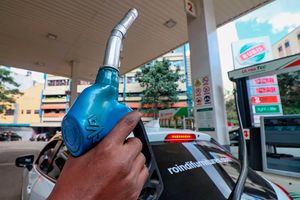
Fuel prices on display at a Rubis Energy service station on Koinange Street in Nairobi on May 15, 2026.
Photo credit: Wilfred Nyangaresi | Nation Media Group
In the pricing cycle, Epra raised the cost of diesel by Sh46.29 per litre while prices of super petrol increased by Sh16.65 per litre. Super petrol and diesel are consequently retailing at Sh214.25 and Sh242.92, respectively, while kerosene remained unchanged at Sh152.78.
“We announce as petroleum products dealers that from midnight today, there will be no movement across the country. We are suspending all travels, all heavy equipment use and we will cease all operations,” Mr Chepsoi, who spoke on behalf of all petroleum products users, said at a press conference at the Bomb Blast Memorial conference hall.
“Going forward, we shall not resume work until the government reduces the prices of petroleum in the country because it is affecting all of us. We are not simply speaking for the matatu owners but all users of petroleum products including mama mbogas and heavy machinery users.”
The steep prices come despite a Sh15.67 subsidies per litre of diesel and Sh98.60 per litre of kerosene. Petrol prices have not been subsidised as the State opts to reduce the burden on an Exchequer already grappling with subsidy arrears estimated at Sh17 billion.
The surge in pump prices reflects the impact of the US-Israel war on Iran which triggered a global rally in fuel prices in March and last month amid thinning supplies and the blockade of the Strait of Hormuz.
Kenya currently imports fuel under the Government-to-Government (G-to-G) and the suppliers had already warned of escalating prices of the fuel supplied.
Strait of Hormuz blockade
Constrained supply in the global market coupled with a logistical nightmare following Iran’s blockade of the Strait of Hormuz triggered a surge in prices of fuel in the global market.
The skyrocketing global prices of fuel have forced most countries to temporarily waive taxes in a bid to cushion consumers from costly fuel. Kenya was forced to halve the Value Added Tax (VAT) on fuel to eight percent last month as part of efforts to contain the prices.
But the latest prices have sparked public outcry over the heavy taxation of fuel even as other countries ease levies on the commodity.
Kenya charges seven levies and two taxes on fuel, making it one of the countries with the highest taxation on fuel in the world.
“We demand the immediate reduction of fuel prices. All stakeholders in the petroleum value chain have resolved here that we down tools effective midnight,” Mr Chepsoi said.
“All transport operations will remain suspended until the government drops the steep increase in petroleum products.”
Mr Chepsoi who was accompanied by Matatu Owners Association chairperson Albert Karakacha and several other leaders accused the government of insensitivity in raising fuel prices by a margin of 70 percent in under two months.
He said the country’s economy purely relies on diesel which has significantly increased rendering the users to incur heavy costs.
“The economy does not run on kerosene which is also jet fuel, we depend heavily on diesel whether one is in small or heavy industry. Borehole drillers, saw millers or light manufacturers are suffering due to increased diesel costs,” Mr Chepsoi said.
Separately, Kiharu MP Ndindi Nyoro asked the National Assembly Speaker Moses Wetang’ula to recall the House from recess so as to consider legislative amendments aimed at reducing the cost of fuel by more than Sh26.
“I respectfully write to request your consideration for the recall of the National Assembly from recess, pursuant to its mandate under the Constitution and the Standing Orders, to deliberate on urgent proposed legislative amendments aimed at reducing the cost of fuel in the country.,” said the MP in a letter to Mr Wetang’ula.
The former Budget and Appropriations Committee chairperson on Friday wrote to the clerk of the National Assembly proposing amendments to the Value Added Tax (VAT) Act and Road Maintenance Levy (RMLF).
He seeks to have petroleum products exempted from VAT, which is currently at 8 per cent after a recent reduction from 16 per cent.
The MP wants RMLF levy reduced to Sh18 from the current Sh25. He also asked the government to release Sh5 billion from Fuel Stabilisation Fund to cushion Kenyans from the high diesel prices that he said is set to hurt the economy.
"Diesel, as outlined in the circular, has a higher landed cost. For prices to come down to the levels I am referring to, we must allocate Sh5 billion from the Fuel Stabilization Fund to reduce the cost of diesel by about 24 shillings."
"These measures will help stabilise the economy by reducing erratic inflationary pressures and ensuring stability in the medium and long term. Failure to implement them will result in fuel prices that are too high for the economy." He also wants the importers and distributors margins reduced by Sh4.
But Energy Cabinet Secretary Opiyo Wandayi and top allies of President William Ruto have defended the latest increase in fuel prices, attributing the surge to global market disruptions caused by the escalating conflict in the Middle East.
Energy and Petroleum Cabinet Secretary Opiyo Wandanyi speaks during the handover ceremony at the KAWI complex on August 14, 2024.
Photo credit: Francis Nderitu| Nation Media
Speaking in Vihiga County while launching several Last Mile Connectivity Projects, CS Wandayi accused those blaming the Government-to-Government fuel importation arrangement for the high price of being dishonest.
"The Government to Government importation framework did not start yesterday or today. It was initiated in 2023 when Rigathi Gachagua was the Deputy President, and he was at the forefront of receiving the first shipment of fuel under the G to G framework. How is it that the arrangement is now considered bad?" wondered Mr Wandayi.
He added, "When he was Deputy President, it was good. That is hypocrisy! We cannot allow this. I have been very silent and restrained as a minister, but now I will respond."
He urged the former Deputy President to stop dragging President William Ruto's name into the fuel issue, emphasising that he is the Energy CS mandated to handle such matters.
"If you have any issues concerning this docket, you should face me. He should stop dragging the name of President William Ruto all the time. This obsession with President Ruto is sickening; you cannot, as a man, continue to cling to the name of a fellow man day in and day out," Mr Wandayi stated.
Speaking separately at a thanksgiving ceremony at Kapkoiga Girls High School in Kesses, Uasin Gishu County, allies of the President argued that the Kenyan government had done everything possible to cushion consumers from rising fuel costs while ensuring a steady supply of petroleum products.
“The government cannot be blamed entirely for the price hike considering that the supply and demand forces determining the cost of petroleum products are driven by external factors beyond Kenya’s control,” said Uasin Gishu Senator Jackson Mandago.
Kesses MP Julius Ruto said the government had made efforts to shield Kenyans from the full impact of the global energy crisis.
“The government has tried its best to keep fuel prices as low as possible despite pressure in the international market. What we are witnessing is a global crisis affecting many economies,” Mr Ruto said.
The sentiments were echoed by Basic Education Principal Secretary Prof Julius Bitok and Head of Public Service Felix Koskei.
The leaders dismissed calls for the reintroduction of fuel subsidies, warning that such interventions would place a heavy burden on the economy and negatively affect public finances in the long term.
According to the leaders, the government was instead focusing on sustainable economic measures aimed at stabilising the economy and protecting essential services.
They also defended President Ruto’s reforms across various sectors, particularly education, saying the changes were beginning to bear fruit despite criticism from some quarters.
“The country is recording steady economic recovery and reforms in various sectors, including education, are aimed at improving the livelihoods of Kenyans,” Prof Bitok said.
The remarks come amid growing public concern over the rising cost of living following the latest fuel price review, which is expected to trigger increases in transport fares and commodity prices across the country.
PHOTO | JEFF ANGOTE A section of Nairobi residents were forced to walk along Thika Superhighway on March 5, 2014 after Matatu plying that route went on strike citing increased parking fees by the county government.
Farmers in the North Rift region, regarded as the country’s food basket, said the rising fuel costs could force some producers to scale down acreage under cultivation due to higher operational expenses.
“Diesel is the backbone of crop production and the government needs to regulate prices to cushion farmers from high operational costs such as maintaining farm machinery and equipment. The increased fuel prices will raise the cost of crop production and animal husbandry, including feeds and acaricides,” said Ms Miriam Too, a farmer from Cherang’any in Trans-Nzoia County.
Mr Joseph Kirwa, a farmer from Ziwa in Uasin Gishu County, said the rising diesel prices would significantly affect farm operations and profits.
“It is ironical that diesel is costlier than petrol yet it is the backbone of production. This means we have to spend more to operate farm equipment and transport produce to markets, translating into lower profit margins,” Mr Kirwa said.
Reporting by Edwin Mutai, Barnabas Bii and Ruth Mbula