President William Ruto swept to power in 2022 promising a government anchored on the rule of law, repeatedly assuring Kenyans that court orders would be obeyed whether politically convenient or not.
Nearly four years later, judges across the country are increasingly being asked to compel compliance from the very officials in his administration entrusted with upholding the Constitution.
Cabinet secretaries, principal secretaries, police chiefs and constitutional office holders have been cited in a growing number of contempt proceedings, exposing an uneasy relationship between the Executive and the Judiciary and raising questions about whether resistance to court orders is becoming normalised within government.
The latest flashpoint involves Health Cabinet Secretary Aden Duale and senior health officials accused of disregarding orders stopping the establishment of a controversial Ebola quarantine facility at Laikipia Air Base for Americans exposed to the killer disease. Katiba Institute and the Law Society of Kenya say the officials proceeded with aspects of the American-backed project despite the court’s intervention.
Health Cabinet Secretary Aden Duale during an interview in Nairobi on January 26, 2026.
Photo credit: Dennis Onsongo | Nation Media Group
“The respondents have disobeyed these orders; there are numerous reports showing that they continue to partner with their counterparts in the United States to advance the establishment of the facility and have not made the disclosures,” Katiba’s advocate Malidzo Nyawa says in court filings.
However, Mr Duale denied the alleged defiance claims and said the Ruto administration is a law-abiding government. “We are a law abiding government and comply with court orders as per guidance given by court,” Mr Duale told the Nation when reached for a comment.
The officials have yet to be found guilty of contempt. The dispute is one of several high-profile cases testing the authority of the courts.
“It is on account of this precarious position in which the court finds itself arising from a series of direct disobedience meant to undermine its legitimacy and authority, that the Katiba Institute approaches this court. This court cannot be helpless or be reduced to babysitting its own court orders,” says lawyer Nyawa in the contempt application.
In Meru, Forestry Principal Secretary Gitonga Mugambi is in the spotlight following the construction of an airstrip in Imenti Forest even after the Environment and Land Court ordered the status quo to be maintained pending the hearing of a petition challenging the project.
Forestry Principal Secretary Gitonga Mugambi.
Photo credit: Bonface Bogita | Nation Media Group
Construction equipment was moved into the forest under heavy security as residents and conservationists protested. Mr Mugambi later publicly stated that the first aircraft would land on the airstrip within days, saying he was implementing plans conceived years earlier and intended to benefit the region. Contacted by Nation yesterday, Mr Mugambi did not provide a response by publication time, having indicated that he would comment on the allegations on Tuesday.
“I'm in some meetings. However, I will get back once I get some more information. I can only get back tomorrow earliest,” he responded.
Attorney-General Dorcas Oduor is also named in the Ebola facility proceedings over alleged non-compliance with disclosure orders.
Attorney-General Dorcas Oduor.
Photo credit: Billy Ogada | Nation Media Group
Environmentalist and investors, including Rhino Ark, which has invested more than Sh1 billion in conservation works around the Mt Kenya ecosystem, have opposed the project.
Rhino Ark warned that the proposed airstrip threatens a critical water catchment area, could disrupt elephant migration routes and maternity grounds, and may undermine one of the country’s most biodiverse forest ecosystems.
Battling contempt allegations
“The airstrip under construction will have long-term significant environmental impact on the Mt Kenya forest ecosystem, particularly the Upper Imenti Forest, an area of high biodiversity which serves as a critical water catchment area, elephant habitat and migratory route,” said Rhino Ark in a letter to the National Environment Management Authority (Nema).
Defence Principal Secretary Patrick Mariru is separately battling contempt allegations over the government's failure to pay more than Sh200 million awarded to former Kenya Defence Forces soldiers tortured following the 1982 attempted coup.
Defence Principal Secretary Patrick Mariru.
Photo credit: Dennis Onsongo | Nation Media Group
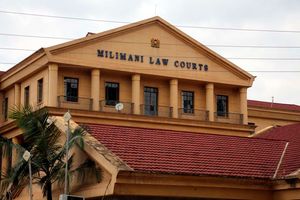
The court rejected budgetary constraints as justification for years of delay. The case is ongoing at the Judicial Review division in Milimani Nairobi.
Inspector-General of Police Douglas Kanja has also faced contempt accusations, including allegations that police failed to comply with court directives relating to the security of former Public Service Cabinet Secretary Justin Muturi.
IG Kanja was also put on the spot over police barricades in Nairobi city after litigants alleged that officers ignored court orders while restricting access to parts of the capital using razor-sharp barbed wires.
Inspector-General of Police Douglas Kanja.
Photo credit: File | Nation Media Group
In February 2026, the High Court in Kerugoya cited Treasury Cabinet Secretary John Mbadi and KRA Commissioner for Customs and Border Control Lilian Nyawanda for contempt after finding that duty-free rice imports had been processed contrary to its orders. The ruling has since been challenged at the Court of Appeal.
Asked yesterday about the contempt allegations and how the government balanced urgent economic decisions with its constitutional obligation to obey court orders, Mr Mbadi declined to address the allegations directly.
He referred queries to the Attorney General, saying: “AG can respond on this better as the lawyer for the Government.”
National Treasury and Economic Planning Cabinet Secretary John Mbadi.
Photo credit: File | Nation Media Group
Parliament itself was drawn into the debate after activists accused National Assembly Speaker Moses Wetang’ula of ignoring a February 2025 High Court judgement that found Azimio la Umoja-One Kenya Coalition was the Majority side in the House based on the outcome of the 2022 General Election.
The petitioners argued that Wetang’ula defied the ruling by subsequently maintaining Kenya Kwanza as the Majority coalition, prompting contempt proceedings against him.
However, recently a three-judge bench declined to cite the Speaker for contempt, finding that the earlier judgment was largely declaratory and that the applicants had failed to prove deliberate and willful disobedience of a clear court order. The dispute is at the Court of Appeal.
The Executive has consistently argued that governance realities sometimes complicate immediate compliance. Officials have cited national security concerns, food security, competing public interests and budget limitations in defending actions challenged in court.
Mr Evance Ndong, a constitutional lawyer, said the growing number of contempt allegations against senior officials should concern all Kenyans.
“This is constitutional recklessness that can leave us with no country,” he said. “The authority of the courts rests on the expectation that their orders will be obeyed. Once obedience becomes optional for those in power, you replace the rule of law with the rule of man, creating the conditions for a banana republic.”
Mr Peter Agoro, a human rights activist based in Nairobi, said the issue extends beyond individual cases.
“The concern is not simply whether a State official disagrees with a decision. The concern is whether court orders are increasingly treated as negotiable depending on who is affected,” he said. “If that perception takes root, it weakens citizens’ faith that the law applies equally.”
“Impunity ends when we, the people, stop tolerating it. When state officers defy court orders, they are inevitably inviting anarchy. The Constitution is the supreme law of the land and state officers are only enjoying delegated authority from the sovereign people of Kenya,” said Mr Agoro.
According to him, state officers are “subjects of the law in a Constitutional democracy like ours”.
Two years ago, President Ruto went on an all-out-war on the Judiciary, accusing some unnamed judges of working in cahoots with government critics to derail his administration’s flagship policies.
Following a string of court decrees against his key policies, including housing and social health programmes, the President at one point vowed to defy court orders that he argued would derail implementation of his party’s manifesto, which he described as a contract with voters who elected him into office.
“It is not possible that we respect the Judiciary while a few individuals, who are beneficiaries of corruption, are using corrupt judicial officials to block our development projects,” President Ruto said in January 2024.
President William Ruto assents to the Judges’ Retirement Benefits Bill at State House on March 9, 2026.
Photo credit: PCS
“We are a democracy. We respect, and we will protect the independence of the Judiciary. What we will not allow is judicial tyranny and judicial impunity,” President Ruto said at the time, drawing public condemnation.
Following weeks of sustained attacks on the Judiciary and judges over alleged corruption, President Ruto, Chief Justice Martha Koome and National Assembly Speaker Moses Wetang’ula held a meeting at State House to strike a truce.
During President Uhuru Kenyatta’s administration, the then Interior Cabinet Secretary Fred Matiang’i was found in contempt over the Miguna Miguna deportation saga before the decision was later overturned on procedural grounds.
Governments before and after the promulgation of the 2010 Constitution have faced criticism over delayed settlement of court awards and resistance to adverse rulings.
What appears to have changed is the frequency with which senior officials are now being named personally in contempt proceedings.
Legal experts and rights advocates caution that allegations alone do not establish guilt and that each case must be determined on its facts.
They also note that courts possess enforcement mechanisms designed to balance accountability with the practical realities of governance.