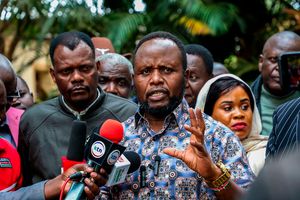
For years, political fortunes across the country could be shaped around elders sitting under a tree, where community leaders negotiated consensus and rallied voters behind preferred candidates.
From the coast, Mt Kenya, Rift Valley, Nyanza and Northern Kenya where negotiated democracy reigned supreme, elders’ word was almost final.
As the August 2027 General Election approaches, that old formula is facing a test as voters demanding to judge politicians for themselves, putting pressure on aspirants to prove their record, policies and ability to deliver.
The contest between traditional influence and direct voter power is already emerging across the country, as battles for President, governor, senator, MP and woman representative seats are expected to be fierce.
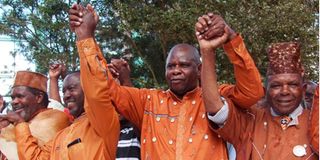
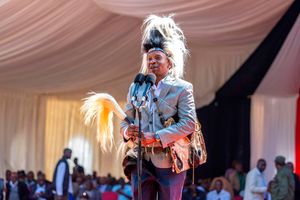
Luo Council of Elders led by Ker Odungi Randa during the ODM rally in Kisumu at Kirembe Grounds on May 31, 2026.
Photo credit: Alex Odhiambo | Nation Media Group
While elders remain influential in mobilising communities and brokering political consensus, a younger and more politically informed electorate is increasingly unwilling to treat their endorsements as automatic tickets to power.
The rise of social media has further weakened the monopoly once enjoyed by community power brokers. Candidates can now take their messages directly to voters through Facebook, TikTok, WhatsApp and X, while voters can scrutinise their promises and past performance in real time.
The result could be a more competitive political landscape in which an elder’s blessing, party endorsement or elite agreement is no longer enough to guarantee victory.
“I live in Mombasa but I follow Tana River politics through different social media, and I can judge aspirants. I don’t need to be in Garsen or any elder or party leaders to influence me to make decision in the coming General Election,” said Hajji Barissa, a Mombasa businessman.
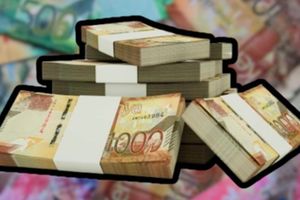
The development comes at a time when the elders have also been accused of being swayed by monetary inducements, and being accused of selling their endorsements to the highest bidder.
Mr Kungu Muigai, the National Council of Elders patron admits that some elders endorse candidates for various seats after being given money, but warns that this should not be the case.
Kindiki crowned Mt Kenya East spokesperson by Njuri Ncheke elders
“We know politicians and at this time of the electoral cycle, they will come to us with loads of cash. But what I should tell my elders is that they should take the money but make wise decisions,” said Mr Muigai, who is also the Kenya Cultural Centre chairman.
The elder, also the patron of Mt Kenya Council of Elders, added: I would not be the one to stand and tell them not to accept money. Once you take it, be wise in your decisions.”
However, in some regions, elders still have sway, with their decisions holding immense weight.
In Taita-Taveta, elders are themselves recognising the changing expectations, saying aspirants will have to demonstrate how they intend to address residents’ concerns before being considered for political support.
The leader of an elders’ alliance, Mr Thomas Mwadeghu, said residents had grown tired of some of the leaders who had represented them in the past.
“Leaders from different alliances in Taita and Taveta are coming together to provide political direction. Although there will be many aspirants, we expect to shortlist them based on the wishes of the residents,” said Mr Mwadeghu.
“Our role is to advise them after interviewing them on how they will implement the people’s policies. This time, we do not want them to tell us what they will do, but how they will implement the needs of our people,” he added.
In Kwale county however, the contest over the role of elders has become more openly political.
Governor Fatuma Achani has criticised a section of Kaya elders for siding with her opponents, arguing that community elders should not determine who occupies political office.
“We respect our elders, but determining our leadership in favour of someone, that one will not work,” said Governor Achani, adding that the male dominated council was favouring men.
“I am surprised by how men demean women. A woman has to be tough to succeed. I ask for respect, and they should know I am a lioness. That is why I have established myself politically,” she said.
Agikuyu Council of Elders chairman Wachira Kiago (Centre) accompanied by other elders at a past event.
Photo credit: File | Nation Media Group
In the vote-rich Mt Kenya region, elders are becoming a force to reckon with as politicians reach out to them for blessings, advancement of unity calls and endorsement.
Recently, Deputy President Kithure Kindiki hosted 30,000 elders from Mt Kenya East and tasked them to look for their colleagues from the West to discuss matters politics and unity of the larger Mt Kenya region.
They endorsed DP Kindiki as President Ruto’s running mate in next year's General Election, and were tasked to reach out to their counterparts from Kikuyu Community and forge unity.
The elders from Nyangi Ndiriri Embu), Ngome (Mbeere) and Njuri Ncheke, boasted that they are the kingmakers and whoever they support and bless succeed in politics.
The elders especially from Kirinyaga said they want the Mountain united for them to be able to endorse good political leadership, and denounced efforts by politicians to divide the mountain into East and West.
In 2022, Meru’s Njuri Ncheke council of elders endorsed Azimio La Umoja’s Raila Odinga alongside former governor Kiraitu Murungi but both lost the elections.
The council has always argued that it works with the government of the day, hence the decision by elders to back the incumbents or candidates aligned with the government.
But in the election, United Democratic Alliance party’s candidate William Ruto garnered over 398,000 votes against Odinga’s 103,000 votes in Meru county.
Deputy President Kithure Kindiki at Nembure Stadium in Embu County where he met elders from Mt Kenya East on August 15, 2026.
Photo credit: DPCS
Njuri Ncheke defied their unwritten law in 2023, when a section of elders withdrew their support for Kawira Mwangaza’s administration and endorsed her impeachment.
In October 2023, Njuri Ncheke regional chairman Linus Kathera and Secretary general Josphat Murangiri announced that the council had resolved to support Governor Mwangaza’s impeachment following failed attempts to arbitrate the political disputes.
But a section of Njuri Ncheke elders led by Mr Adriano Aruyaru, an elder from Tigania West, disputed the move by the council's leadership to take sides was irregular and against Njuri Ncheke code of practice.
He said Njuri Ncheke does not take sides during conflict but pursues justice before making conclusions.
The two warring factions reunited a month ago ahead of the coronation of Deputy President Kithure Kindiki as the Mt Kenya region’s spokesperson.
In neighboring Isiolo County, Governor Abdi Guyo, defied the Borana Council of Elders’ choice of Godana Doyo and went ahead to win the election.
In the South Rift, the predominant communities in Nakuru, Bomet, Kericho, Narok, Laikipia and Nyandarua are the Kalenjins, Maasai, Kikuyu with pockets of Kisii, Luo, Luhya and Somali communities who are competing for various positions in the 2027 general election.
Mzee Richard Ng’eno, the chairman of the Kipsigis Myoot Council of Elders said there was a need to allow all the candidates seeking elective positions to contest, sell their policies to the voters and let the people choose their preferred candidates.
Elders perform a special ritual in the Ngilai area, Samburu County.
Photo credit: File | Nation Media Group
Former Bahati Member of Parliament Kimani Ngunjiri and former Molo Member of Parliament Njeng’a Mungai said the candidates from the various communities should be free to contest for elective positions without fear of reprisals.
In Narok, members of the Kipsigis, Kikuyu and Maasai communities have been fighting for positions in Kilgoris, Emurua Dikirr, Narok South, Narok West constituencies.
In Luo Nyanza, the once powerful Luo Council of Elders, an institution that used to give directions appear, to be losing its influence in the absence of the late Raila Odinga, its former patron.
When Odinga was alive, leaders used to respect the directions given by the council of elders.
But the recent wrangles that have arisen over a stand by the council to support President William Ruto is a clear indication that not every leader respects the direction issued by the council led by Ker Odungi Randa.
The council is also dealing with internal wrangles with Randa and Nyandiko Ongadi both laying claim to the throne as the head of the Luo community. This has confused the community more with conflicting political messaging.
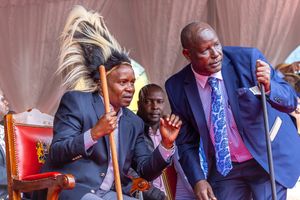
Nyandiko Ongadi (centre), who leads a faction of Luo Council of Elders, displays registration documents during an elders' meeting in Kendu Bay in Homa Bay County on August 29, 2026.
Photo credit: George Odiwour | Nation Media Group
Speaking at Ofafa Memorial Hall in Kisumu recently, Mr Randa said the elders had, after internal consultations, resolved that they could no longer remain silent on issues affecting the community.
"As elders, we are a symbol of guidance. When we see things are not going in the right direction, we have a responsibility to speak," he said while reaffirming the council's support for President William Ruto's broad-based government.
In July 2024, the council urged opposition leaders to engage in talks that eventually culminated in the broad-based government arrangement. During the funeral of former Prime Minister Raila Odinga in 2025, Mr Randa appealed to the community to support the political path initiated by the late ODM leader.
In May this year, the council publicly backed President Ruto's 2027 re-election bid during a rally in Kisumu attended by ODM leaders.
The latest declaration comes against the backdrop of growing divisions within ODM following Odinga's death.
In northern Kenya, the Garre Council of Elders in Mandera played a major role in politics in 2017 including picking candidates for different offices in the county.
The powerful council led by Mr Malim Ali Noor suffered a setback after then Mandera Governor Ali Roba (current Mandera senator) defied their decree causing a split in 2017.
The council had handpicked him from his aviation job and made him a governor in 2013 only for Roba to turn against the same group after five years.
Mr Roba had been ordered by the elders not to run for a second term in office but he disagreed with them. His defiance caused a rift in the community but later a reconciliation meeting was called and peace made.
Despite reconciliation, the clan elders vowed to keep off politics and concentrate on peace and cohesion within the community.
In Mandera, the council of elders has become a vestige of the past while in Wajir and Garissa, the council of elders still have the real sway.
Despite the Garre Council of Elders being rendered powerless in local politics, other clans residing in Mandera have continued to manipulate the negotiated democracy way locally when picking ward representatives.
“We use the council of elders at our ward levels to ensure the seat is rotational. We don’t want that position to be held by one individual and make it look like his birthrite,” Mr Osman Abdullahi from the Murule clan in Mandera said.
In Garissa for instance, the council of elders has since endorsed Senator Abdukadir Haji for the top county position and gone ahead to persuade other candidates to drop their ambitions.
Across the country, the political equation is changing. Elders may still influence opinion, parties may provide political machinery and alliances may shape contests, but the final decision will increasingly depend on voters.
Reporting by Gitonga Marete, Anthony Kitimo, Rushdie Oudia, Vitalis Kimutai, George Munene, David Muchui and Manase Otsialo.