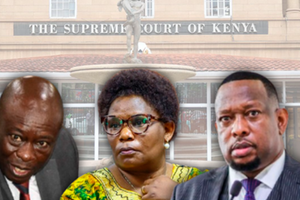
Former Deputy President Rigathi Gachagua has filed his main appeal challenging the High Court's decision to uphold his 2024 impeachment by the Senate.
Among key grounds of appeal is an argument that the court "modified the final written judgment to depart from the oral judgment pronounced in open court".
He also argues that the court made an inconsistent conclusion and erred by upholding an impeachment it found had violated his constitutional right to a fair hearing.
The memorandum of appeal says the court should have found the Senate's decision “null and void” because he was not subjected to a lawful and fair trial.
Justices Fridah Mugambi, Eric Ogolla and Anthony Mrima during the delivery of their judgment in the case against the impeachment of former Deputy President Rigathi Gachagua at the Milimani High Court on June 8, 2026.
Photo credit: Billy Ogada | Nation Media Group
The appeal, packed into 121 volumes, challenges the June 8, 2026 judgment of Justices Eric Ogola, Anthony Mrima and Frida Mugambi.
He alleges alterations and discrepancies between the oral and the written judgements. The alleged discrepancy in the written judgment concerns paragraphs read immediately after paragraphs 484, 488, 503 and 508.
Mr Gachagua says those passages were delivered in open court and on live television broadcast as part of the judgment but were excluded from the written verdict submitted to the parties.
He says that the court produced a written judgment "materially inconsistent with the oral judgment pronounced in open court and which excluded four critical paragraphs the court had read".
The appeal says the discrepancy was not explained or corrected despite a formal protest by parties "about the incompleteness of the court’s record determining the parties’ rights with finality on the basis of that very record."
Mr Gachagua says the omission and modification deprived him of reasoning contained in the passages and asks that the record be corrected.
"Improperly modifying the judgment has deprived the appellant of the benefit of the court’s reasoning in the paragraphs pronounced after paragraphs 484, 488, 503, and 508," he argues.
He adds: "The High Court thus acted contrary to its very essence and character as a superior court of record obligated to keep a recordum of its acts, proceedings, and decisions as a perpetual memorial and testimony."
The appeal then attacks the High Court's decision to uphold the impeachment despite finding that the Senate breached Mr Gachagua's constitutional rights during the proceedings.
He faults the court for dismissing the allegations of bias, predetermination, and conflict of interest advanced against the Speakers of Senate and National Assembly, Members of Parliament, and senators.
In the judgement, the judges found that the Senate violated his rights to fair administrative action and a fair hearing when it refused to adjourn after he became ill and could not complete his defence.
Mr Gachagua argues that the finding should have resulted in the Senate's impeachment resolution being declared invalid. He argues those findings could not be reconciled with preserving the impeachment.
"The High Court fundamentally erred in law by failing to find that the Senate’s decision to impeach the appellant was null and void on the basis of the court’s own firm determination that the appellant was not subjected to a lawful and fair trial process within the meaning of Articles 25(c), 47 and 50 of the Constitution," the memorandum says.
The appeal lists the court's findings that the right to a fair trial is an absolute constitutional guarantee, is non-derogable and does not yield to constitutional timelines or political exigency.
Then Deputy President Rigathi Gachagua during his impeachment hearing at the Senate in Nairobi on Wednesday, October 16, 2024.
Photo credit: Dennis Onsongo | Nation Media Group
He says courts can review impeachment proceedings where Parliament breaches constitutional safeguards.
"The High Court finding that the Senate’s decision to impeach is final and beyond judicial review is not only erroneous in law but also irreconcilable with the court’s findings in the same judgement and in previous rulings in the same petition that the right to a fair trial is of a non-derogable character," he argues.
Mr Gachagua further challenges the court's reliance on Article 145(7), which treats a Senate resolution on impeachment as final, and its reasoning on dual incumbency.
He says the court wrongly relied on what it called "the constitutional absurdity that would arise from dual incumbency."
According to the appeal, Mr Gachagua had ammended his petition and told the court that he was no longer seeking to return to the Deputy President's office. He sought invalidation of the impeachment and compensation instead.
He also challenges the court's treatment of the Senate's procedure under Article 145, which sets out the constitutional process for impeaching the President or Deputy President, including investigation.
"Senate by-passed safeguards"
He argues that the judges correctly found that "the investigatory phase was mandatory" and that the committee route was "the inescapable mechanism for digesting evidentiary complexities".
The court nevertheless declined to invalidate the impeachment despite finding that the Senate had failed to appoint a special committee.
He also challenges the absence of dedicated legislation governing removal of a Deputy President, saying the court erred by holding that the absence of such legislation did not invalidate the impeachment.
Public participation is another ground. Mr Gachagua argues that the Senate conducted no public participation after receiving the National Assembly resolution.
He says participation of the public was inadequate and part of the National Assembly standing orders that prescribe timelines undermined meaningful participation and fair-hearing rights.
He also contests the finding that public participation was unnecessary for the nomination and approval of Kithure Kindiki as Deputy President.
Mr Gachagua further says the court failed to determine whether he was entitled to retirement benefits.
He challenges the Sh50 million damages award, arguing that compensation could not substitute for declaring the impeachment unconstitutional.
"The High Court erred in law by failing, declining, or refusing to decide whether a Deputy President who has been removed from office by a process of impeachment that is thereafter found to be in violation of the constitution was entitled to retirement benefits," he states.
The judges "directed the appellant to seek redress before a different and/or appropriate forum which they did not specify and which in any event was not available to the appellant."
The memorandum says the court erred by holding the damages were sufficient "without declaring the impeachment unconstitutional, null and void."
Mr Gachagua asks the Court of Appeal to allow the appeal and set aside the High Court judgment in the portions identified in his notice of appeal.
He asks the appellate court to declare the Senate's October 17, 2024, removal resolution unconstitutional, null and void.
Finally, he wants the High Court judgment remitted for correction so the written record reflects the passages he says were read in open court.