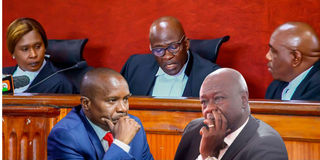
A three-judge High Court bench has dismissed an application seeking their recusal from hearing a petition challenging the legality of Deputy President Kithure Kindiki's appointment, marking the latest twist in a legal battle stemming from Rigathi Gachagua’s impeachment.
Justices Eric Ogolla, Antony Mrima, and Fredah Mugambi ruled that activist Enock Aura failed to substantiate claims of judicial bias, paving the way for substantive hearings on whether Professor Kindiki's ascension to office violated constitutional procedures.
The dispute stems from September 2024 when Parliament impeached then-Deputy President Gachagua following a controversial motion by Kibwezi West MP Mwengi Mutuse.
Kibwezi West MP Mutuse Mwengi tabling his impeachment motion against Deputy President Rigathi Gachagua at the National Assembly in Nairobi on October 8, 2024.
Photo credit: Dennis Onsongo | Nation Media Group
Mr Aura contends the impeachment process was fundamentally flawed and that Prof Kindiki's subsequent appointment lacked transparency and proper constitutional safeguards.
His 242-page petition raises multiple legal arguments challenging the validity of Prof Kindiki's appointment, including allegations that the National Assembly approved him without conducting mandatory vetting, allowing public participation, or obtaining an essential eligibility letter from the electoral commission.
These procedural deficiencies, Mr Aura argues, rendered the November 1, 2024 swearing-in ceremony a "sham."
At the core of the petition is the assertion that Prof Kindiki was unlawfully nominated, approved, and sworn in as Deputy President through a process that violated multiple constitutional provisions.
He maintains that Kindiki "never appeared before the National Assembly for vetting," and that there was "no hearing at all, and no public participation," contrary to requirements under the Public Appointments (Parliamentary Approval) Act.
This alleged failure, Mr Aura contends, denied Kenyan citizens their constitutional right to participate in and scrutinize the appointment process, violating Articles 10, 95, and 118 of the Constitution.
The petition raises additional constitutional concerns regarding Prof Kindiki's transition from Cabinet Secretary for Interior to Deputy President.
Mr Aura claims Prof Kindiki never formally resigned his cabinet position despite being nominated as Deputy President, rendering his appointment invalid under Article 135.
The swearing-in ceremony itself faces scrutiny, with the rights activist terming it a constitutional nullity.
He argues the declaration of November 1, 2024 as a public holiday was illegal because the Executive Order used to establish it reused a number from an earlier order issued months before.
Furthermore, Mr Aura presents evidence suggesting President William Ruto was abroad when the second Executive Order was issued, raising questions about its authenticity and whether the Assumption of the Office of President Act's requirements were properly met.
Mr Aura's legal challenge extends to Parliament's role in the appointment process. He alleges the National Assembly failed to adhere to procedures outlined in the Public Appointments (Parliamentary Approval) Act, rendering Prof Kindiki's appointment null and void.
Additionally, he claims the appointment breached the Assumption of Office of the President Act and Article 141(2)(b) of the Constitution by proceeding with the swearing-in while petitions challenging the process remained pending.
The recusal application dismissed by the court represented Mr Aura's attempt to reconstitute the judicial panel hearing his case. Through his lawyer Harrison Kinyanjui, Mr Aura accused the judges of isolating his petition from consolidated cases challenging Mr Gachagua's impeachment, arguing their procedural decisions demonstrated bias favouring Kindiki's appointment.
Specifically, he pointed to the bench's January 2025 decision to deconsolidate the matters as evidence of prejudgment.
However, the judges rejected these allegations, noting that court records showed Mr Aura himself had initially demanded standalone hearings for his petition.
"The segregation resulted from the applicant's own insistence that his petition raised unique issues," the judges stated in their ruling.
They further emphasized that Mr Gachagua's decision not to participate in Mr Aura's case undermined claims of prejudice, concluding that no evidence had been presented to demonstrate "real or perceived" bias on their part.
With the recusal matter settled, the case now moves toward hearing Mr Aura's substantive constitutional challenge.
He seeks several declaratory orders, including findings that Prof Kindiki's nomination bypassed Article 135 requirements (particularly regarding resignation from his cabinet position) and that the swearing-in ceremony violated constitutional and statutory law.
Mr Aura alleges the gazetted public holiday declaration reused an outdated executive order number, while evidence suggesting President Ruto's absence from the country when key documents were signed raises authentication concerns under the Assumption of the Office of President Act.
The petition also challenges Parliament's oversight role, arguing lawmakers rushed Kindiki's approval through an implausibly short 12-hour window between late October 17 and early October 18, 2024.
This accelerated timeline, Mr Aura contends, made proper verification impossible and violated constitutional principles of transparency and accountability in public appointments.
PHOTO 47
Photo credit: File | Nation Nation Media Group
Adding complexity to the case is the Court of Appeal's May 2025 decision to nullify the same bench's earlier empanelment in related impeachment cases.
While Mr Aura cited this ruling as grounds for reconstituting the current bench, the High Court judges distinguished their present role, emphasizing they are now addressing distinct legal questions about appointment validity rather than impeachment merits.
He had used the appellate court's decision to demand an expanded five-judge bench, warning that Prof Kindiki's contested legitimacy could trigger a constitutional crisis should presidential succession become necessary.
As the case progresses toward its February 26, 2026 hearing date, all branches of government face unprecedented scrutiny. The National Assembly must defend its approval process, while the Executive branch must justify its appointment decisions.
The outcome of this case could either validate Prof Kindiki's position as Deputy President or plunge the country's leadership structure into uncharted legal territory with potentially far-reaching consequences for Kenya's democratic institutions and governance framework.
Legal experts anticipate the ruling will establish important precedents regarding presidential succession procedures and parliamentary oversight responsibilities in high-level government appointments.