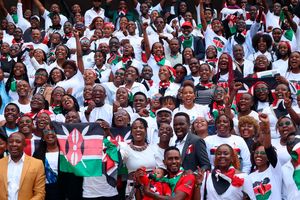
As the country gears up for the 2027 General Election, many anticipate that it will be driven by the Gen Z, prompting political heavyweights to court the youth as key allies in their parties.
President William Ruto, former President Uhuru Kenyatta and other established leaders with declared 2027 ambitions appear to be targeting the youthful voters.
But a pressing question remains: will the youth fight for power on behalf of the old guards, or for themselves?
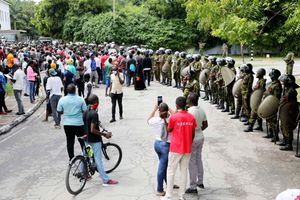
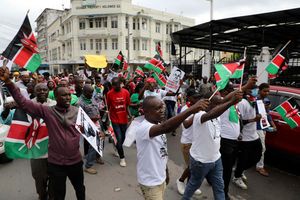
Protesters march along Kenyatta Avenue in Nairobi during anti-Finance Bill demos on June 25, 2024.
Photo credit: Bonface Bogita | Nation Media Group
“That is the million-dollar question… we either go to the ballot to democratically take over power, or we turn out to help the usual characters seize it. Is it for power, or for the old guards?” poses Mixson Gitau, 29, who aspires to contest the Kamahuha ward in Maragua constituency.
Citing the November 27 by-elections, Mr Gitau says Kenya’s political terrain is murky.
“It does not matter what vision you have. This is a game of patronage,” Mr Gitau says.
“No aspirant entered the battlefront without being sponsored by godfathers, which spells doom for those of us from humble backgrounds whose only source of support is God. Good deeds or personal achievements count for little. In Kenya, elections boil down to money, as we saw in the by-elections,” he explains.
Saddam Nyagah, who hails from Mbeere North constituency, wonders aloud how Leonard Muthende of UDA won that seat.
“We had nine aspirants, and five of them were youths. Of the 109,000 people in Mbeere North, those between 18 and 35 are the majority, yet a nearly 50-year-old man won,” he says.
Mr Muthende was elected the new Mbeere North MP after beating Newton Karish of the Democratic Party with a margin of 494 votes.
Mbeere North UDA candidate Leo Muthende casts his vote at Siakago Social Hall in the Mbeere North by-election on November 27, 2025.
Photo credit: Joseph Kanyi | Nation Media Group
“The youth are still not stable enough to bid for power because politics has been made an exclusive club for the elite, tycoons, and daredevils,” Mr Nyagah contends.
He recalls a contest in Mbeere North characterized by violence, monetary enticements and flamboyant displays.
In his view, this dynamic may turn young people into voters only seeking handouts rather than candidates pursuing change.
Mr Nyagah also faults the mainstream media for giving prominence to certain candidates while ‘ignoring’ others.
“About 95 per cent of the aspirants in the November 27 by-elections never got media coverage,” he says.
Eric Wekesa, 35, who won the Chwele/Kabuchai ward as an independent, says the ambitious youth still need to be supported to rise to political office.
“You need a strong hand to hold you through the process. The youth also need the grace of God to persevere and guardian angels to help them.”
“Political contests do not respect age. What matters is how well you can shake the ground and evade the traps along the way,” he says.
According to Young Parliamentarians Association chairman Gitonga Mukunji, some of the gains the youth had made on matters leadership have been eroded.
Member of Parliament for Manyatta Constituency Gitonga Mukunji.
Photo credit: Boniface Mwangi | Nation Media Group
“Before President William Ruto’s regime, we were making great strides in the inclusion of youth and women in decision-making. Now we are fast losing ground,” Mr Mukunji said.
On her part, Kirinyaga Woman Representative Njeri Maina, 31, is of the view that the youth need to join political parties, be active and negotiate to be nominated to run for political office.
Orange Democratic Movement youth leader Kasmuel Kasmuel McOure cautions that 2027 may be another deferred opportunity for the youth.
“It will likely be another tribal election. The experiences of the past do not inspire optimism,” he says, adding that young people remain entangled in online vitriol and tribal bigotry, which undermine collective progress.
Kasmuel McOure speaks at Bukiri Primary School, Funyula, Busia County, on February 28, 2025, as the Orange Democratic Movement celebrated 20 years in Kenya's political landscape.
Photo credit: Alex Odhiambo | Nation Media Group
According to Wanjiku Thiga, who is a member of the Democracy for the Citizens Party (DCP), the youth must institutionalise their political participation.
“We cannot continue being tribeless, leaderless, and partyless. We must belong and harness our 80 per cent voting power,” she says.
Ms Thiga is also of the view that the youth need to resist tokenistic political roles limited to blogging, roadshows, or entertainment, and instead hold institutions of governance accountable.
Lydiah Lanoi, 25, from Narok County, says the youth’s goal is clear.
“We are either part of the table or we break the table in 2027… that is the slogan of the youth in Narok. Nothing inspires me more than seeing women rise above insults, violence, and stigma,” she said.
Joseph Kibugi, 30, from Murang’a County, warns aspiring youth leaders of the high costs of contesting elections independently.
“Founding your party is one of the major breakthroughs, but it is costly and tedious. If fat cats offer you a livelihood or gain, grab it,” Mr Kibugi says.
Mr Kibugi says the monetized nature of Kenyan politics paints a picture of a market where there are buyers of positions and sellers of votes.[email protected]