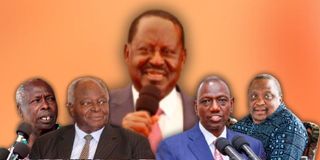
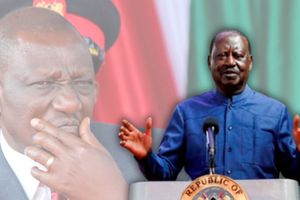
ODM leader Raila Odinga has, for nearly four decades, perfected the art of unsettling presidents and regimes.
From challenging president Daniel arap Moi’s ‘authoritarian’ rule to forcing power-sharing with Mwai Kibaki in 2007, to cutting deals with Uhuru Kenyatta and now keeping President William Ruto guessing, Mr Odinga’s political maneuvers have consistently rattled successive regimes.
From his detention days under Moi to the famous “handshake” with Mr Kenyatta in 2018, Mr Odinga has remained the country’s master tactician, capable of forcing concessions from regimes and rewriting political scripts.
Prime Minister Raila Odinga and former President Daniel Arap Moi during a church service at AIC-Kabarak Community Chapel on July 8, 2012.
Photo credit: File | Nation Media Group
Now, as President Ruto courts him while watching his every move, the ODM leader’s unpredictability continues to define Kenya’s power games.
Mr Odinga has once again thrown Kenya’s political scene into suspense after declaring that his Orange Democratic Movement (ODM) party has not abandoned its presidential ambitions in 2027.
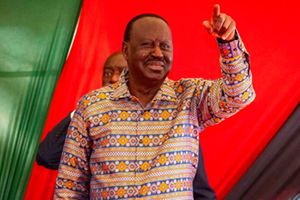
ODM leader Raila Odinga (center) with some of the party's MPs during a Parliamentary Group meeting in Nairobi on September 22, 2025.
Photo credit: Evans Habil | Nation Media Group
The statement comes at a time when he is working closely with President Ruto under the broad-based government framework, raising questions on whether the seasoned politician is preparing for yet another dramatic political duel.
For decades, Mr Odinga has been the master of political realignments, often joining governments, shaking them to their core, and exiting with a significant following that alters the national political balance.
Prof Gitile Naituli of Multimedia University of Kenya argues that Kenya’s politics is never short of surprises, “but one development is becoming increasingly predictable: Raila Odinga will not last long in William Ruto’s government.”
“In fact, by mid next year, the alliance of convenience that brought the Azimio leader into Kenya Kwanza’s orbit will likely unravel. Raila is too seasoned, too aware of the political currents, and too protective of his base to remain tethered to an administration that is so blatantly hostile to the people’s economic and democratic aspirations,” the Prof of management and governance says.
He insists that Mr Odinga’s entire political career has been defined by his identification with the ordinary citizen.
From the Second Liberation struggles of the 1990s to his populist campaigns across the 2000s and 2010s, he has consistently positioned himself as the defender of mwananchi against the arrogance of power, says Prof Naituli.
“That brand, the pro-people reformer, is the lifeblood of his politics. It is what sustains his support in Nairobi’s urban poor neighbourhoods, in Kisii and Nyamira, in Western Kenya, and in the Coast. To dilute it by associating too closely with Ruto’s regime is to court political suicide.”
Indeed, Mr Odinga’s track record speaks volumes.
In the late 1990s and early 2000s, the ODM leader was at the heart of the push to end President Daniel arap Moi’s long rule.
Although Moi attempted to co-opt him into KANU ahead of the 2002 elections, Mr Odinga broke away, rallying a massive coalition under the National Alliance Rainbow Coalition (NARC) that swept Mwai Kibaki to power.
Barely three years into Kibaki’s presidency, Mr Odinga again engineered a rebellion within government ranks.
Following disagreements over the 2005 constitutional referendum, which Mr Odinga’s ‘No’ camp won against his boss, Kibaki, the ODM leader and his allies walked out of government, forming the Orange Democratic Movement party.
By 2007, ODM had grown into the largest opposition force, giving Kibaki one of the fiercest electoral battles in Kenya’s history, only losing by 231,728 votes in the highly contested poll that led to fierce post-election violence.
Mr Kibaki was declared the winner by the then chairman of the electoral commission, Samuel Kivuitu, by 4,584,721 (46.42 percent) votes against Mr Odinga’s 4,352,993 (44.07 percent) votes, while Kalonzo Musyoka polled 879,903 votes (8.91 percent).
President Mwai Kibaki shakes hands with ODM leader Raila Odinga outside Harambee House, Nairobi in January, 2008.
Photo credit: File | Nation Media Group
Mr Odinga’s same script of joining successive regimes again played out during President Kenyatta’s second term.
After years of political rivalry, the ODM leader stunned the country with the 2018 “handshake” that redefined Kenya’s political landscape.
Unlike his earlier partnerships, Mr Odinga remained firmly within Kenyatta’s administration, pushing through reforms and positioning himself as the establishment’s choice for the 2022 presidency.
However, despite the backing from Mr Kenyatta, Mr Odinga fell short at the ballot.
Just like in 2007, Mr Odinga lost to his rival Ruto by barely 233,211 votes.
The famous handshake between President Uhuru Kenyatta and former Prime Minister Raila Odinga at Harambee House in 2018.
Photo credit: File | Nation Media Group
Dr Ruto was declared winner by the then Independent Electoral and Boundaries Commission (IEBC) chairman Wafula Chebukati with 7,176,141 votes (50.49 percent) against Mr Odinga’s 6,942,930 votes (48.85 percent).
The ODM leader would, however, later join Dr Ruto’s government under a broad-based framework following weeks of vicious anti-tax protests in mid-2024.
Now, with President Ruto, Mr Odinga is once again engaged in a delicate balancing act.
His decision to support the broad-based government initiative has been interpreted in some quarters as an implicit endorsement of President Ruto’s administration.
For the United Democratic Alliance (UDA), the expectation was that he would eventually back Ruto’s re-election bid in 2027, cementing their newfound cooperation.
“Who told you that ODM will not have a presidential candidate in 2027? First, think as ODM, we have a clear plan that we have negotiated and agreed on; other decisions will be taken when the time comes,” Mr Odinga declared during a recent meeting with ODM legislators in Nairobi.
By affirming that ODM remains in the race, he has reignited speculation of yet another high-stakes contest with Ruto.
Such a move would echo his past strategy of cooperating with governments before mounting strong challenges from within or outside.
Analysts argue that Mr Odinga’s political manoeuvres serve two purposes: they keep him relevant in shifting political times and ensure ODM’s survival as a national force.
“Raila has mastered the art of entering governments to consolidate influence, then exiting when the timing is right,” notes advocate Chris Omore. “His signal on 2027 is a reminder that ODM is far from finished.”
Prof Gitile Naituli holds that President Ruto’s government is, by all accounts, anti-people.
“The punitive taxes, the skyrocketing cost of living, the weaponisation of state institutions, and the hollow promises of 'bottom-up' have exposed the administration’s true face. Ordinary Kenyans are paying the price while a small elite grows richer. It is a government that governs by extracting pain, not delivering relief.”
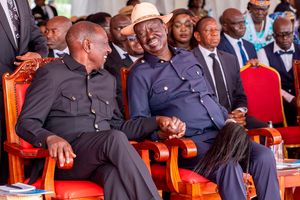
President William Ruto with ODM party leader Raila Odinga at the funeral of Mama Phoebe Asiyo at Wikondiek in Homa Bay County on August 8, 2025.
Photo credit: PCS
“For Raila to sit in that space and appear complicit is profoundly unnatural,” Prof Naituli says.
ODM National Chairperson Gladys Wanga insists that the party’s loyalty to Mr Odinga is undisputed, adding that members are ready to move whichever direction given by the ODM supremo.
“ODM is one of the biggest parties North of River Limpopo and South of the Sahara. It’s a national party under Baba Raila Odinga. If Raila says left, we will go left, if he says right, we shall all go right,” Ms Wanga, also the Homa Bay governor, asserted.
But President Ruto’s allies have moved to downplay fears that Mr Odinga’s recent pronouncements could destabilise their political arrangement with ODM, insisting that their partnership with him remains mutually beneficial.
Former Presidents Mwai Kibaki (left) and Daniel Arap Moi (centre) with former Prime Minister Raila Odinga at Kibaki's Muthaiga home on May 4, 2016. Mr Moi and Mr Odinga had gone to condole with Mr Kibaki following the death of former First Lady Lucy Kibaki.
Photo credit: File | Nation Media Group
UDA National Organising Secretary Vincent Kawaya downplayed concerns raised after the ODM leader appeared to retreat from earlier commitments, saying both sides need each other to remain politically relevant.
“I think there’s nothing wrong. Our relationship with Raila is symbiotic. We need each other and nobody should imagine that Raila doesn’t need us,” Mr Kawaya said.
He argued that Mr Odinga’s decision to rebuild and strengthen ODM was, in fact, in UDA’s interest, warning that a weakened opposition party would only embolden smaller outfits to eat into Raila’s base, weakening the coalition’s prospects in the long run.
“Politically speaking, the easiest way we can lose is if ODM is not strong. Because other small parties could emerge and start taking control of Raila’s base. It’s extremely important for us to have Raila as strong as possible,” the UDA official explained.
UDA Deputy Secretary General Omboko Milemba said their coalition’s 2027 game plan would depend on decisions made at the top level between President Ruto and Mr Odinga.
“For 2027, Raila and President Ruto will agree at their own level and we shall execute it at that time. We shall execute the instructions they will give us,” he said as he dismissed talk of a fallout, noting that Raila has consistently acted as a statesman in delicate national moments.
Mr Milemba lauded the ODM leader for choosing dialogue and compromise at critical moments in the country’s history, including the 2007 power-sharing deal with then-President Kibaki after a disputed election.
“We thank Raila for being a statesman who did not think that Kenya should be taken to the abyss when we looked like we were at a very delicate moment. He became a statesman last year just like his father in 1964,” said Mr Milemba.
Mr Odinga’s latest declaration that ODM would still field a candidate has, however, reopened political uncertainty in the broad-based government.
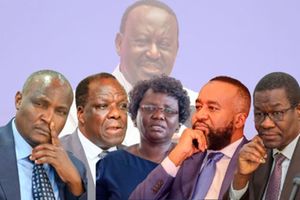
“Mr Odinga has now introduced known unknowns and unknown unknowns as far as the 2027 elections go,” Mr Mokua observes. “This makes him the centre of 2027 presidential conversations. All candidates will want to hold court with him because ODM has not taken a definitive position.”
For President Ruto, Mr Odinga’s wavering is a double-edged sword.
On the one hand, the ODM leader’s cooperation has helped stabilise the broad-based administration, with key ODM figures benefiting from state appointments and development projects flowing to Mr Odinga’s backyard.
On the other hand, his flip-flopping has made it difficult for UDA to craft a clear re-election script.
“President Ruto is an experienced politician, and it would be naive to imagine that he is not crafting a 2027 strategy with all scenarios on the table,” Mokua says.
“But one of those scenarios—Mr Odinga withdrawing his support and teaming up with former President Uhuru Kenyatta to back another candidate such as Kalonzo Musyoka or Fred Matiang’i—would complicate matters and could even make Ruto a one-term president.”
Now, uncertainty continues to surround Mr Odinga’s next move, though his political past suggests that his current engagement with the government could be another calculated gambit to keep leaders on edge.
Political observers believe his track record indicates that alliances with the government rarely come without a disruptive twist.