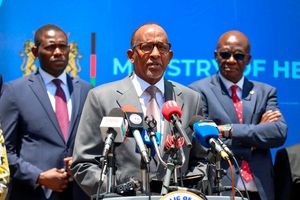
Even though the Independent Electoral and Boundaries Commission (IEBC) has denied the existence of such a proposed law, attention now turns to the National Assembly as it considers the Senate’s bold move to remove the requirement for live transmission of election results announced at polling stations following the passing of the Elections (Amendment) Bill 2024.
The government-sponsored bill seeks to delete section 39 of the Elections Act and introduce a new section that does not require the IEBC to facilitate the live streaming of election results, including presidential results, at polling stations.
This sets up a high-stakes showdown over transparency and the future of national elections, coming as it does after the former Speaker of the National Assembly, Justin Muturi, criticised the move, saying that live-streaming election results “is a common democratic norm across progressive democracies”.
The Bill, passed by the Senate in December 2024, goes against the electoral reforms of 2016, which, among others, made it mandatory for the electoral commission to undertake livestreaming of election results from polling stations.
However, the clause that seeks to replace the proposed deletion of section 39 of the Act and which was carried by the Senate, does not include the requirement for the livestreaming of the poll results as announced at the polling stations.
“The new section has omitted provisions providing for the requirement for IEBC to establish a mechanism for the livestreaming of results as announced at polling stations to facilitate public information,” reads clause 22 of the Bill as highlighted in the memorandum of objects and reasons on the Bill.
The Commission Thursday sought to set the record straight on the matter which risks the whole credibility of the polls.
“The Bill does not in any way propose amendment to Section 44 of the Elections Act that provides for the deployment of an Integrated Elections Management System for voter registration, voter identification and results transmission. Instead, it proposes a complementary mechanism for result transmission to address instances where transmission of results is not possible owing to lack of 3G network which is the minimum standard required for transmission of result Forms” it said in a statement.
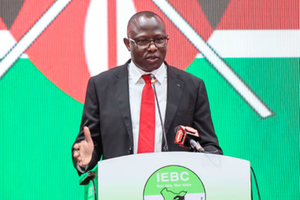
Independent Electoral and Boundaries Commission Chairperson, Erastus Ethekon addresses MPs during the 2026 Legislative Retreat for Members of the National Assembly in Naivasha, on January 27, 2026.
Photo credit: Boniface Mwangi | Nation Media Group
“The Bill seeks to align the law with the Supreme Court’s decision in the Presidential Election Petition No. 1 of 2017, which affirmed that the election result in the one recorded in the statutory Results Declaration Form (34A Series), the primary and final record of the results at the polling station. Accordingly, the Commission is required to verify the results by comparing the original physical form 34A with the electronically transmitted image of the same form from the polling station,” the Commission said.
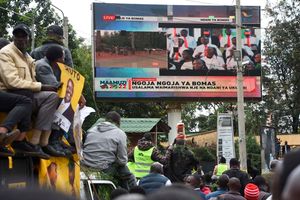
Currently, the commission is required to live-stream the election results on its big screens mounted at the national tallying centre as announced at the polling stations.
It is from these screens that the media pick the feed and broadcast live to update the general public on who is leading, by what margin and from how many polling stations.
The Bill, jointly sponsored by Senate majority leader Aaron Cheruiyot (Kericho) and his minority colleague Stewarts Madzayo (Kilifi), is a product of the National Dialogue Committee (Nadco).
It was forwarded to the National Assembly for consideration, where it was read a first time on February 13, 2025, then shelved.
The Nadco team, which drew membership from the ruling Kenya Kwanza administration and Raila Odinga’s Azimio coalition, was established by the government following deadly protests in the country immediately after President William Ruto was declared the winner in the August 9, 2022 presidential elections.
“The commission shall, to facilitate public information, establish a mechanism for the livestreaming of results as announced at polling stations and results so streamed shall for purposes of public information only and shall not be the basis for a declaration by the commission,” reads section 39 (1) (G) of the Elections Act.
The Act also requires that the commission shall verify that the results transmitted “under this section are an accurate record of the results tallied, verified and declared at the respective polling stations.”
“Where there is a discrepancy between the electronically transmitted and the physically delivered results, the commission shall verify the results and the result which is an accurate record of the results tallied, verified and declared at the respective polling station shall prevail.”
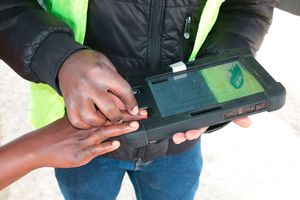
An IEBC official displays a KIEMS kit during a simulation process in the past.
Photo credit: File | Nation
The law also provides that the chairperson may declare a candidate elected as the president before all the constituencies have transmitted their results if the commission is satisfied that the results that have not been received will not affect the result of the election.
Yesterday, Mr Muturi affirmed that live streaming of the election results as announced at the polling stations enhances transparency, strengthens public confidence in the electoral process and enables citizens to witness democracy in action.
“Darkness and democracy are not synonymous. Transparency is the lifeblood of free, fair, and credible elections,” said Mr Muturi, adding that the media, “as an independent pillar of democracy, plays a vital role in ensuring that elections are conducted in a manner that inspires confidence and trust.”
The immediate former House Speaker also served as the Attorney-General and Public Service Cabinet Secretary in President William Ruto’s Kenya Kwanza administration.
“Any proposal from whichever corner to ban the livestreaming of election results is not only unconstitutional and offensive to the principles of open governance, but also a stain on the democratic conscience of the Kenyan people,” said Mr Muturi.
The immediate former Speaker noted that across the world, countries such as Germany, France, Spain, Italy, Poland, Ireland, Sweden, the United Kingdom, Canada, Australia, the United States, India, South Africa, Ghana, Nigeria, Brazil and Indonesia embrace robust media participation in election coverage.
“Such a proposal undermines public confidence, fuels suspicion, and weakens the legitimacy of electoral outcomes.”
Democratic Party leader Justin Muturi delivers his speech during the launch of the Independent Electoral and Boundaries Commission Strategic Plan 2024–2029 and Election Operations Plan 2025–2027 at Kenyatta International Convention Centre in Nairobi on June 24, 2026.
Photo credit: Wilfred Nyangaresi | Nation Media Group
In 2022, the National Assembly Committee on Justice and Legal Affairs (JLAC), then chaired by Kangema MP Muturi Kigano, overruled IEBC’s proposal not to live-stream presidential election results.
The commission, then chaired by Wafula Chebukati, now deceased, wanted the law that compelled it to live-stream the results repealed, but the committee opposed, saying doing so would defeat the purpose of enhancing transparency in the announcement and declaration of the election results.
“The commission shall establish a mechanism for the live-streaming of the presidential election results as announced at the polling stations,” the committee recommended in its report tabled in the House, adding; “live-streaming of election results is one way of conforming to the constitutional principles of transparency and accountability.”
“Kenyans should be able to compare the live-transmitted results with the final declared results to confirm the accuracy of the election results,” the committee added.
According to Mr Muturi, while electoral laws differ “on matters such as exit polls and projections before the close of voting,” the transparent reporting and live broadcasting of official election results have become hallmarks of credible democratic practice.
“Kenya must not retreat from democratic openness. We should strengthen transparency, not diminish it. The credibility of our elections and the confidence of our citizens depends not on secrecy, but on openness, accountability and respect for the Constitution.”
This, even as he added that the country’s laws are founded on the sovereignty of the people, transparency, accountability and access to information, noting that “these constitutional values demand an electoral process that is open to public scrutiny.”