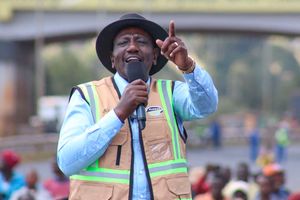
A quiet revolt unfolded inside the Orange Democratic Movement (ODM) after senior party officials boycotted a State House meeting convened by President William Ruto for newly elected broad-based MPs — effectively leaving party leader Dr Oburu Oginga to attend the event alone.
Multiple interviews with the Daily Nation indicate that several top ODM officials deliberately stayed away in protest over what they termed as State House overreach, disrespect for party structures and simmering internal tensions, particularly in Homa Bay politics.
The officials — ODM Secretary-General Edwin Sifuna, co-deputy party leaders Abdulswamad Nassir, Godfrey Osotsi and Simba Arati as well as Executive Director Oduor Ong’wen - had earlier on Tuesday attended a meeting at the party’s Chungwa House headquarters but did not accompany Dr Oginga to State House. ODM national chairperson Gladys Wanga attended neither meeting.
Their absence left Dr Oginga flanked only by the three ODM MPs-elect — Boyd Were (Kasipul), Moses Omondi (Ugunja), and Harry Kombe (Magarini) — when they were received by President Ruto alongside newly elected UDA parliamentarians.
In contrast, UDA legislators were accompanied by a top-tier team including Secretary-General Hassan Omar, national chairperson Cecily Mbarire, national treasurer Japheth Nyakundi and National Assembly Majority Leader Kimani Ichung’wa.
Sources familiar with internal deliberations say the decision by ODM’s top brass to skip the meeting was triggered by what the party viewed as a “procedural insult.”
According to an ODM official who attended the morning meeting at Chungwa House, State House allegedly contacted MPs-elect directly — bypassing party leadership — before later sending a formal invitation only after the MPs alerted Dr Oginga.
“It was only after the MPs told Dr Oburu that State House dispatched a formal letter,” the official said, noting that the delay was interpreted as an attempt to undermine ODM’s authority during a fragile transition following the death of party leader Raila Odinga.
The official added that party leaders initially recommended a boycott, arguing the event appeared choreographed to suggest ODM MPs were defecting or aligning individually with President Ruto.
Later, however, an emissary reportedly met Dr Oginga privately and convinced him to attend with the MPs-elect, while senior party officials stayed away.
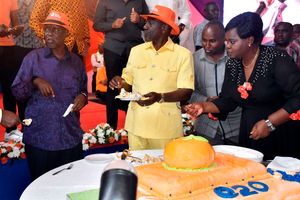
ODM Party leader Dr Oburu Oginga (left), President William Ruto and ODM Chairperson Gladys Wanga share a cake during ODM@20 celebrations at Sarova Whitesands in Mombasa on November 16, 2025
Mr Arati, Mr Nassir, Mr Osotsi and Mr Sifuna — all of whom were present earlier — skipped the visit, leaving Dr Oginga to lead the delegation alone.
“I did not attend the State House meeting because there was an urgent matter at the Senate,” he said.
Interestingly, Dr Oginga — himself the Siaya Senator — did not attend the Senate session, reinforcing speculation that internal disagreements, not scheduling, fueled the boycott.
In an interview, Mr Nassir attempted to downplay speculation of a rift within ODM and the broad-based coalition.
“We were invited for lunch at State House. A number of us were not available. Don’t read too much into it. The fact that I was unable to make it does not mean I’m against anything,” he said, adding that absence did not equate to dissent.
Mombasa Governor Abdulswamad Nassir.
Photo credit: Kevin Odit | Nation Media Group
He confirmed the earlier Chungwa House meeting and said he had been informed that Dr Oginga would attend.
“He called me, but some of us had prior commitments,” the governor said.
“There was nothing like that, not to my knowledge. We have agreed on how to move forward and avoid confusion. There is no bad blood. It is a very minor issue,” he went on.
Cracks in broad-based government
Multiple party insiders say she is aggrieved by the actions of a senior government official from Nyanza, whom her allies accuse of undermining her by sponsoring anti-Wanga demonstrations.
During the campaign, her deputy governor Oyugi Magwanga openly backed independent candidate Philip Aroko, defying the party’s nominee Boyd Were. UDA leaders in Nyanza — including former governors Okoth Obado and Evans Kidero and activist Odoyo Owidi — also backed Aroko, despite a national agreement between President Ruto and ODM identifying Were as the broad-based candidate.
The by-election became a critical test of Ms Wanga’s authority in the post-Raila ODM. Violence marred the campaign; two people were killed, several injured and tensions ran high. Internal sabotage and UDA’s mixed messaging added to the chaos.
“They spent sleepless nights to ensure we delivered a strong victory in Kasipul,” she later said, praising her grassroots team.
Even so, the by-election exposed cracks in the broad-based government.
Homa Bay Town MP Opondo Kaluma accused some UDA politicians of violating the Ruto–Odinga agreement by openly backing an independent.
“The big problem is that we cannot be in broad-based government together while the UDA team campaigns against us,” he said.
Senate Majority Leader Aaron Cheruiyot warned that supporting Aroko amounted to defying the President.
“Anybody operating contrary to that instruction is defying the President,” he said, branding some pro-Aroko UDA actors as “conmen infiltrating politics.”
Homa Bay Governor Gladys Wanga (left) addresses ODM supporters after Boyd Were (centre) was declared the winner of the Kasipul parliamentary by-election on Nvemebr 28, 2025.
Photo credit: George Odiwuor | Nation Media Group
After the UDA–ODM bloc swept all seven by-elections — Baringo Senate, Kasipul, Ugunja, Mbeere North, Malava, Magarini and Banissa — the UDA Secretary-General hailed the outcomes as proof Kenyans endorsed the broad-based administration.
“These results clearly show that the broad-based arrangement is what Kenyans want,” he said.
For ODM insiders, however, the lesson was different: internal tensions were bubbling beneath the surface.
Against this backdrop, Dr Oginga’s solitary presence at State House became politically symbolic — unprecedented in ODM’s recent history, particularly at a sensitive stage of implementing the late Odinga’s 10-point broad-based agreement with President Ruto.
Still, Dr Oginga used the platform to affirm ODM’s commitment to the deal.
“We are in the arrangement of the broad-based government where we have a ten-point agenda which we want to see implemented fully before the 2027 elections,” he said.
He praised the broad-based team for sweeping the seven parliamentary seats and urged ODM leaders to deliver for the people.
“ODM is a party for the unity of Kenya. If we don’t work hard and make our party strong, we will be taken for granted,” he said.
The three ODM MPs-elect also pledged loyalty to the party. Mr Were credited the party machinery for his win while his Ugunja counterpart Moses Omondi said he would “seek guidance from party leadership” and Magarini’s MP Harry Kombe supported ODM’s unity.
The sequence of events — the alleged State House bypass, the standoff at Chungwa House, Wanga’s absence, and the silent protest by top ODM leaders — underscores the fragile state of the party as it navigates leadership transitions and a complex power-sharing deal with President Ruto.
Insiders warn that unless ODM establishes clearer protocols for engaging State House and reinforces internal discipline, similar incidents may deepen divisions.
Others say the boycott was symbolic rather than structural — a warning shot to State House that ODM must be treated as a coherent institution, not a loose collection of individual MPs.