A coalition led by former Chief Justice David Maraga has threatened to lead Kenyans in protests if five sweeping electoral reforms are not implemented; setting up a fresh confrontation with the IEBC, Parliament and the government ahead of the 2027 General Election.
The People’s Coalition on Electoral Reforms is demanding the abolition of a national presidential tallying centre, an independent audit of the voters’ register, tougher penalties for electoral offences, a decentralised election technology system and a transparent recruitment process for IEBC officials.
The coalition, which brings together Mr Maraga, Saboti MP Caleb Hamisi, Suba South MP Caroli Omondi, Thirdway Alliance leader Ekuru Aukot and former National Assembly Speaker Justin Muturi, said the reforms must be implemented before the August 2027 election to guarantee a free, fair, transparent, verifiable and credible poll.
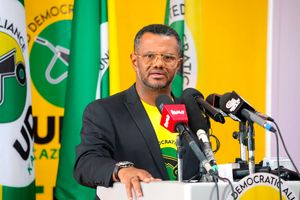
Former Chief Justice David Maraga (right) briefs media at the Sarova Panafric Hotel on September 15, 2026 in asking for electoral reforms ahead of the 2027 national general elections. He was joined by various opposition political leaders as part of the Peoples Coalition on Electoral Reforms. With him is Democratic Party of Kenya (DP) Party Leader Justin Muturi.
Photo credit: Francis Nderitu | Nation
Dr Maraga said the coalition had been formed by political parties, civil society organisations, faith leaders, professional associations, youth and women’s movements around what it described as a single demand for electoral credibility.
“Kenya cannot afford another election whose credibility is contested after ballots are cast. The 2007/2008 post-election violence is a national warning we refuse to relive,” Dr Maraga said.
The coalition said the credibility of the 2027 election was not only a political concern but a national interest requiring guarantees for voters, candidates, the ruling party, the opposition and the Republic.
“There is no democratic legitimacy in asking Kenyans to vote first and negotiate the credibility of the process afterwards. Kenya must invest in electoral peace before the election, not reconciliation after electoral failure,” Dr Maraga said.
Mr Omondi said the coalition wants an end to national tallying of presidential results, arguing that the Constitution requires votes to be counted and announced at polling stations and constituency level.
“The first mandatory reform for the 2027 General Election is that: There shall be no national tallying centre by the IEBC or the Chairperson of the Commission at Bomas or elsewhere,” Mr Omondi said.
The coalition wants the IEBC chairman confined to declaring the cumulative presidential result from results already declared at polling stations and the 290 constituencies, as well as the diaspora vote.
It proposes that Forms 34A and 34B be published simultaneously through a randomised and auditable stream from the constituency level, with live publication of results. Under the proposed system, Presiding Officers would transmit results directly to constituency returning officers, with no centralised servers at IEBC headquarters or a national tallying centre.
Instead, each constituency and the diaspora vote would have an independent server receiving results from polling stations, with read-only access for the media, political parties and independent candidates.
The coalition also wants the Elections Act and regulations amended by November 30, 2026, with IEBC gazetting a decentralised results-management framework by the same date.
“The forms 34A and 34B must be published simultaneously in a randomized and auditable stream, from the constituency level, with live publication or televising of all the 291 constituency results,” Mr Omondi said.
The coalition has also raised concern regarding the integrity of voters’ register, insisting that the coalition was concerned about the absence of what it considers a fully verifiable and independently audited register.
The coalition wants an internationally reputable independent auditor to conduct a multi-stakeholder audit of the voters’ register and biometrics, with the findings published and reported to Parliament.
It also wants voters given a continuous opportunity to verify their biometric details for at least six months before the election.
“IEBC’s verification online portal is not an ‘inspection’ and does not constitute a publication of the online register of voters as required by the Elections Act,” Mr Hamisi said.
The coalition said all registered voters should be able to verify their biometrics and that biometric voter identification should be mandatory in the 2027 election.
The proposed timetable requires an independent auditor to be procured by November 15, 2026, a cleaned-up register by February 15, 2027, publication of the full five-part register by March 10 and completion of inspection and verification by April 10. The leaders recommended a five-year jail term for serious electoral offences
Mr Muturi said the coalition wants Parliament to introduce tougher criminal penalties for election officials who interfere with the electoral process.
“The IEBC has been told every now and then that they need to use their powers to punish the offenders but they have failed and they do not have trust of the Kenyans,” Mr Muturi said.
IEBC officials set up solar lighting kits, ballot boxes and other polling materials.
Photo credit: File | Nation Media Group
The coalition proposes a mandatory minimum five-year custodial sentence, without the option of a fine, for specified serious offences by IEBC officials, including altering or withholding results, compromising election technology, unlawfully barring agents or announcing results from a non-gazetted polling station.
It also wants disqualification where provided for by law and prompt prosecution of state officials who misuse public resources for partisan campaigning.
“The People’s Coalition proposes a mandatory minimum custodial sentence of five years, without the option of a fine, for specified serious election offences by IEBC officials such as altering or withholding results, compromising election technology or unlawfully barring agents or announcing results of a non-gazetted polling station,” Mr Aukot said.
The coalition wants an Elections Offences (Amendment) Bill tabled and passed by November 30, 2026.
The coalition also wants IEBC to publish its technology policy and procurement specifications, including relevant hardware, software source code and server-hosting configurations, subject to security and data-protection safeguards.
It is opposed to a single-vendor system covering voter registration, biometric identification, candidate management, results transmission and publication of election results.
“We demand the procurement of a decentralized, modular election technology architecture, not a vendor-locked monolith,” Mr Muturi said.
The coalition wants the electoral system to cover voter registration and deduplication, electronic identification, results transmission, candidate management and public publication of results without necessarily being bundled into one vendor contract.
It wants IEBC to publish its election technology policy, requirement analysis report, solution design and feasibility report, procurement specifications and deployment plan before proceeding with the procurement.
The coalition said the technology procurement process should include public participation and technical input from civil society, security researchers, disability-rights advocates and the private technology sector.
The leaders have set September 30, 2026 as the deadline for publication of the technology policy and procurement specifications, followed by public comment, an amended tender by November 30 and tender award, certification and escrow arrangements in December.
The coalition also wants independent certification and penetration testing, voter-register migration to be subjected to a Data Protection Impact Assessment and a full-scale public mock election conducted before July 27, 2027.
On the recruitment of officials, the coalition wants returning officers and county election managers recruited through an open and competitive process, with longlists and shortlists published, candidates fully vetted and the process subjected to independent multi-party oversight.
It also wants an independent audit of ballot materials and their printing, with no more than 10 per cent of extra ballot papers printed and all printed materials serialised.
The coalition wants competent ballot-paper audit agents and technology agents involved in testing the electoral technology and decentralised results transmission system.
The coalition also threatened to mobilise Kenyans for protests if the five reforms are not implemented before the 2027 General Election.
“If these five (5) important reforms are not fully implemented before the August 2027 General Election, the people of Kenya shall pursue every lawful constitutional, statutory and international avenue available to defend their sovereignty upto and including the People exercising their sovereignty directly!” Mr Muturi said.