The 2027 General Election has entered a new phase with the political class now operating against a fixed legal clock.
The Independent Electoral and Boundaries Commission (IEBC) on Monday formally set the country on the road to the August 10, 2027 polls, gazetting the election notice. This activated a series of constitutional and statutory deadlines that will now govern campaigns, political party nominations, voter registration, election offences and the participation of public officers.
The move marks a shift from political positioning and preparations to implementation of the timelines, with every party, aspirant and public institution now racing against dates set in law.
It also sets the stage for an election that will, for the first time in more than three decades, not feature the name of former opposition chief Raila Odinga, whose death on October 15, 2025, has left political parties and alliances scrambling to realign ahead of the contest.
The notice gives legal effect to the election calendar and brings into force key rules governing the August 10 contest, including the Electoral Code of Conduct and the Election Offences Act.
The Code governs the conduct of political parties, candidates, agents and supporters during the election period, while the Election Offences Act criminalises conduct that undermines the integrity of elections, including bribery, violence, intimidation, multiple voting and interference with electoral processes.
Campaign financing timelines
“The public is hereby notified that pursuant to the powers conferred by Article 88(4) of the Constitution of Kenya, the provisions of the Elections Act, Cap 7 and the Elections (General) Regulations, 2012, IEBC has published the Notice of the General Election scheduled to be held on Tuesday, August 10, 2027, for the respective elections and election campaign financing timelines ...” reads the notice by IEBC Chairperson Erastus Ethekon dated September 14.
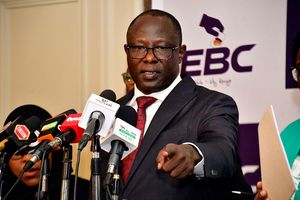
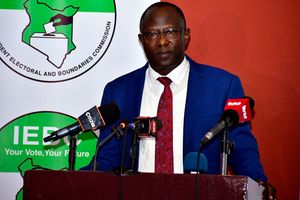
Independent Electoral and Boundaries Commission (IEBC) chairperson Erastus Edung Ethekon.
Photo credit: Wilfred Nyangaresi | Nation Media Group
Mr Ethekon said the commission was implementing a clearly defined electoral calendar and undertaking critical preparatory activities to ensure that key legal, operational, financial and logistical requirements are addressed within the prescribed timelines.
But as the legal clock starts ticking, the IEBC itself faces questions over whether it can complete the preparations without further delays, court battles or political interference.
Last week, the commission suffered a setback after the High Court in Nairobi temporarily halted the tendering process for the supply of ballot papers and other election materials following a challenge by a bidder.
Justice William Musyoka, sitting in the Judicial Review Division at the Milimani Law Courts, stayed the tender process following an application by Oilmax Ventures Limited.
The company challenged a decision by the Public Procurement Administrative Review Board dismissing its request for a review of the procurement process.
Pending determination of the judicial review case, the court has suspended the procurement process, placing the commission in the spotlight over the tight election-readiness deadlines, international security-printing capacity, local-content rules and constitutional requirements for fair and competitive procurement.
The dispute concerns a tender advertised by IEBC on August 11 for the supply and delivery of ballot papers, tactile folders, the Register of Voters and statutory election result declaration forms for the General Election.
The procurement dispute comes against a backdrop of growing political scrutiny of the commission’s preparedness.
Democracy for the Citizens Party Leader Rigathi Gachagua has led calls for the cancellation of the Sh6.5 billion election technology tender, arguing that IEBC should instead upgrade the existing election management system and address shortcomings identified in the current technology. He has warned that replacing the system less than a year before the elections could undermine the integrity of the electoral process.
Mr Gachagua has also alleged that the procurement specifications were tailor-made to favour a foreign firm.
“The IEBC is determined to force the discredited firm into the 2027 General Election for financial gain and to bungle the elections,” Mr Gachagua claimed.
On August 25, IEBC published a series of constitutional timelines that will now drive the political calendar.
The first major deadline falls on October 15, when political parties must submit the names of their authorised persons and specimen signatures to the commission. By October 30, the Registrar of Political Parties must certify parties’ nomination rules, which must then be submitted to the IEBC by November 6.
The dates will be closely watched by political formations still seeking to settle their alliances and electoral vehicles, including the Linda Mwananchi movement led by Nairobi Senator Edwin Sifuna.
Yesterday, the Political Parties Disputes Tribunal concluded hearing a case over control of the “Linda” political identity, with two rival groups contesting its registration.
The decision, scheduled for September 30, will determine whether the Registrar of Political Parties acted lawfully in rejecting Nairobi Senator Edwin Sifuna’s Linda Mwananchi Movement while allowing Phenasio Thuku’s Liberty National Democratic Alliance, known as LINDA, to pursue registration.
The appeal was filed by Mr Sifuna’s allies – Suba South MP Caroli Omondi, former Law Society of Kenya president Faith Odhiambo and political activist Pauline Njoroge. They challenged the registrar’s letter dated August 7 declining to reserve Linda Mwananchi Movement, or LMM.
For public officers with political ambitions, the most consequential deadline comes on February 10, 2027, when those seeking elective office must resign.
The requirement is expected to force several officials in the current administration who harbour political ambitions to make their choice months before the election.
On March 16, 2027, political parties must submit their membership lists to the commission, together with the names of candidates seeking to contest in their party primaries and the dates and venues of the nominations.
All party primaries must be completed and intra-party disputes resolved by May 8, 2027.
Independent candidates must, by the same date, demonstrate that they are not members of a registered political party and submit their names and symbols to the commission.
Presidential aspirants face another demanding deadline. By May 24, 2027, they must submit a list bearing the names, signatures and identity card or valid passport numbers of at least 2,000 voters registered in a majority of the counties.
Candidate registration will then take place between May 29 and June 11, 2027, depending on the elective position being contested, with any nomination dispute required to be lodged within 24 hours and no later than June 12. The disputes shall be resolved by June 23, 2027.
The campaign period will run from May 29 to August 7, 2027, leaving candidates with just over two months to make their final pitch to voters.
“Any campaigning outside this prescribed period is unlawful. This includes the display of campaign posters, caravans, billboards and other forms of campaigning. Political parties, candidates and their supporters are therefore urged to adhere to the law. The commission will take appropriate action against violations of the electoral laws and regulations,” said Mr Ethekon.
On August 7, the commission gazetted the Election Campaign Financing Regulations 2026, together with contribution and spending limits for the 2027 General Election. The regulations seek to promote a level playing field and prevent financial resources from unduly influencing political participation and electoral competition.
They bind political parties, candidates, campaign teams, donors and other regulated persons to set caps on contributions and expenditure, as well as to record-keeping, disclosure, reporting and accountability standards.
The rules apply to all six elective positions of president, member of the National Assembly, senator, woman representative, governor and member of county assembly.
Expand voter registration
At the same time, IEBC is planning to expand the voter register significantly. The commission estimates that about 28.5 million voters will be registered for the 2027 elections, up from the 22.1 million registered for the 2022 polls. It also plans to expand voter registration for Kenyans in the diaspora from 12 to 26 countries.
As at August 20, some 2,936,516 Kenyans had newly registered as voters.
“Further, the register of voters will be subjected to a professional independent audit firm that will undertake a forensic audit and certify it for use in the 2027 General Election. As we move forward, adherence to the set timelines is non-negotiable. These are not mere guidelines, but legally binding requirements essential to the orderly and credible conduct of the electoral process,” Mr Ethekon said on August 20.
The scale of the preparations comes with another challenge of ensuring that the political contest does not descend into the violence and intimidation that have marred some recent electoral contests.
“Credible elections require the partnership of government, Parliament, the Judiciary, the media, civil society, development partners and, above all, the people of Kenya,” Mr Ethekon said.
On August 25, the IEBC and the National Cohesion and Integration Commission launched the 2027 roadmap to violence-free elections, a framework aimed at promoting peace, national cohesion and peaceful political competition.
Article 81 of the Constitution requires elections to be free from violence and corruption, among other standards, and the commission plans to train more than 200,000 police officers and its staff on election rules and public order management.
Ms Fahima Araphat Abdallah.
Photo credit: Nation Media Group
IEBC Vice-Chairperson Fahima Abdallah said the campaign period was the most volatile stage of the election cycle and warned that the commission would enforce the Electoral Code of Conduct. Sanctions could include fines, restrictions on access to public media, prohibition from public meetings and restrictions from specified areas.
Ms Abdallah decried the rising tide of goon attacks witnessed in recent by-elections, saying the trend threatens Kenya’s democratic gains. She warned that candidates involved in such violations would face significant fines, while repeated breaches could lead to disqualification or cancellation of election results regardless of political standing.
“When political actors invade polling stations or rallies with gangs to stop campaigns and intimidate staff, we must act swiftly. The commission will not tolerate violence, intimidation or interference,” she said.