Days after handing President William Ruto one of his biggest political blows in Mt Kenya West, former Deputy President Rigathi Gachagua is shifting his attention eastwards in what analysts describe as the next phase of a carefully calculated strategy to wrest control of the entire Mt Kenya voting bloc from him ahead of the General Election.
Having demonstrated his enduring influence in Nyandarua's Ol Kalou constituency, where his Democracy for the Citizens Party (DCP) candidate Sammy Waweru garnered 35,440 votes against his main competitor, Muchina Nyaga, of President Ruto’s ruling United Democratic Alliance (UDA), who managed 5,460 votes, Mr Gachagua now believes the political tide in western Mt Kenya has largely turned in his favour.
His immediate challenge, political observers say, is to break Deputy President Kithure Kindiki's grip on Mt Kenya East—the one section of the mountain where Kenya Kwanza has continued to show resilience despite Mr Gachagua's relentless attacks on President Ruto's administration.
It is against this backdrop that Mr Gachagua has announced an ambitious six-day political tour of Meru and Embu counties, marking his boldest political offensive yet into a region increasingly viewed as Deputy President Kindiki's political backyard.
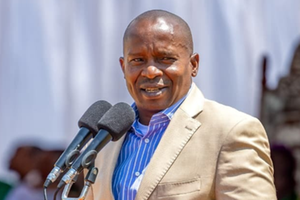
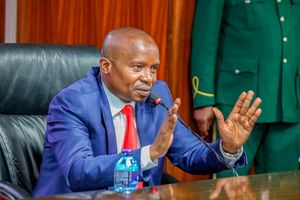
DCP Party leader Rigathi Gachagua addressing journalists in Nairobi on July 10, 2026.
Photo credit: Bonface Bogita | Nation Media Group
Only days before unveiling the tour, Mr Gachagua surprised many by publicly defending Prof Kindiki against attempts by some Kenya Kwanza leaders to split Mt Kenya into eastern and western voting blocs.
The former deputy president urged his supporters to refrain from attacking Prof Kindiki personally, insisting that the mountain should remain politically united.
To many observers, however, the conciliatory tone had little to do with reconciliation and everything to do with political strategy.
Political analyst John Anditi argues that Mr Gachagua's move towards Prof Kindiki is intended to calm political temperatures before he embarks on a charm offensive in the East.
"Since Gachagua is aware that Mt Kenya East could be under Prof Kindiki's influence, his move is simply to help pacify the ground ahead of his six-day tour," Mr Anditi observed.
He argues that Mr Gachagua is making an early push into the region to deny his rival an opportunity to consolidate it as an exclusive UDA stronghold while presenting himself as the defender of Mt Kenya unity.
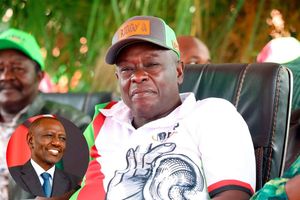
Deputy President Kithure Kindiki speaks during a thanksgiving service for Embu Anglican Diocese at St Mark's Teachers College in Kigari, Embu County on July 19, 2026.
Photo credit: DPCS
While Mr Gachagua celebrated a landslide victory in Ol Kalou, Kenya Kwanza had earlier demonstrated surprising resilience in Mt Kenya East during the November 2025 by-elections.
UDA narrowly retained the Mbeere North parliamentary seat after Leonard Muthende defeated Democratic Party candidate Newton Kariuki by only 494 votes.
The ruling party also held onto Evurore and Muminji ward seats in Embu County, victories widely interpreted as evidence that Prof Kindiki had managed to stabilise government support in the eastern counties despite mounting national criticism of President Ruto's administration.
In the west—covering Nyeri, Nyandarua, Murang'a, Kiambu and parts of Nakuru—Mr Gachagua increasingly dominates political conversation.
In the east, comprising Meru, Embu, Tharaka Nithi and surrounding counties, Prof Kindiki has emerged as Kenya Kwanza's principal political mobiliser.
For President Ruto, the division presents both an opportunity and a headache.
On one hand, Prof Kindiki has managed to prevent a complete collapse of UDA support across the mountain.
On the other, Mr Gachagua's continued dominance in western Mt Kenya threatens to erode one of the political coalitions that propelled Dr Ruto to State House in 2022.
Rather than consolidating only the areas where he already enjoys overwhelming support, the former deputy president appears determined to challenge Kenya Kwanza on its strongest remaining front within the mountain.
Deputy President Kithure Kindiki during a consultative forum with Tharaka Constituency grassroots leaders at Irunduni, Tharaka Nithi County on May 18, 2026.
Photo credit: DCPS
“It is on this basis, to unite the entire Mt Kenya region, that Gachagua has even held two meetings with Safina Party presidential candidate Jimi Wanjigi and continues to have kind words for both former President Uhuru Kenyatta and now Prof Kindiki,” argues advocate Nelson Osiemo.
Mr Osiemo insists that Mr Gachagua is keen on having Mr Wanjigi play a central role in the 2027 election negotiations, “hence their two cordial meetings.”
In his bid to foster unity of the mountain, Mr Gachagua’s message has equally evolved.
Unlike previous rallies that focused almost exclusively on attacking President Ruto, the planned Meru and Embu tour will revolve around one dominant theme—protecting the unity of Mt Kenya against what the former deputy president describes as deliberate attempts to divide the region into East and West.
That message comes amid growing debate triggered by Public Service Cabinet Secretary Geoffrey Ruku, who has argued that Mt Kenya East should chart its own political course if leaders from the western side fail to support Prof Kindiki.
"The time has come for us to politically divorce as the Mountain," Mr Ruku declared, arguing that Mt Kenya East had long played second fiddle in regional politics.
Lands Cabinet Secretary Alice Wahome publicly dismissed calls to divide the region, insisting that Mt Kenya belonged to all Kenyans and warning leaders against creating unnecessary political fault lines.
For Mr Gachagua, however, the debate presents an opportunity.
Instead of engaging Prof Kindiki directly, he has positioned himself as the defender of Mt Kenya's historical unity, accusing unnamed government operatives of sponsoring divisions for electoral gain.
Political analyst Dismas Mokua believes the strategy is part of a broader effort to establish Mr Gachagua as the undisputed political spokesman of the region.
"Riggy G is positioning himself as the de facto Mt Kenya leader. That he is the only Mt Kenya leader with capacity to defend former president Uhuru Kenyatta and DP Kindiki. This is a clever strategy to have all Mt Kenya politicians and political parties kiss his ring," Mr Mokua argues.
Mt Kenya East contains hundreds of thousands of voters whose political direction could determine whether President Ruto retains sufficient support within the mountain in 2027.
Should Mr Gachagua succeed in weakening Prof Kindiki's influence there, Kenya Kwanza could find itself defending every corner of what was once its most reliable political base.
Political analyst Martin Andati believes recent by-election results suggest precisely such a possibility.
According to him, political shifts in Mt Kenya West have historically influenced voting behaviour in the eastern counties.
"Mt Kenya West is like a bigger brother to the East. Where West goes, East follows," Mr Andati says.
He argues that if the trend witnessed in Ol Kalou continues, eastern counties could gradually embrace Mr Gachagua's political message before the next General Election.
"Now that West has shifted from Ruto to Gachagua, East will do the same in 2027 and vote against Ruto," he predicts.
Advocate Chris Omore warns against reading too much into by-election outcomes, terming them isolated.
He argues that although economic frustrations are being felt equally across both eastern and western Mt Kenya and the whole country, by-elections often reflect local political dynamics rather than definitive electoral trends.
DCP leader Rigathi Gachagua addresses journalists at a past event. He is hosting a retreat at his home in Wamunyoro, Nyeri.
Photo credit: Billy Ogada | Nation Media Group
“Indeed, Gachagua's tour appears designed not merely to win votes but to reshape perceptions,” says Mr Omore.
Since his impeachment, Mr Gachagua has steadily reinvented himself from a regional kingpin into the face of a broader anti-Ruto political movement.
Earlier this year he temporarily suspended public rallies, saying political mobilisation against President Ruto had largely been completed and that attention would now shift to identifying a single opposition presidential candidate.
The renewed focus on Mt Kenya East therefore represents more than another campaign stop, analysts say.
“It is a test of whether Gachagua can translate his popularity in western Mt Kenya into region-wide influence capable of challenging both President Ruto and Deputy President Kindiki,” says Mr Omore.
For State House, the stakes are equally high.
Prof Kindiki has invested considerable political capital in cultivating support across Meru, Embu, Tharaka Nithi and neighbouring counties through repeated development tours, project launches and grassroots mobilisation.
Government strategists believe those investments, coupled with UDA's recent by-election victories, provide a strong foundation for retaining the eastern flank of the mountain.
Mr Omore observes, electoral loyalty in Kenya can shift rapidly when economic frustrations persist or when opposition movements gain momentum.
He argues that President Ruto faces a two-pronged challenge: recovering lost ground in Mt Kenya West while ensuring victories in the East do not breed complacency within Kenya Kwanza.
The region remains one of Kenya's largest voting blocs and has historically played a decisive role in determining presidential elections. Any fragmentation—or consolidation—will inevitably influence national political alignments ahead of 2027.
That explains why Mr Gachagua has increasingly framed his campaign around unity rather than regional rivalry, says Omore.
Speaking during a church service in Kirinyaga, he argued that President Ruto's only realistic path back to State House lay in dividing the mountain vote.
"The only way William Ruto can come back to power is if he succeeds in dividing the mountain," he told worshippers, insisting that a united Mt Kenya would remain a formidable political force in the next election.