President William Ruto is confronting a fresh political headache after the High Court declared his Cabinet unconstitutional over failure to meet the two-thirds gender rule.
He may be forced to sacrifice two male ministers, setting the stage for one of the most politically delicate reshuffles of his presidency just a year to the August 10, 2027 General Election.
The Head of State could be staring at the delicate decision after the High Court ordered him to reconstitute his Cabinet within 120 days to comply with the Constitution.
The ruling has thrust the President into a constitutional, legal and political balancing act, forcing him to weigh loyalty against legality, coalition management against public expectations, and political stability against constitutional compliance.
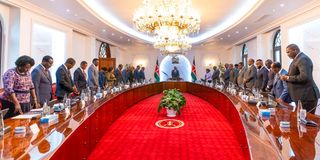
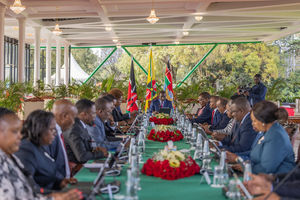
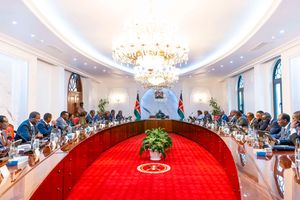
President William Ruto chairs a cabinet meeting at Kakamega State Lodge.
Photo credit: PCS
On the face of it, the court's decision appears straightforward.
The President's current Cabinet of 22 Cabinet Secretaries has only six women, two short of the constitutional threshold requiring that no more than two-thirds of members be of the same gender.
Unless the judgment is overturned on appeal, Dr Ruto will have to find room for at least two more women in the Cabinet. Yet, beneath the arithmetic lies a much more complicated political puzzle.
The immediate assumption is that two male Cabinet Secretaries will have to leave office to create vacancies for female appointees.
Such a move, however, analysts say, would inevitably trigger political ripples within Kenya Kwanza and among the broad-based government partners that Dr Ruto “painstakingly” assembled after his political realignment with Orange Democratic Movement (ODM) Party.
Of the three-judge bench; majority judgment was by Justices Eric Ogola and Stephen Githinji while Justice Jairus Ngaah dissented.
The three-judge bench held that the current Cabinet composition falls short of Article 27(8) of the Constitution, which requires the State to ensure that not more than two-thirds of members of elective or appointive bodies are of the same gender.
The ruling has immediately reignited debate over whether Dr Ruto will comply through a Cabinet reshuffle, appeal the judgment, or pursue another legal interpretation of what constitutes Cabinet membership.
A senior State House official argued that the Cabinet should not be viewed as comprising only Cabinet Secretaries.
The six female Cabinet Secretaries include; Beatrice Asukul Moe –East African Community and Regional Affairs, Hanna Wendot Cheptumo –Gender, Culture, the Arts and Heritage, Deborah Mulongo Barasa –Environment, Climate Change and Forestry, Alice Wahome –Lands, Public Works, Housing and Urban Development, Rebecca Miano –Tourism and Wildlife and Roselinda Soipan Tuya –Defence.
Besides the six female Cabinet Secretaries, the State House official noted that two other women—the Attorney-General, Dorcas Agik Oduor, and the Secretary to the Cabinet, Mercy Kiiru Wanjau—regularly sit in Cabinet meetings and participate in Cabinet business.
Attorney-General Dorcas Oduor.
Photo credit: Billy Ogada | Nation Media Group
"This brings the women to eight, hence reason to believe the Cabinet is well constituted," the source said.
"It can be challenged at the Court of Appeal. That's my thinking because there are eight critical women who engage on Cabinet matters on a daily basis. In fact, the Attorney-General plays a very critical role in the Cabinet and she is a woman. Therefore, you cannot ignore her membership to that Cabinet. This is a very unique composition."
That argument could form the basis of an appeal should the government decide to challenge the High Court decision instead of immediately restructuring the Cabinet.
The Constitution provides that the Cabinet consists of the President, Deputy President, Attorney-General and Cabinet Secretaries.
However, the Attorney-General is not a Cabinet Secretary and is not counted among the 22 ministerial portfolios, while the Secretary to the Cabinet is an administrative office established under Article 154 and attends Cabinet meetings without being a Cabinet member in the constitutional sense.
“In case of an appeal, whether those offices can be counted towards satisfying the two-thirds gender principle could be one of the key legal questions likely to shape the next phase of the dispute,” argues advocate Chris Omore.
He adds: “If the government elects not to appeal—or loses on appeal—the President will have limited options and the most obvious would be dismissing at least two male Cabinet Secretaries and replacing them with women.”
Another possibility would involve swoping Attorney-General and the Secretary to the Cabinet with two of their male counterparts in the Cabinet, without necessarily triggering a sacking.
A third option would be expanding the Cabinet, but this is restricted by the Constitution.
Article 152 of the Constitution caps the number of Cabinet Secretaries at between 14 and 22, meaning the President cannot simply create additional ministerial positions to accommodate more women without breaching the constitutional limit.
Unlike previous reshuffles driven by performance or political expediency, this would require the President to remove serving ministers primarily to satisfy a constitutional requirement.
Analysts note that the challenge becomes even more sensitive because today's Cabinet is not purely a Kenya Kwanza Cabinet.
Following the June 2024 Gen Z protests and the subsequent political détente between President Ruto and the late ODM leader Raila Odinga, the President expanded his political base by appointing at least five senior ODM figures into the cabinet.
President William Ruto, Deputy President Kithure Kindiki and former ODM leader Raila Odinga during the signing of a Memorandum of Understanding between ODM and UDA at Kenyatta International Convention Centre in Nairobi on March 7.
Photo credit: File| Nation Media Group
In July 2024, former ODM Deputy Party Leaders Hassan Joho and Wycliffe Oparanya were appointed to the Mining and Cooperatives dockets respectively.
The Head of State also named ex-ODM National Chairman John Mbadi as the Treasury Cabinet Secretary, former Director of Political Affairs and then National Assembly Minority Leader Opiyo Wandayi as Energy and Petroleum CS, while National Election’s Board member Beatrice Askul was appointed as the CS for East African Community.
Those appointments were widely interpreted as cementing the broad-based arrangement between Dr Ruto and the late Odinga while broadening the government's political legitimacy after months of unrest.
Two years later, those appointments now present another political calculation, even though Siaya Senator Dr Oburu Oginga took charge of the ODM Party leadership role following his late brother’s death in India on October 15, last year.
Would the President sacrifice some of the ODM-linked Cabinet Secretaries to comply with the court order?
Doing so, political analyst Dismas Mokua argues, could risk unsettling the delicate political understanding that has significantly lowered political temperatures and strengthened cooperation between the ruling United Democratic Alliance (UDA) Party and ODM.
Cabinet Secretary for the National Treasury and Economic Planning John Mbadi presents the Financial Year 2026/27 budget highlights at Parliament Buildings, Nairobi on Thursday, June 11, 2026.
Photo credit: Dennis Onsongo | Nation Media Group
Mr Wandayi heads the critical Energy docket amid electricity and fuel sector reforms. Mr Oparanya manages the politically significant Co-operatives ministry, while Mr Joho remains one of ODM's most influential Coast leaders.
“Replacing any of them could easily be interpreted as weakening ODM's footprint in government unless their positions were filled by women drawn from the same political formation.”
“Equally, removing long-serving Kenya Kwanza loyalists would not be politically cost-free,” adds Mr Mokua.
Several Cabinet Secretaries represent important regional and political constituencies whose removal could create new internal tensions within the ruling coalition.
The President therefore finds himself navigating multiple competing interests—constitutional compliance, coalition management, regional balance, political loyalty and government performance.
At State House, there has been no official indication that any Cabinet Secretaries have been earmarked for removal.
State House Spokesperson Hussein Mohamed during a press briefing at Harambee House, Nairobi on May 19, 2024.
Photo credit: Lucy Wanjiru | Nation Media Group
Questions sent to State House Spokesperson Hussein Mohamed seeking clarification on whether the President intends to comply with the ruling, whether any Cabinet changes are under consideration and whether specific ministers have been identified for replacement had not been answered by the time of publication.
Similarly, Head of Public Service Felix Koskei did not respond to requests for comment on the government's intended course of action following the judgment.
A State House source noted that it was still too early for the president to make a decision on the matter; “after all it is his prerogative to hire and fire, there’s no law that compels him to decide on these two aspects to satisfy any organisation or arm of government as the separation of powers is crystal clear in the constitution.”
Whether that decision comes through an appeal, a constitutional reinterpretation or a politically costly Cabinet reshuffle will determine not only the future composition of his Cabinet but also the strength of the broad-based government he has spent the past two years consolidating.
“The ruling presents more than a legal challenge. It is a test of how far the President is prepared to go in enforcing constitutional principles when they collide with political realities,” adds Mr Omore.
Apart from President William Ruto, his Deputy Prof Kithure Kindiki, Attorney-General Dorcas Agik Oduor and Secretary to the Cabinet Mercy Kiiru Wanjau, who sit in the cabinet, Cabinet Secretaries include;
Musalia Mudavadi – Prime Cabinet Secretary and Cabinet Secretary for Foreign and Diaspora Affairs Kipchumba Murkomen –Interior and National Administration Davis Chirchir –Roads and Transport Hassan Ali Joho –Mining, Blue Economy and Maritime Affairs Aden Duale –Health Alice Wahome –Lands, Public Works, Housing and Urban Development Alfred Mutua –Labour and Social Protection Julius Ogamba –Education Rebecca Miano –Tourism and Wildlife Salim Mvurya –Youth Affairs, Creative Economy and Sports Soipan Tuya –Defence Wycliffe Oparanya –Co-operatives and Micro, Small and Medium Enterprises (MSMEs) Development John Mbadi –National Treasury and Economic Planning Eric Muriithi Muuga –Water, Sanitation and Irrigation Deborah Mulongo Barasa –Environment, Climate Change and Forestry Lee Kinyanjui –Investments, Trade and Industry Mutahi Kagwe –Agriculture and Livestock Development Opiyo Wandayi –Energy and Petroleum William Kabogo –Information, Communication and the Digital Economy Geoffrey Ruku –Public Service and Human Capital Development Beatrice Asukul Moe –East African Community and Regional Affairs Hanna Wendot Cheptumo –Gender, Culture, the Arts and Heritage