President William Ruto on Wednesday moved to quell growing anxiety over the Kenya-United States Health Cooperation Framework, insisting that the deal does not permit the transfer, sharing or exposure of any Kenyan health data to foreign entities.
The remarks followed more than a week of mounting public concern after civil society groups, health-sector unions and several lawmakers questioned whether the agreement could grant Washington unprecedented access to Kenya’s medical records.
The controversy had grown particularly on social media, where unverified claims circulated widely, prompting demands for government clarity.
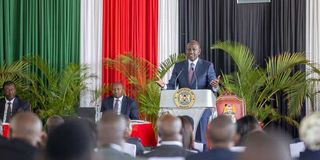
During the 12th National and County Governments Coordinating Summit at State House, the Head of State said the agreement is anchored in Kenyan law and had undergone what he termed rigorous review by the Office of the Attorney General to ensure local data-protection standards take precedence.
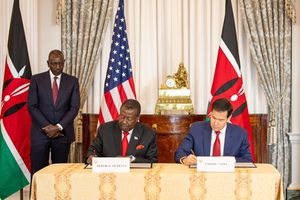
US Secretary of State Marco Rubio and Kenyan Foreign Cabinet Secretary Musalia Mudavadi sign the US-Kenya health pact as President William Ruto looks on.
Photo credit: PCS
“Nobody and no government will take advantage of the people of Kenya or the government of Kenya as long as I am President,” he said, adding: “Our goal is crystal clear… that we not only centralise the interest of the people of Kenya, but also pursue what is good for our nation.” His comments appeared aimed at stemming claims that the framework was rushed and lacked adequate safeguards – an accusation the administration has repeatedly rejected.
Deliberate misinformation
President Ruto dismissed criticism of the pact as the product of what he described as deliberate misinformation from organisations that previously acted as intermediaries in US-funded health programmes.
The accusation revived long-running tension between government and non-profits over control of resources in the HIV/Aids, TB and malaria sectors, where donor funds historically flowed through NGOs rather than state systems. These organisations say they provide accountability and capacity the government struggles to match, while successive administrations insist public institutions should oversee decisions affecting national health strategy.
Ruto said it was the American government that opted “not to fund the ‘NGO industrial complex’,” arguing that US President Donald Trump’s administration chose to channel health resources directly to state systems “for efficiency.” Kenya, meanwhile, has cited reforms under the Social Health Authority as proof it has the capacity to manage donor support effectively.
The President told governors that funds would reach counties, noting that the US is supporting Kenya’s healthcare “to the tune of over $1.6 billion (KSh208 billion) over the next five years,” stressing: “This is not a loan facility.” He framed the partnership as a deliberate request by Kenya “because of the significance of healthcare in the country.”
The summit brought together the Council of Governors and senior national government officials, including cabinet and principal secretaries, to resolve longstanding disputes over functions, financing and coordination. A communiqué read by Deputy President Kithure Kindiki directed the Intergovernmental Relations Technical Committee (IGRTC) to accelerate the finalisation of unbundling and delineation of contested functions.