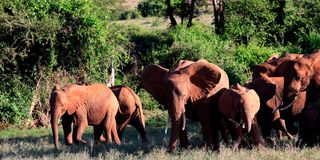
President William Ruto has found himself on the receiving end of a problem facing thousands of Kenyan farmers, elephants invading farms, destroying crops and damaging fences erected to keep them out.
Speaking in Taita-Taveta, Dr Ruto revealed that elephants had raided his farm, destroyed his maize crop and even brought down an electric fence he had installed to protect his crops.
“I am also grappling with the elephant invasion on my farm. They have also eaten and destroyed my maize crops and I have also incurred losses,” President Ruto said.
The President, who owns a home in Taita-Taveta where he breeds exotic bulls and practises crop farming, said he had sought the intervention of the Kenya Wildlife Service (KWS) and called for a lasting solution to the conflict.
“We must find a lasting solution through trenches and fencing to inhibit them from invading our crops,” he said.
From left: Taita Taveta Woman Representative Lydia Haika, President William Ruto, AIC Milimani Pastor Jeremiah Mombasa, Taita Taveta AIC Bishop Frank Mamre and AIC District Church Council Chairman Pastor Peter Mutua during a church service at AIC Makutano in Taita Taveta County on August 23, 2026.
Photo credit: PCS
For farmers living along the boundaries of Tsavo East and Tsavo West national parks, the President’s experience is an unusually personal illustration of a conflict that has become increasingly difficult to contain.
But behind the escalating human-elephant conflict is a conservation success story of Kenya’s elephant population has surged by 30.6 per cent in just over a decade from 32,214 in 2014 to 42,072 in 2025, according to KWS data.
KWS Director-General Prof Erustus Kanga said the growth is a major conservation achievement driven by sustained anti-poaching operations, intelligence-led investigations, prosecution of wildlife crimes and stronger cooperation among security agencies.
Yet the success has brought a new challenge of more elephants, combined with shrinking habitats and expanding human settlements, mean more encounters between wildlife and people, particularly in communities bordering major parks and wildlife corridors.
It is a paradox at the heart of Kenya’s conservation story that protecting elephants has helped their numbers recover but that recovery is increasingly bringing the animals into conflict with the people living closest to them.
“It is important to note that between 2022 and 2025, the elephant population increased by 6,000. That is a serious increase and due to rampant land use change and agriculture expansion, human-elephant conflicts have equally increased,” Prof Kanga said.
The problem is particularly acute along the Coast where communities bordering Tsavo and other wildlife habitats have repeatedly reported crop destruction, property damage and in some cases, injuries and deaths.
Kenya Wildlife Service Director-General Erustus Kanga.
Photo credit: File | Nation
Two months ago, more than 300 elephants reportedly moved out of Tsavo National Park into villages in Kilifi destroying crops, water sources and farmland, including property belonging to Youth Affairs Principal Secretary Fikirini Jacobs.
As the situation escalated, KWS deployed helicopters to drive the elephants back into the park. Residents, however, said some of the animals remained in the villages.
President Ruto later announced that the Government had secured Sh315 million for a 140kilometre electric fence around the park.
“I have heard the challenges you are facing on the issue of human-wildlife conflict. The same was raised by Governor Gideon Mung’aro, Ganze MP Kenneth Tungule and other leaders. I had promised to look for funds and I have now secured Sh315 million to construct a 140-kilometre electric fence around the national park,” he said during a thanksgiving ceremony for PS Jacobs.
The President said the fence would prevent elephants and other wildlife from leaving the park and entering farms and villages.
“We know whenever you plant, wild animals come and destroy your crops. But this problem will end this year and normalcy will be restored. This I promise you,” he said.
At the time, Dr Ruto also said Prof Kanga was finalising the tendering process with contractors expected to begin work by July.
William Ruto at his farm in Taita Taveta back in 2021.
Photo credit: File | Pool
The President’s latest experience in Taita-Taveta has therefore placed fresh attention on whether the promised measures can keep pace with a growing elephant population and expanding human settlements.
At the same time, elephant trophy poaching has fallen sharply. Prof Kanga, who was last week reappointed as KWS Director-General for another three year term said the number of elephants killed for their tusks declined from 164 in 2014 to 16 in 2025 with the annual figure peaking at 80 in 2017.
The decline has been attributed to stronger investigations, prosecutions, deterrent penalties, intelligence-led operations and inter agency collaboration that have disrupted poaching networks.
The recovery of Kenya’s elephant population has strengthened the country’s conservation credentials and helped meet national and international wildlife protection commitments.
As their numbers increase and habitats come under pressure, they increasingly wander into farms and settlements in search of food and water.
For KWS, the challenge has therefore changed. The task is no longer simply to protect elephants from people; it is increasingly to protect people and their livelihoods from elephants without undermining the conservation gains of the past decade.
In neighbouring Kwale County, Kinango MP Gonzi Rai has appealed to President Ruto to intervene saying elephants are destroying crops and worsening food insecurity.
In Taita-Taveta, Woman Representative Lydia Haika has similarly urged the President to act, describing elephant invasions as a major menace in the county.
Tana River Senator Danson Mungatana has raised concerns over repeated elephant incursions, saying the animals are destroying crops and worsening food insecurity.
“I met Prof Kanga to present our complaints about elephants invading villages and destroying crops. Residents are suffering injuries and deaths. We are hopeful of getting a permanent solution,” he said.
In Kilifi, President Ruto also ordered the deregistration of Shirango Conservancy saying it had been unlawfully registered and directed that the land be returned to local communities.
“Shirango Conservancy was registered illegally. I have ordered that it be dissolved and the land returned to wananchi,” he said.
The conservancy has been at the centre of tensions involving local communities, conservation groups and political leaders with residents accusing it of restricting access to community land while failing to adequately address the wildlife menace.
Kilifi Governor Gideon Mung’aro welcomed the decision and said Coast leaders had agreed to push the national government to prioritise the crisis.
The governor said he had engaged Tourism and Wildlife Cabinet Secretary Rebecca Miano who assured him that aircraft and additional KWS officers would be deployed to drive elephants back into Tsavo.