November 13, 2026 began like any other working day for many families in Nairobi. Sons, husbands and fathers left home to earn their daily bread, unaware that some would never return.
By Sunday night, some of those left behind had become widows, others orphans.
Six workers died when a building under construction collapsed in Syokimau, while others lost their lives in separate incidents, including wall collapses at Riverside, Nairobi.
Beyond the deaths, the incidents have exposed the vulnerability of construction workers and their families, many of whom depended entirely on the wages of the men who left home each morning to eke out a living in the construction sites.
At Nairobi Funeral Home, relatives gathered to seek the release of the bodies, with grief giving way to frustration over delayed post-mortems, difficulties reaching employers and uncertainty over who would support the dependents left behind.
Among the victims was 25-year-old Brighton Okinyi, whose mother, Everline Adhiambo Maroko, wants the government to intervene and protect workers in the construction sector.
"Our children are dying every time, every week, and we are being played here daily at City Mortuary," she said.
Who is responsible for Nairobi's deadly buildings?
Her husband, John Tambo, said Brighton left home at 6.00am for work and never returned. His brother, David Ranga, noted that the 25-year-old left behind young children whose future is now uncertain.
The family is also unhappy with the company's response; despite promising to meet relatives and discuss assistance, it only sent a junior officer whose explanations were unsatisfactory.
This frustration is shared by the other families from the Syokimau collapse. George Mwongela, the lawyer representing the six families, said relatives had not received satisfactory explanations from either the police or the company about what happened at the site.
He added that families were concerned by reports that work was continuing at the site despite unresolved investigations.
By Tuesday, relatives were still waiting for post-mortems that had originally been scheduled for Monday. Newton Mulimi, the spokesperson for Geoffrey Alusa's family, said reaching the company since Friday had proved difficult.
Although the company undertook to pay for the post-mortems, relatives returning to the funeral home on Monday and Tuesday were told no pathologist was available, and that Directorate of Criminal Investigations officers handling the cases had been assigned other duties.
"We want the President to intervene and help us leave here satisfied. After that, we can follow up on compensation with our brother's employer," Mulimi said.
For Sarah Kisavuli, wife of 53-year-old carpenter George Saiya, the delays have brought severe financial strain. Having travelled from Western Kenya on Monday to collect his body, she found the post-mortem had not been conducted, and the process remained stalled on Tuesday.
With her children back home, she has been forced to pay for hotel accommodation because her husband lived with a workmate.
"We are in distress because the delayed post-mortem is confusing us. We have no message to give our families waiting back at home," she said.
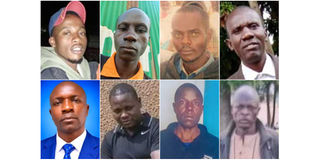
From top left
Photo credit: Nation
The family of Christopher Mirambo, 48, a carpenter from Imara Daima, is similarly struggling.
His brother, Clive Nyakemiga, said relatives have had to abandon work to follow up on the post-mortem. Mirambo's wife, Jackline Nyambeki, has been left to raise their child alone and is appealing for government assistance, particularly with education of the child.
The death of 27-year-old Peter Muema has devastated a family with high hopes for his future. His father, Stephen Muema, said Peter had recently completed a Building Construction course in Nandi before moving to Syokimau.
Describing him as a calm, deeply loved young man, he noted that his death was a massive blow, compounded by repeated, fruitless trips to the funeral home.
For Millicent Alusa, Geoffrey's widow, the tragedy has triggered an immediate struggle for survival. Her husband was the sole breadwinner supporting their five school-going children and extended family.
"Our children are still very young, all in school. I am appealing for support," she said.
The sixth Syokimau victim, Paul Nyamasura, 50, a carpenter from Mukuru Kwa Njenga, left behind four children, including his eldest daughter, 24-year-old Jane Mairi, who works while studying in Nakuru.
His cousin, Charles Maera, said the family learned of the death through a neighbour who saw television reports of the collapse.
"We do not know where to start, how to ferry the body to Kisii and who will help our children?" he asked.
Meanwhile, the family of Brevin Ogoyi, who died when the wall collapsed at Riverside, is demanding accountability. His father, Josphat Agene, was in Kakamega when he learned of his firstborn son's death—just a day after they had spoken. Brevin was the breadwinner for his wife and two children.
Travelling to Nairobi, Agene was distressed to find the employer had allegedly left the scene.
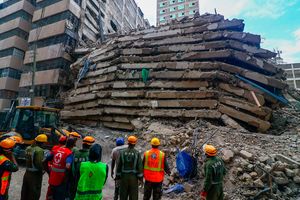
Nairobi County Chief Officer for Disaster Management Bramwell Simiyu confirmed the six deaths as rescuers continued to search the rubble for possible survivors.
Photo credit: File
Because a disability affecting his fingers limits his ability to work, he fears he might be able to support his son's young family.
"How will I take my child to Western for burial?" he asked, urging the government to trace the employer.
Another family seeking justice from a Riverside wall collapse is that of 36-year-old Alex Mutua Ogare, survived by his wife, Irene Namalia, and five children. What began as an ordinary Saturday turned tragic when Alex failed to return home. Having run out of airtime, Irene attempted a reverse call, which was answered by an officer from Kilimani Police Station who broke the news of his death. His sister, Felister Ogare, later confirmed his identity at City Mortuary.
"If the government can help ensure these children continue with their education, I would be grateful,” she said. I cannot manage everything alone," she said. She also called for stricter site inspections, citing concerns over poor supervision and substandard materials.
For these families, the tragedies have exposed the acute vulnerability of daily wage earners. When the graves are finally filled, the families will grapple with the new reality, which will be shrouded in uncertainty over who will provide for the children and those whose loved ones never returned from work.
The government failed the families of the eight people who died in the Eastleigh building not only by taking two weeks to recover their loved ones, but also by failing to honour their promises. These include meeting the cost of transporting the bodies and their families.
Some of the bereaved said that they had already laid their loved ones to rest and that they were now waiting for justice.
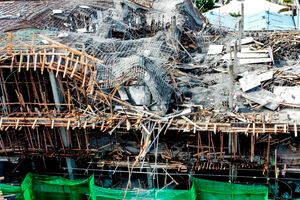
An aerial view of the collapsed upper floor of an eight-storey building under construction along Mombasa Road in Syokimau, Nairobi, showing the extent of the damage following the collapse that killed six people on November 13, 2026.
Photo credit: Bonface Bogita | Nation
Jairo Wanjala Wekesa said that his wife Rosemary Chepkoech, who died in the collapsed building in Eastleigh, was buried on Wednesday in Kitale.
He said the family and friends are asking questions about accountability and whether they will be able to see the culprits prosecuted.
"The burial of my wife is today. The government only waived the Mortuary bills, which was Sh15,000. We have not received anything else from the government. We have been left to do everything for our own," Mr Jairo said.
His wife was a tailor in one of the shops located in the basement of the building. She had started the job barely two months before the tragedy struck.
Mr Jairo said that even as he demands justice, he is starting a new, difficult life without his wife.
Since the incident occurred, he says that he has had to deal with his two children's daily questions about their mother's whereabouts.
Nelson Shikomela, the brother to Joyce Naumi said that they buried her remains on Saturday, and that they were still waiting for justice.
"We didn't get any help from the government. Every family was left to handle their issues alone. For us, the only help was the clearance of Sh13, 000 bill of the mortuary," Mr Shikomela said.
The investigations are still ongoing, with the DCI stating that several people, including the developer and officials from the Urban Planning sector in the County Government of Nairobi, have already provided statements.
The Nairobi Funeral Home located along Ngong Road.
Photo credit: Francis Nderitu | Nation Media Group
While detectives continue to investigate, the Nairobi County Assembly Committee on Urban Planning is making progress in probing how the developer managed to construct an 18-storey building without the necessary documentation.
During its meeting earlier this week, the committee revealed that the developer had used fake documents purporting to be from the county to obtain approval from the National Construction Authority (NCA).
All eyes are now on the Director of Criminal Investigations (DCI) since their findings will determine the next direction in the case.
Nairobi County Governor Johnson Sakaja has vehemently distanced his administration from any wrongdoing regarding the collapsed building.
Governor Sakaja claimed that they condemned the construction twice and arrested some of the people who were found in the site.