For decades, Kenya’s political landscape has been dominated by familiar faces whose influence has survived successive administrations, shifting alliances, political betrayals and electoral defeats.
But as the country edges towards the August 2027 General Election, a generational question is increasingly confronting some of its most experienced political operators: are they approaching the end of their era, or can they reinvent themselves in a political order increasingly demanding new faces, fresh ideas and a different style of leadership?
From Prime Cabinet Secretary Musalia Mudavadi and National Assembly Speaker Moses Wetang’ula to Wiper leader Kalonzo Musyoka, Cooperatives Cabinet Secretary Wycliffe Oparanya, People’s Liberation Party chief Martha Karua, ODM leader Dr Oburu Oginga and Governor James Orengo (Siaya) and Boni Khalwale (Kakamega), the established political class is facing a changing environment in which age, succession, political relevance and the growing assertiveness of younger voters, pundits say, are becoming increasingly difficult to ignore.
“The challenge is not necessarily that these leaders have run out of political capital. Many retain extensive networks, institutional experience, regional influence and the ability to negotiate their way into powerful political arrangements. Rather, the question is whether the political structures that sustained their influence for decades, and age, can withstand the growing appetite for generational change,” political analyst Geoffrey Mboya says.
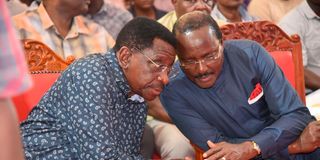
Moses Wetang'ula (left) and Musalia Mudavadi.
Photo credit: File | Nation Media Group
That tension is already playing out in Western Kenya, where some of the region’s most seasoned political figures have rallied behind Nairobi Senator Edwin Sifuna’s presidential ambitions, effectively challenging the established political order represented by Mr Mudavadi and Mr Wetang’ula.
The endorsement by former Cabinet ministers Musikari Kombo, Fred Gumo, Noah Wekesa and Philip Masinde, alongside former MPs Joash Wamang’oli and Bifwoli Wakoli, illustrates an unusual political development: veterans who once shaped the region’s leadership choices are now advocating for a younger politician to take the baton.
Mr Mboya argues that the development is significant because these are not political newcomers seeking relevance through a youthful candidate, but are “men who served in successive governments, worked with influential political figures and participated in shaping the political direction of the country for decades.”
Their argument is that Western Kenya must begin preparing a new generation for national leadership rather than remain dependent on leaders whose political careers began in a different era.
Deputy Party Leader of Democracy for the Citizen’s Party Cleophas Malala recently caused a stir at Mr Sifuna’s rally in Western when he publicly urged Dr Khalwale to retire alongside his peers and let the young generation take the driver’s seat, drawing violent reaction from the Kakamega Senator.
The developments expose a changing political conversation in a region where leadership has traditionally revolved around established political personalities, negotiated alliances and the influence of community elders.
But the generational debate is not confined to Western Kenya alone. Across the country, younger politicians are increasingly positioning themselves as alternatives to established political figures, challenging their parties’ internal hierarchies and attempting to build independent political identities.
Kakamega Senator Boni Khalwale and DCP deputy leader Cleophas Malala during the burial of Gloria Sekeiyan Khalwale in Malinya, Ikolomani Constituency, Kakamega County, on August 21, 2026.
Photo credit: Alex Odhiambo | Nation
The pattern is also evident in the opposition, where the contest over who should carry the presidential ticket has exposed tensions between veteran politicians and a younger crop seeking to redefine the country's political leadership.
Mr Musyoka, 72, has intensified his national mobilisation as he positions himself for another opportunity to contest the presidency.
Having served as Vice-President under the late President Mwai Kibaki, Mr Musyoka remains one of the most experienced opposition figures, with a political career stretching back to his election to Parliament in 1985.
But his ambitions are unfolding against the backdrop of an opposition increasingly under pressure to accommodate younger politicians, some of whom argue that the country needs a departure from familiar presidential candidates.
The generational question has also complicated the political calculations of Ms Karua, who has remained an important figure in opposition politics, and Mr Orengo, whose political career stretches back to the struggle for multiparty democracy.
An examination of the publicly available birth records of some of these politicians shows that several will be approaching or have crossed their eighth decade by the time Kenyans vote in August 2032.
The figures do not determine their political capacity, advocate Chris Omore argues, “but they illustrate the narrowing window within which some could pursue another presidential or major elective ambition.”
The IEBC has scheduled the next General Election for August 10, 2027. If the five-year electoral cycle remains unchanged, the subsequent election will be held in August 2032.
The figures are particularly striking for Dr Oginga, who will be 83 during the 2027 election and 88 in 2032, while Mr Orengo will be 76 and 81 respectively. Mr Musyoka, meanwhile, will be 73 in 2027 and 78 five years later.
Mr Mudavadi and Mr Wetang’ula, who have traditionally been regarded as the senior political figures in Western Kenya, will be 66 and 70 respectively in 2027. By 2032, they will be 71 and 75.
“At 71, Mudavadi could still be able run around, but that will depend on how the youthful leaders conduct themselves post 2027 election,” Mr Omore says.
For the veteran politicians, the implications extend beyond the numerical question of age. The 2027 election could represent their last realistic opportunity to pursue certain political ambitions before the next electoral cycle presents a considerably different set of circumstances.
For those interested in the presidency, the calculations are particularly difficult. A politician who fails to secure a ticket in 2027 would have to consider whether to wait another five years, support a younger candidate or negotiate a political arrangement that allows him to retain influence without necessarily occupying the highest office.
Former Nairobi Governor Mike Sonko recently illustrated this dilemma when he challenged Mr Musyoka to reconsider his options should the opposition deny him its presidential ticket.
Wiper Patriotic Front leader Kalonzo Musyoka, accompanied by party officials, addresses the media in Nairobi on October 19, 2026.
Photo credit: Dennis Onsongo | Nation Media Group
“This is his last bullet and his last chance. If the Opposition does not give him the opportunity to be its presidential flagbearer, he should not gamble again. He would be better off becoming Ruto’s Deputy President or Prime Minister,” Mr Sonko said in an interview with NTV last week.
The debate has also acquired another dimension following President William Ruto's remarks that he intends to leave active politics alongside some opposition chiefs including Mr Musyoka and former Deputy President Rigathi Gachagua in 2032.
Speaking during his Gusii region tour on November 10, Dr Ruto described the politicians as belonging to his generation and suggested that they should make way for younger leaders after the next electoral cycle.
Although the President's remarks were politically charged, they captured a question increasingly confronting the established political class: whether the next five years should be spent consolidating their remaining influence or preparing a transition to a younger generation.
Mr Musyoka has not indicated that he intends to abandon his presidential ambitions, while other veteran politicians are equally unlikely to surrender their political positions simply because younger leaders are emerging.
In fact, Mr Orengo has just unveiled his Liberal Democratic Party (LDP), on whose ticket he plans to reorganise his political ambitions.
For Mr Mudavadi and Mr Wetang’ula, the dilemma is slightly different. Both remain influential figures within government, with institutional positions that give them access to the national political conversation.
Their challenge is how to maintain their influence in Western Kenya while younger leaders increasingly demand a greater role in determining the region's political direction.
The endorsement of Mr Sifuna by former Cabinet ministers and MPs, analysts say, suggests that even some of the region's established political networks are beginning to accommodate a different leadership proposition.
Mr Mboya, however cautions against outright dismissal of the older leaders.
“The old guard retains extensive political experience, established connections, financial networks and relationships with political parties that younger aspirants may struggle to replicate. Their experience in coalition negotiations, presidential campaigns and government provides them with advantages that cannot simply be measured by age,” he says.
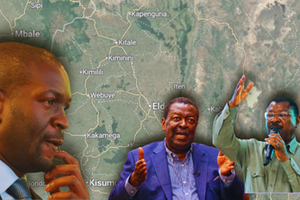
Kiharu MP Ndindi Nyoro and Embakasi East MP Babu Owino.
Photo credit: File | Nation Media Group
The politicians challenging this established order include Mr Sifuna, Kiharu MP Ndindi Nyoro, Embakasi East MP Babu Owino, Nyandarua Senator John Methu, Kirinyaga Woman Representative Njeri Maina, Nyali MP Mohammed Ali and DCP deputy party leader Cleophas Malala, Vihiga Senator Godfrey Osotsi, Saboti MP Caleb Amisi, the late Raila Odinga’s daughter Winnie, who has declared interest in the Nairobi gubernatorial seat, among others.
Their emergence reflects a political environment in which younger leaders are increasingly seeking to influence party decisions, challenge established hierarchies and build political movements outside traditional political structures.
Mr Sifuna, who will be 45 in 2027, has become a central figure in the emerging generational contest through his Linda Mwananchi movement, which has attracted support from younger voters and politicians dissatisfied with the broad-based government arrangement.
Mr Nyoro, who is 40, has established himself as a prominent voice on economic policy, while Mr Owino has built a considerable following through his combative political style and mobilisation of urban voters.
The changing demographics of the electorate could further complicate the position of veteran politicians.
According to the Centre for Multiparty Democracy's 2026 People Dialogue Festival outcome report, young people aged between 18 and 35 account for approximately 57 per cent of eligible voters. The report emphasised their growing importance in electoral participation and accountability.
“However, the figures should not be interpreted as a guarantee that young voters will automatically support younger candidates. Their political preferences are diverse, and issues such as unemployment, taxation, the cost of living, corruption and accountability may matter more than the age of those seeking office,’ advocate Omore warns.
Frankline Mukwanja, Executive Director of the Centre for Multiparty Democracy, argues that younger politicians who are progressive and issue-oriented have a promising political future.
He cautions, however, that they must demonstrate an ability to organise independently and mobilise supporters beyond the established political machinery.