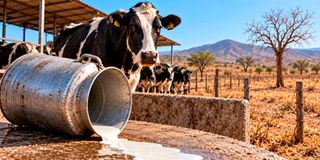
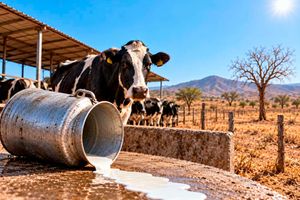
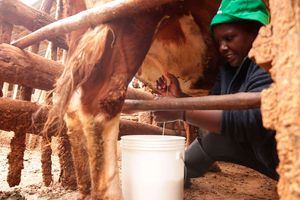
A Foot-and-Mouth Disease (FMD) outbreak in major milk-producing regions has been linked with low production, cattle deaths and high maintenance costs, contributing to an unprecedented shortage of milk in the country that has lasted months, the Nation has established.
While the government has attributed the supply constraints largely to prolonged drought and inadequate animal feeds, farmers in Kiambu, Nandi, Uasin Gishu and Trans Nzoia counties say disease outbreaks have compounded the crisis, leaving dairy enterprises struggling to recover.
The Kenya Veterinary Vaccines Production Institute (Kevevapi) on Wednesday confirmed the FMD outbreak, but cautioned that multiple other factors also contributed to the milk shortage.
Kevevapi CEO Alex Zephania Sabuni acknowledged that FMD affects milk production, but added that drought, availability of animal feeds and poor farming practices have also influence national output.
A shopper carries a basket with milk. A 500ml packet of processed milk has become scarce and now retails at up to Sh100 in some regions.
Photo credit: Billy Ogada | Nation Media Group
“Livestock diseases are an important contributor to reduced milk production, but it would be misleading to attribute the national decline to FMD alone. Milk production is influenced by several interacting factors, including drought, availability and cost of feed and water, herd management, breeding, market conditions, production costs and other animal diseases. Comprehensive national epidemiological and production data would therefore be required to quantify reliably the specific economic losses attributable to FMD, particularly its impact on milk production,” Dr Sabuni said.
Dr Sabuni’s responses followed the Nation ’s questions stemming from dairy farmers complaints that they have been unable to access FMD vaccines.
In Githunguri, Kiambu County, one of Kenya's leading dairy-producing areas, farmers say they have lost cattle to FMD and lumpy skin disease, while surviving animals are producing significantly less milk despite expensive veterinary interventions.
A Nation spot check in the area found farmers struggling to rebuild their herds, with some forced to depend on private veterinary doctors to treat infected animals.
David Maganjo, a dairy farmer in Githunguri, said repeated infections strained farmers, especially those who lost livestock. Maganjo, in the month of September lost his only two cows to the FMD noting that he is struggling to get back to dairy farming– which he says is his sole venture to raise his family.
David Maganjo, a dairy farmer in Githunguri, Kiambu County, at his farm on November 13, 2026. He lost all his cows to Foot-and-Mouth Disease.
Photo credit: Sammy Waweru | Nation
"Milk production is affected because the cows are dying. We are trying to replace them, but buying another cow is expensive. A good milk-producing cow costs between Sh180,000 and Sh200,000," he said.
Mr Maganjo, who ventured into dairy farming in 2021, said his production had initially reached about 40 litres daily per cow, adding that it supported his children's education.
He recalled that the last time his animals were vaccinated against FMD was around 2024, while vaccination teams that visited in 2025 concentrated on lumpy skin disease.
"The county government (Kiambu) used to come and vaccinate our animals, at least once a year. We paid Sh300 per cow for vaccination against lumpy skin disease and other diseases," Mr Maganjo said.
He stated that treatment costs had become increasingly difficult to manage, with some drugs expensive and requiring veterinary supervision. Insurance, he adds, is also unaffordable for him.
"FMD is one of the worst diseases affecting livestock. When an animal is infected, it takes time to recover, even after treatment. During that period, milk production drops, and farmers suffer losses," he said.
Hannah Munene, another farmer in Githunguri, said her animals started showing FMD symptoms in September, including eye infections, nasal and mouth discharge and bleeding.
She said the cows struggled to feed, forcing her to seek veterinary intervention that cost approximately Sh70,000.
She is currently milking two cows and has three heifers, all of which were affected by FMD.
Hannah Munene, a dairy farmer in Kiambu County, at her farm on November 13, 2026 Githunguri, recounting how Foot-and-Mouth Disease affected milk production in her herd.
Photo credit: Sammy Waweru | Nation
Ms Munene said that her cows previously produced 15 litres daily, but at some point could not produce any milk. Production has since improved to approximately five litres.
"I spent a lot of money treating them, but I thank God that they are now recovering. However, I blame the government because we have been struggling with this disease. Vaccination is what will help farmers, and I believe the lack of adequate vaccination has affected many people," Ms Munene added.
In Uasin Gishu, authorities introduced quarantine measures to contain FMD spread.
"Sporadic cases of Foot-and-Mouth Disease were reported in parts of the county and quarantine measures were introduced to contain the outbreak," said Phillip Biamah, the county director of veterinary services.
Dr Biamah said that milk production dropped by up to 60 per cent for affected animals and that 80 per cent of calves in the region contracted FMD. Vaccination, he added, was being done through an electronic voucher system targeting over 350,000 livestock in the county.
He also linked the disease burden to prolonged dry conditions, which had weakened livestock resilience and reduced the availability of pasture and animal feeds.
The county director of livestock, Abraham Kiptanui, said dairy production in Uasin Gishu had dropped from approximately 800,000 litres to 480,000 litres, a decline of 40 per cent. He attributed the reduction to depressed rainfall, disease outbreaks and shortages of animal feeds.
Mr Kiptanui urged farmers to adopt modern pasture production systems and cut reliance on rain-fed agriculture.
Caroline Wanjiru, another farmer in Githunguri, said all her 28 dairy cattle were affected by the disease. Her herd comprises 13 mature cows and 15 calves.
Before the outbreak, she used to produce approximately 150 litres of milk daily, but output has since plunged to below 60 litres.
"All my 28 cows were affected. I lost two mature cows and four calves. Some were in very bad condition, and veterinary doctors advised me to withdraw the contaminated feed or water and give the animals molasses mixed with water. I followed their instructions, and some of the animals survived," said the farmer from Githunguri, Kiambu County.
She estimates the value of the animals she lost to FMD at more than Sh500,000. Ms Wanjiru said veterinary officers informed her that there is no specific curative drug for Foot-and-Mouth Disease (FMD), leaving vaccination as the main preventive measure.
"The disease has also affected other farmers in the area. Some have lost animals, while others have reported injuries, including broken legs among their livestock. Many farmers are suffering, and the situation in Githunguri is worrying," she said.
"The cause is not drought. It is FMD. I have enough fodder reserves because I make silage and lease additional farms to grow pastures such as Napier grass," Ms Wanjiru, who has farmed for over 20 years, added.
Caroline Wanjiru, a dairy farmer in Kiambu County, at her farm in Githunguri on November 13, 2026, recounting how Foot-and-Mouth Disease killed six of her dairy cows.
Photo credit: Sammy Waweru | Nation
Githunguri MP Gathoni Wa Muchomba has also disputed the government's stand on drought being the primary reason for the shortage.
"I am a farmer myself. I lost six cows to Foot-and-Mouth Disease and about eight cows to lumpy skin disease. I even have records. This is happening everywhere, and farmers are afraid to speak out because they feel intimidated by the governor," she said, adding that output by farmers in the region reduced by approximately 75,000 litres between April and June.
The area MP revealed that the losses forced her to shut down her farm, giving away to neighbouring dairy farmers the fodder she had banked for three years.
She also argued that Kevevapi has been starved of government funding, weakening the country’s ability to respond to livestock disease outbreaks.
The State corporation has over years relied primarily on internally generated revenue from vaccine sales to finance its operations and investments.
Kevevapi, however, on Wednesday said that amounts allocated for vaccine production in its operational budgets should not be confused with direct government development grants.
The institute said its vaccine production expenditure requirements stood at Sh423.3 million in the year to June, 2025. That figure went up to Sh504.87 million in the year to June, 2026.
“These amounts constitute the operational resources required for vaccine manufacturing and are largely financed through internally generated revenue from vaccine sales and other institutional income, rather than direct Exchequer allocations,” stated KevevapiCEO, Dr Sabuni.
For the FY2026/27, KEVEVAPI said it had no direct Net Exchequer development allocation. However, its internal budget estimates anticipated a development grant of Sh23 million.
CS Mutahi Kagwe on milk shortage
The institute further disclosed that the National Treasury had approved the utilisation of Sh153 million in retained earnings under the FY2025/26 Supplementary II budget and another Sh112 million in the FY2026/27 to support modernisation.
In February, 2026, Livestock Development PS Jonathan Mueke told the National Assembly’s Departmental Committee on Agriculture and Livestock that Kevevapi had struggled to secure adequate funding for modernisation for 14 years.
Stanley Ngombe, chairman of the Kenya Dairy Farmers Federation (KDFF) and Lelchegoo Farmers Cooperative Society, said FMD and other livestock infections had disrupted production, with milk deliveries to the society declining from 18,000 litres daily during peak season to approximately 12,000 litres.
“Lactating animals attacked by the FMD can take three weeks to recover after vaccination, while milk production declines,” he said.
Mr Ngombe said farmers had also reported lumpy skin disease, blackwater fever, East Coast fever and rabies following attacks by stray dogs.
“Although the national government has rolled out an electronic voucher-based vaccination programme, the county government should make follow-up efforts and ensure that farmers vaccinate their animals after every three months and strengthen disease surveillance and control,” he said.
He urged county veterinary departments to intensify surveillance and vaccination to prevent further spread of infections.
The North Rift region has an estimated 1.2 million dairy cows and between 400,000 and 500,000 heifers, making the disruption particularly significant for the country’s milk supply.
The Ministry of Agriculture estimates that Kenya produced an average of 4.2 billion litres of milk last year, against a potential of 12 billion litres, citing poor animal husbandry practices and other production constraints.
Kenya began recording a decline in milk production in 2026, with the reduction becoming more pronounced between June and August, according to data from the Kenya National Bureau of Statistics (KNBS).
However, comparisons with production levels during the 2022/23 drought period show that current output remains higher, raising questions about the extent to which drought alone explains the prevailing milk supply constraints.
During the 2022/23 drought, considered the worst in 40 years, Kenya produced 65,687,150 litres of milk in June 2022 and 66,102,870 litres in June 2023, according to a recent KNBS Leading Economic Indicators report.
Packets of milk on display at a Naivas Supermarket outlet in Nairobi.
Photo credit: Billy Ogada | Nation Media Group
In comparison, production reached 84,440,050 litres in June 2026.
In July, production stood at 61,227,570 litres in 2022 and 73,662,420 litres in 2023, compared with 82,979,530 litres in July 2026. In June and July 2024, the country produced 76,623,220 litres and 75,990,580 litres, respectively.
The August figures also show that production has remained above the levels recorded during the drought years. Kenya produced 59,118,940 litres in August 2022, 73,785,180 litres in August 2023 and 75,049,680 litres in August 2024.
However, a comparison of the latest two years points to a decline. Milk production fell from 86,331,980 litres in July 2025 to 82,979,530 litres in July 2026, a reduction of approximately 3.9 per cent. In August, output declined from 81,119,880 litres in 2025 to 79,058,850 litres in 2026, representing a 2.5 per cent drop.
KDB figures show that formal milk deliveries to processors declined from 84.4 million litres in June to 81.3 million litres in July 2026, representing a 3.7 per cent drop.
The decline has resulted in reduced stocks and rationing in some supermarkets, while processors are facing higher raw milk procurement costs.
Delia Andrew, co-director of Brown’s Food Company, attributed the supply constraints largely to drought. “It’s just a drought. About eight years ago, we had the same thing. When we have extreme dry periods, there is not enough milk and that’s when the milk prices adjust dramatically,” Ms Andrew said.
Brown’s collects milk from smallholder farmers in Embu, Molo in Nakuru County and Kinangop in Nyandarua County, alongside production from its own farm in Tigoni, Kiambu County.
She said milk volumes available to processors had declined by approximately 30 per cent, pushing up the cost of raw milk by between Sh8 and Sh10 per litre.
The increase has been particularly costly for cheese manufacturers because much of the milk is separated during processing. “When you make cheese you throw away a lot of whey (liquid part of the milk) because you only get the milk solids. Any increase in milk price means it’s like four times the impact to cheese than liquid milk,” she explained.