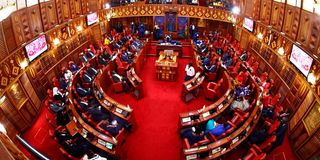
A silent sibling rivalry is brewing in Parliament over a Bill seeking to expand Senators’ legislative mandate to include powers such as vetting and approving State Officers, including Cabinet Secretaries and Principal Secretaries.
The Constitution of Kenya (Amendment) Bill, 2025, introduced last month, proposes amendments to confer upon the Senate the power to vet and approve nominees for independent offices and constitutional commissions, as well as remove holders of such positions.
Currently, Article 96(2) of the Constitution limits the Senate’s oversight role to considering and determining resolutions for the removal of the President, Deputy President and governors.
Sources within the National Assembly told the Daily Nation that questions have been raised about the timing and intent of the Bill, especially as the Senate is also expected to consider the Constitution Amendment Bill, 2024, which seeks to entrench three funds in the Constitution, including the National Government Constituency Development Fund (NG-CDF).
Since both Houses must consider these Bills, sources suggest the Senate Bill is being used as leverage to pressure MPs into approving the NG-CDF Bill.
“From the foregoing, it is clear that the Senate’s push for constitutional amendments is purely a quest for power and self-preservation,” said one source.
During the debate on the County Allocation of Revenue Bill on Thursday, MPs urged their Senate counterparts to focus on their core mandate: overseeing billions of shillings sent to counties to ensure proper use, rather than pursuing issues beyond their constitutional scope.
“It is time to call out the Senate. There are many illegalities for instance why do they give bursaries when education is not devolved except for ECD? Do you give bursaries to ECD children?” asked Suba South MP Caroli Omondi.
Gilgil MP Martha Wangari also questioned the Senate’s obsession with Cabinet Secretaries instead of focusing on their mandate.
“The Senate is obsessed with summoning Cabinet Secretaries to answer questions even though they have no constitutional role to bring censure motions against them. I wish the Senate would stick to its role and oversee the use of county funds to ensure they are well spent,” Ms Wangari said.
Lawmakers questioned whether the Senate has effectively overseen county funds to justify its demand for expanded powers traditionally held by the National Assembly.
Mandate of advancing devolution
The Senate’s attempt to extend its oversight beyond its constitutional mandate raises concerns about whether it is neglecting its primary role of protecting and promoting county interests.
Article 96(3) of the Constitution assigns the Senate the role of determining the allocation of revenue among counties and overseeing how national revenue allocated to counties is utilised.
The National Assembly has also questioned the timing of the Bill which requires a referendum as it changes parliamentary structure just two years before general elections. Concerns were raised about whether taxpayers can afford to fund two costly political processes in such close succession.
Minority Leader Junet Mohamed said he remains undecided on the Bill but questioned whether the Senate is prepared for a referendum.
Critics argue the Bill shows the Senate drifting from its core mandate of advancing devolution by representing county interests as stated in Article 96.
The Bill also seeks to expand the Senate’s role in the budget-making process likely intensifying rivalry between the two Houses, as the National Assembly guards its constitutional power of the purse.
Speaking to the Daily Nation , Speaker of the National Assembly Moses Wetang’ula acknowledged the rivalry but said that the National Assembly is constitutionally stronger because it holds the power of the purse.
“It is not war but sibling rivalry in a new arena. The new Constitution created two Houses. In other jurisdictions, the Senate is an appellate house; ours is different. This gives the National Assembly more authority and power over the purse,” Mr Wetang’ula said.
He reiterated that the Senate’s role per Article 96(3) is to allocate revenue equitably among the 47 counties and oversee how allocated funds are used.
“The Senate’s responsibility is to pass the County Allocation of Revenue Bill and ensure proper utilization of funds in the counties,” Mr Wetang’ula added.
“I don’t see it ending soon until we reach a level like the UK where every Bill from the House of Commons goes to the Senate without contest. Until then, contestation will remain, but I see it as the vibrancy of our politics,” he said.
“Siblings often disagree; it is part of life. What matters is that both the National Assembly and Senate live up to their constitutional expectations,” he concluded.