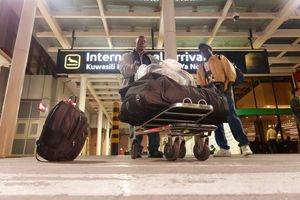
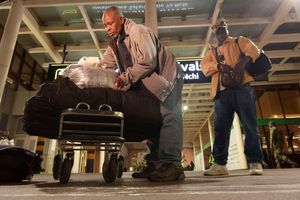
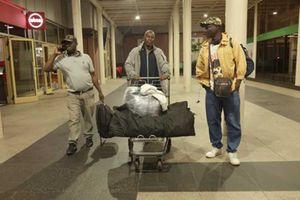
At the end of the government-led repatriation of Kenyans from South Africa on Thursday night, only 472 out of the estimated 27,000 had chosen to be returned home.
The number represented just under two per cent of the total, the returnees were clearly in the minority.
It gives credence to a remark in Prime Cabinet Secretary Musalia Mudavadi’s July 2 press statement: “The majority of the estimated 27,000 Kenyans residing in South Africa continue to make meaningful contributions to the prosperity of both our nations.”
The final free repatriation flight for relocating Kenyans landed in Nairobi on Thursday night, carrying 50. The first flight had landed on the night of June 30 with 61 on board.
Prime Cabinet Secretary and CS for Foreign and Diaspora Affairs Musalia Mudavadi.
Photo credit: File | Nation Media Group
There is, however, a likelihood of more flights beyond the government’s deadline. A Foreign Affairs ministry official told Nation that the repatriation might resume if the situation demands it.
So, why didn’t Kenyans down south have a mass exodus home? According to Mr William Thageya, the secretary-general of the Kenyan Diaspora in South Africa (Kedasa) that has 12,000 members, many factors explain the situation.
Speaking with Nation on phone from South Africa, Mr Thageya said the Kenyans who were operating from the poorer sides of the country, and those who did not have their immigration papers in order, formed the bulk of the returnees.
“The majority of the Kenyan community, unlike most of the other communities you see in the media, migrated here and became professionals. Perhaps they were still pursuing further education then they got into their professions. You might find some of them working in the insurance industry; others are in the corporate world. These sectors are not much affected,” he said.
“When people work in that sector, they are well documented, which means they have the papers to stay in South Africa,” he added as he explained why the quest for diligence and reliability makes some employers prefer foreign staff.
Those targeted by xenophobic mobs, he said, were those who took lower-cadre jobs and businesses.
There had been upheaval in South Africa after riotous anti-immigration activists imposed a June 30 deadline for undocumented foreign nationals to leave the country, an ultimatum not recognised by the government but powerful enough to send fear through migrant communities.
The protests were driven by anti-migrant groups, including the “March and March” movement, “Operation Dudula” and other citizen-led formations.
Their campaign framed undocumented migration as a cause of crime, unemployment and pressure on public services. Although the June 30 deadline had no legal force, it triggered anxiety among immigrants, Kenyans included. Ruth Wambui, a mother of two who lost her house to a fire last year, opted to take the free government flight as she was not sure what would befall her.
“I sat with my husband and I said, ‘No, I need to evacuate the kids because we don’t know.’ We could see a week before then, about 10,000 Malawians were in a tent,” said Ms Wambui, who had been in South Africa for 13 years.
An anti-immigrant demonstrator throws a bottle at a building as items which the demonstrators say belong to foreign nationals burn on the street during an anti-immigrant demonstration, in Johannesburg, South Africa, June 30, 2026.
Photo credit: Reuters
Mr Thageya said much of the disturbance was witnessed in the suburbs and the informal settlements, the dwellings for black Africans since the days of apartheid.
“The apartheid system shaped this country in a very funny way,” he said, adding that in the areas reserved for blacks, “there’s a lot of joblessness and people are hopeless”.
“Most of the Kenyans that chose to leave were living in those kinds of pockets. The violence you see is not actually spread all over. There are places in South Africa where they don’t even know these things are existing,” said Mr Thageya.
The family factor, the Kedasa executive said, also played a role. Even among those who did not have their papers in order, some elected to stay because they were raising children.
“We still have a few undocumented people that chose to stay specifically because they have already established families here. They are married to South Africans, they have South African citizen children who depend on them and they are the main caregivers and providers to their family.
“So, if you ask a father to leave his three or four children here, yet there is no one to take care of them, what are those children going to do? So, some of them have decided to stay to make sure that they continue taking care of their family although they understand the danger,” he said.
For Kenyans without the right immigration papers, the repatriation offered a chance to avoid arrest. This is because Kenya had negotiated an immunity pact with South Africa stipulating that those who were staying in South Africa illegally were allowed to return home if they had never engaged in crimes.
However, some of them received bans that may prevent their re-entry to South Africa for some years. Mr Thageya advised them to visit the South African High Commission in Nairobi to plead their cases.
Anti-immigrant protesters march after an unofficial June 30 deadline set by anti-immigrant groups for undocumented migrants to leave the country had passed, in Soweto, Johannesburg, South Africa, July 9, 2026.
Photo credit: Reuters
“You can always present your case there. Give them a very good reason why you overstayed and then they can actually [remove] the ban,” he said.
Some of the Kenyans who returned narrated harrowing ordeals of what they went through, with a number of them vowing never to return.
Insurance specialist Joseph Gichini had to flee with just a backpack, not sure of the fate of his car and his house; bus driver Anthony Waweru had his house burnt; electronics technician Jim Oyango had customers’ TVs stolen from his shop; cyber café assistant Mike Mwita watched as a Pakistani was lynched and escaped with barely nothing, among others.
Mr Thageya said that some suffered losses but elected to stay anyway. They included a businessman who was based in KwaZulu Natal.
“They made him close his well established businesses and then criminal elements within them broke into his business premises and stole his stock and vandalised the property,” he said.
As a coping mechanism, Mr Thageya noted, some Kenyans had relocated to calmer places.