This past week, Nairobi governor Johnson Sakaja gazetted a new, expert-led board for NCCG-Green Nairobi Limited Company, the outfit charged with tidying up the capital city.
Unveiling of the team led by renowned eco-preneur Isaac Kalua Green, is an important development, albeit not the first, in the county’s attempts to reform its sanitation.
The approach involves transitioning waste management from a county department into a corporatised, financially independent utility, similar to the Nairobi Water Company.
With a mounting solid waste crisis, the county government appears to be aiming at institutionalising efficiency while tapping into the growing global circular economy.
However, Dr Kalua, the city’s new ‘Green Czar’, and his team will have no time for a honeymoon as they seek to fix one of East Africa's most complex urban ecosystems.
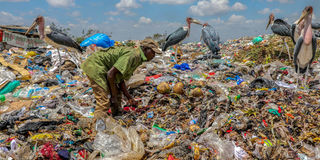
While the company's mandate is much wider, nowhere is the scale of the institutional challenge more starkly illustrated than in waste management. And the Dandora dumpsite - the poster child of Nairobi’s solid waste crisis – is the place to begin. The massive landfill was declared full in 2001, but 25 years later, still receives anything from 2,000 to 3,500 tonnes of the city’s refuse every day, depending on whose statistics one believes. After all, the site itself does not have a functional weighbridge capable of producing reliable figures.
Multiple investigations into the operations around the site have routinely exposed criminal gangs extorting residents and controlling collection routes in entire estates. An estimated 900,000 households pay private collectors directly, creating a vibrant waste economy in the order of Sh5 billion annually, and operating largely outside the county government’s books.
Auditors have also documented trucks invoiced for empty runs and single loads billed multiple times, undercutting county revenue by millions of shillings every week. Meanwhile, some county assembly members have been accused of using waste tenders to secure political loyalty.
The security situation is further complicated by the near-total withdrawal of the police from the site, ceding ground to lawless gangs.
The Kalua board is, therefore, inheriting more than a broken waste system. They are walking into an economy where the very disorder they are charged with fixing has powerful beneficiaries and protectors, even at City Hall itself.
That is why corporatisation is a good start. The Nairobi Water Company, though far from being perfect, offers a noteworthy precedent. By separating its day-to-day management from the political chaos of City Hall, and giving it the tools and incentives to plug the revenue leaks, the company has grown revenues by a respectable 46 per cent, from Sh8 billion to roughly Sh11.7 billion.
Of course, at the operational level, this still translates to the relatively unglamorous tasks of setting up a professional board, installing digital billing, and expanding metering. But at a deeper level, it demonstrates that turning around services in the city need not involve legislation or any external intervention. Sometimes it simply requires building an institution and allowing it to do its job.
Yet corporatisation alone will not be adequate. While efficient and functional systems can plug administrative leaks, they cannot substitute for the wider political will required to confront deeply entrenched interests. This is a conversation that the new board must have early with governor Sakaja whose political cover will be a necessary condition for success.
Political sociologist Peter Evans famously described this tension as ‘embedded autonomy’, arguing that effective public institutions must be sufficiently autonomous to resist capture by vested interests, yet sufficiently embedded in the political and social system to mobilise the support needed to get things done. That may precisely be the balance Green Nairobi requires in navigating the city’s political jungle.
In Dandora, the board will undoubtedly need to go after cartels if it is to stand any chance of success. But it must not lump these criminal gangs together with thousands of residents who earn an honest living through what amounts to Nairobi's only functioning recycling system.
The informal waste pickers should not become collateral damage in the drive towards a ‘green city’. Instead, they should be organised into cooperatives, given access to recycling contracts and deliberately incorporated into any planned transition to Ruai. Indeed, a circular economy that erases its pioneers would be an eviction by another name. That must not be the legacy of this board.
Beyond that, the board should, from day one, prioritise the setting up of a functional weighbridge at the site to track every movement of garbage. This would close the tap on empty-truck invoicing and duplicate billing.
In addition, they would need to publish regular waste management reports capturing key numbers such as tonnage collected, illegal dumpsites cleared, and revenue collection, to enable residents to check actual delivery against political rhetoric.
But the seemingly intractable problem of law enforcement cannot be solved from the boardroom. The board will, inevitably, have to seek a formal arrangement with the National Police Service to restore effective state authority around Dandora and confront the criminal networks operating within the waste economy.
For Green Nairobi, therefore, professional management and political protection must remain the organising principles, whether the task is waste management, restoring green spaces or improving the city's broader environment.
Dr Ageyo is the Editor-in-Chief of the Nation Media Group. He holds a PhD in media studies with a focus on science and environment communication